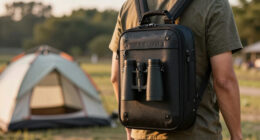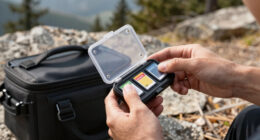
If your GPS fails, you can still find your way using the sun, stars, and simple tools like a sextant and compass. During the day, observe the sun’s position to estimate direction, and at night, recognize key stars like Polaris to find north. Measuring angles with a sextant lets you determine your latitude, while rough timekeeping helps with longitude. Mastering these skills guarantees you can navigate confidently when technology isn’t an option—continue exploring to learn the details of this timeless skill.

Get emergency and outdoor gear delivered free — and shop member deals
- Fast, free delivery on millions of items
- Access to Prime Big Deal Days deals on October 6–7
- Prime Video, Amazon Music and more included
Key Takeaways
- Use a sextant to measure the angle between celestial bodies and the horizon for determining your latitude.
- Identify key stars like Polaris to find north and assist in navigation during nighttime.
- Maintain accurate time with a chronometer to calculate longitude by comparing local noon to a known reference.
- Combine celestial measurements with an analog compass to cross-check and confirm your position.
- Practice and familiarize yourself with sky patterns and instrument use to navigate confidently without GPS.

Have you ever wondered how sailors and explorers navigated vast oceans before modern technology? Long before GPS and digital charts, they relied on celestial navigation to find their way across open waters. This method involves using the sun, stars, moon, and planets to determine your position and direction. At the heart of celestial navigation are tools like the sextant, which helps measure the angle between a celestial body and the horizon, providing critical data to pinpoint your location. Alongside these tools, analog compasses played a essential role in maintaining your course, especially when visual cues from the sky weren’t immediately available. The combination of celestial measurements and a reliable compass allowed sailors to traverse thousands of miles with impressive accuracy.
Using celestial navigation begins with understanding the sky’s patterns. You need to recognize key stars and constellations, which change with seasons and latitude. By measuring the angle of a celestial body above the horizon with a sextant, you can calculate your latitude. For example, the North Star, Polaris, is almost directly above the North Pole, making it a vital reference point for northern navigators. Knowing your latitude helps narrow down your position on the map. To determine longitude, sailors used timekeeping—comparing local noon to a known reference time, often kept with an accurate chronometer. These measurements, combined with charts, allowed them to plot their course across the ocean confidently. Additionally, understanding the importance of high contrast ratios in visualization can be crucial when reading instruments or celestial charts under different lighting conditions.
Recognize stars, measure angles with a sextant, and use timekeeping to navigate across the ocean confidently.
An analog compass complements celestial navigation by providing a steady reference for direction. Unlike digital compasses, these rely on a magnetized needle that aligns with Earth’s magnetic field. When you’re at sea, especially under cloudy skies or during the day when stars aren’t visible, the compass helps you maintain a consistent heading. It’s simple, reliable, and doesn’t depend on batteries or electronic signals, making it an essential backup if celestial observations become difficult or impossible. Properly combining information from celestial navigation and an analog compass allows you to cross-check your position and correct any drift caused by currents or wind.
Mastering celestial navigation takes practice, patience, and a good understanding of your tools. While it’s more complex than modern GPS, it’s a skill that’s invaluable when electronic systems fail or are unavailable. By learning to read the sky and use your compass accurately, you gain independence from technology and deepen your connection to traditional navigation methods. Whether you’re venturing into remote waters or simply exploring the art of navigation, understanding the principles behind celestial navigation and the use of analog compasses ensures you’re prepared to find your way, no matter what.
As an affiliate, we earn on qualifying purchases.
Frequently Asked Questions
How Accurate Is Navigation by Sun and Stars Compared to GPS?
Navigation by sun and stars is less accurate than GPS, but it’s reliable with proper skills. You use celestial alignment and star patterns to determine your position, but factors like weather and light pollution can affect visibility. Unlike GPS, which offers precise coordinates, celestial navigation provides a general sense of direction and latitude. With practice, you can achieve a good level of accuracy, though it takes more time and effort.
What Tools Are Essential for Celestial Navigation?
Imagine revealing the secrets of the skies—your essential tools for celestial navigation include a sextant, for precise angle measurements; a chronometer, to keep accurate time; and nautical almanacs, which detail star positions. While historical techniques relied on these tools, modern versions might include electronic versions or apps. With these, you can confidently chart your course by the sun and stars, even when modern tech takes a unexpected break.
How Do Weather Conditions Affect Star and Sun Navigation?
Weather impact, especially cloud cover, can profoundly hinder your star and sun navigation efforts. Thick clouds block the view of celestial bodies, making it difficult or impossible to determine your position. Clear skies are essential for accurate navigation, so you should always check weather conditions beforehand. If the sky is overcast, consider alternative methods or wait for better weather to ensure safe and reliable navigation.
Can Celestial Navigation Be Learned Quickly?
You can learn celestial navigation relatively quickly with focused practical training, but expect a moderate learning curve. By practicing regularly, you’ll become comfortable using a sextant and interpreting sun and star positions. Hands-on experience helps you understand concepts faster than theoretical study alone. While mastering it takes time, consistent practice boosts your confidence, enabling you to navigate effectively when GPS isn’t available.
Is Celestial Navigation Effective at Night in Urban Areas?
They say “every cloud has a silver lining,” but urban light pollution and atmospheric interference make celestial navigation at night tricky in cities. The bright city lights drown out stars, and atmospheric conditions can distort celestial positions. While you can learn the basics, relying solely on stars in urban areas isn’t effective. It’s best to combine celestial navigation with other backup methods to guarantee safe and accurate navigation at night.
As an affiliate, we earn on qualifying purchases.
Conclusion
Without GPS, you might feel lost, but remember, the sun and stars can still guide you. While technology fails, nature’s timeless signals remain reliable. It’s a comforting paradox: in a world obsessed with digital precision, simple celestial navigation offers a graceful, ancient backup. So, when screens go dark and satellites disappear, trust your instincts and the sky above—proving that sometimes, the oldest methods are the most dependable guides.
As an affiliate, we earn on qualifying purchases.
As an affiliate, we earn on qualifying purchases.
Fall Picks
fall essentials
As an affiliate, we earn on qualifying purchases.