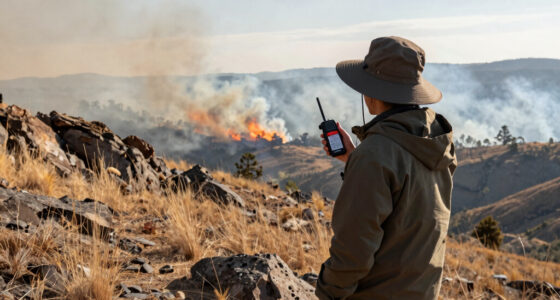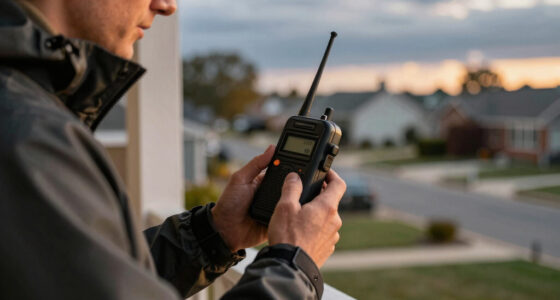

When all your tech fails in the wild, rely on natural navigation skills like observing the sun, stars, and landscape features. Use the sun’s position during the day to maintain your heading and find east or west with shadows. At night, locate the North Star for orientation. Recognize landmarks like rivers or mountain ranges to guide your way. Developing these skills guarantees you’re less dependent on electronics—keep exploring to discover more effective techniques.
Key Takeaways
- Use natural cues like the sun, stars, and landscape features to determine direction without electronic devices.
- Employ a solar compass to find bearings based on the sun’s position, independent of batteries or signals.
- Track shadows during the day or locate the North Star at night to establish cardinal directions.
- Recognize and utilize landmarks such as rivers, mountains, and distinctive trees to navigate effectively.
- Practice natural navigation techniques beforehand to quickly orient yourself when technology fails.

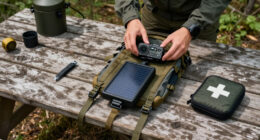
In emergency situations, steering quickly and accurately can mean the difference between safety and danger. When your electronic devices fail or you lose cell service, relying on traditional navigation methods becomes essential. One of the most reliable tools in such moments is a solar compass, which helps you determine direction based on the position of the sun. Unlike digital compasses, solar compasses don’t depend on batteries or signals, making them invaluable in wilderness survival or off-grid adventures. Learning how to use a solar compass effectively can restore your sense of direction when all else fails.
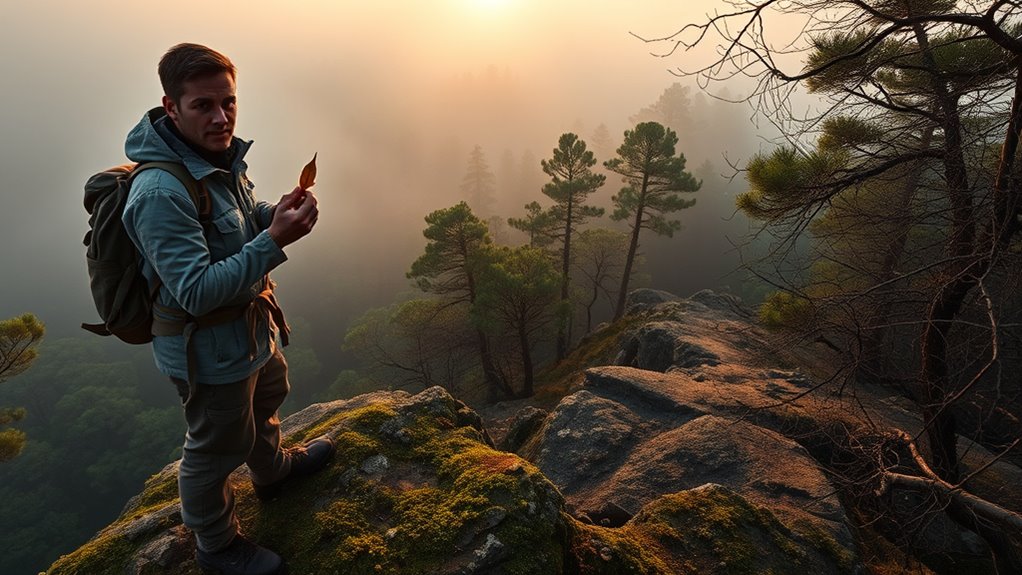
Alongside solar compasses, natural navigation techniques come into play, enabling you to find your way by observing the environment. These methods involve paying close attention to the sun’s path, the stars, landscape features, and other natural cues. For example, in the northern hemisphere, the sun rises roughly in the east and sets in the west, so tracking its movement can help you maintain a consistent heading. At night, navigating by the stars, such as locating the North Star, can help you find north and orient yourself properly. Recognizing natural landmarks like rivers, mountain ranges, or distinctive trees also guides your route, especially if you’re familiar with the terrain beforehand.
Use natural cues like the sun, stars, and landscape features to navigate when technology fails.
Using natural navigation requires practice, but it’s a skill that can serve you well when technology isn’t an option. Always start by identifying the sun’s position at different times of day; in the morning, the sun rises roughly in the east, and by late afternoon, it’s in the west. You can mark these observations mentally or physically, creating a mental map of your surroundings. During the day, watch for shadows; the sun’s position causes shadows to stretch east to west, which can help you determine cardinal directions. At night, locate the North Star in the northern hemisphere—it appears nearly stationary and directly above the North Pole, making it a reliable anchor point for navigation. Developing proficiency with natural navigation techniques enhances your independence from electronic devices and can be lifesaving in remote areas.
In any emergency, combining tools like a solar compass with natural navigation techniques enhances your ability to stay oriented. Carrying a simple solar compass and understanding how to read natural cues can turn the environment into your guide. Practice these skills beforehand, so they become second nature when needed. Remember that staying calm, conserving energy, and continuously assessing your surroundings are crucial. By mastering these methods, you give yourself the best chance to find safety, even when all modern technology has failed.
As an affiliate, we earn on qualifying purchases.
Frequently Asked Questions
How Can I Signal for Help Without Electronic Devices?
You can signal for help without electronic devices by using signal mirrors to reflect sunlight toward rescue crews or distant observers. Additionally, employ whistle techniques like three short blasts to attract attention, as sound travels far and is easily recognizable. Combine these methods with visible signals like large, contrasting ground markers or SOS signs made from rocks or branches to increase your chances of being noticed.
What Natural Signs Indicate Safe Water Sources Nearby?
Ever wonder how to find safe water sources without gadgets? Look for natural water clues like lush green vegetation, especially greener patches compared to surrounding areas, and animal tracks leading downhill or toward vegetation. Environmental water indicators also include bird calls near water, insects like dragonflies, and the presence of damp soil or moss. These signs suggest nearby water, guiding you to a safe source when tech fails.
How Do I Judge the Direction to Follow Without a Compass?
You can judge direction without a compass using celestial navigation and natural indicators. Look for the sun’s position—rises in the east and sets in the west—and use the North Star at night if you’re in the Northern Hemisphere. Observe natural indicators like moss on trees, which often grow on the north side, or the way shadows fall, helping you determine your direction and stay oriented in the wild.
What Plants Are Safe to Eat in an Emergency?
Imagine finding a bush bursting with bright edible berries and lush green leaves swaying in the breeze. You can eat safe greens like dandelion, lamb’s quarters, and wild spinach, which are nutritious and abundant. Look for berries that are shiny, firm, and not white or green—these are usually safe. Always double-check plant identification before consuming, and avoid anything with a milky sap, strange smell, or bitter taste.
How Can I Stay Warm if Stranded Overnight?
If you’re stranded overnight, stay warm by building a shelter using shelter building tips like insulating it with leaves or pine needles. Start a fire using fire starting techniques such as friction or using a magnifying glass if available. Keep your body heat in by layering clothing or using natural insulators like moss. Prioritize creating a shelter and fire to conserve warmth and protect yourself from the elements.
As an affiliate, we earn on qualifying purchases.
Conclusion
When all your tech fails, you’re suddenly thrust into a high-stakes game of survival. Every decision counts, and your instincts become your last line of defense. Will you trust your senses, or let panic take over? The wilderness holds secrets, and your next move could mean the difference between rescue and danger. Stay alert, think quickly, and remember—sometimes, the simplest skills are your greatest salvation when everything else falls apart.
As an affiliate, we earn on qualifying purchases.
As an affiliate, we earn on qualifying purchases.