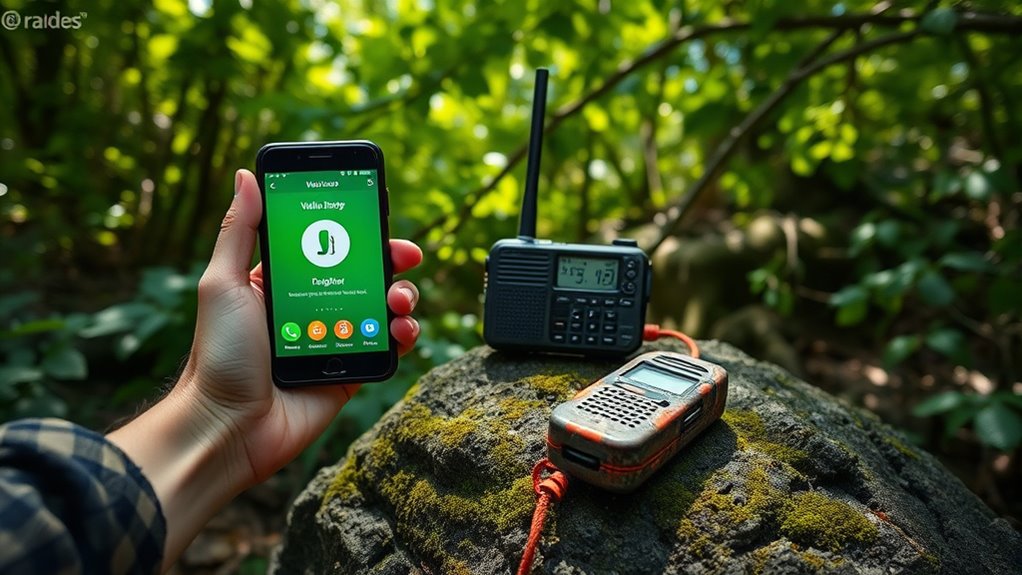

Phone apps for walkie-talkie communication depend on internet or cellular networks, making them unreliable off-grid or in areas with poor coverage. In contrast, real radios operate on dedicated frequencies and can work independently of any infrastructure, offering more dependable, instant communication. If you need off-grid or long-distance communication, real radios are your best bet. Keep exploring to discover which option suits your specific needs better and how regulations might play a role.

Get emergency and outdoor gear delivered free — and shop member deals
- Fast, free delivery on millions of items
- Access to Prime Big Deal Days deals on October 6–7
- Prime Video, Amazon Music and more included
Key Takeaways
- Real radios operate on dedicated frequencies, offering more reliable communication off-grid than phone apps reliant on internet or cellular networks.
- Phone walkie-talkie apps depend on internet or cellular coverage, making them less reliable in remote or off-grid environments.
- Higher-powered, licensed radios provide longer range and better obstacle penetration compared to low-power, license-free models.
- Regulatory requirements for high-power radios may limit their use, while license-free apps are easier to deploy but less robust off-grid.
- For dependable off-grid communication, dedicated radios generally outperform phone apps in range, reliability, and independence from network coverage.
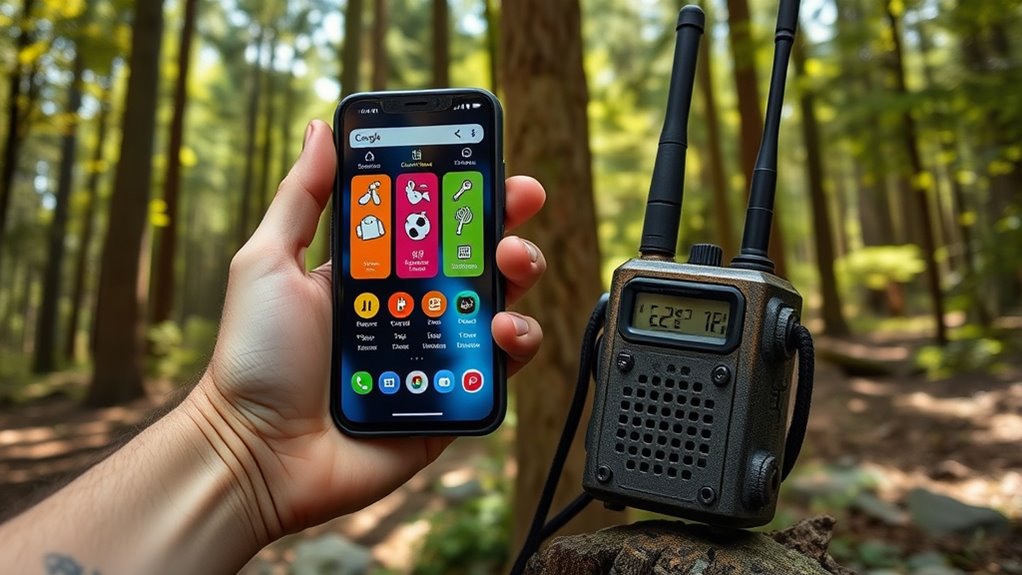
In today’s connected world, walkie-talkie apps and real radios both offer quick, reliable communication, but understanding their differences can help you choose the right option for your needs. When it comes to real radios, one major consideration is license requirements. Many two-way radios, especially those with higher power output, are regulated by government agencies like the FCC in the United States. If you plan to use devices with significant power output, you might need a license to operate legally—this guarantees you’re not interfering with other critical communications and that you’re complying with regulations. For example, handheld radios with power outputs above 2 watts often require licensing, whereas lower-powered models might be license-free. Knowing this is essential because using a radio without proper licensing can lead to fines or equipment confiscation.
Power output determines how far your radio signals can travel and how clear your communication remains over distance. Higher power output means a stronger signal that can penetrate obstacles and reach distant locations more effectively. This is especially important if you’re working in environments with lots of walls, buildings, or natural barriers. Lower-powered radios, often used for casual or short-range communication, may be sufficient within a small area but can struggle over longer distances. When choosing a radio, you’ll want to consider the power output in relation to your typical use case—whether it’s coordinating with a team on a construction site or staying in touch during outdoor activities. Keep in mind, increasing power output might require a license and could also lead to more interference with other devices, which is why regulations are in place. Additionally, regulatory compliance is crucial to ensure legal operation and avoid penalties.
handheld two-way radio for outdoor use
As an affiliate, we earn on qualifying purchases.
As an affiliate, we earn on qualifying purchases.
Frequently Asked Questions
How Do Walkie-Talkie Apps Perform During Extreme Weather Conditions?
During extreme weather conditions, walkie-talkie apps often struggle with weather resilience and signal stability, making communication unreliable. Heavy rain, snow, or storms can disrupt your connection, causing dropped calls or complete signal loss. Unlike real radios, which are designed to withstand harsh elements, phone apps depend on cellular networks that are vulnerable to weather disruptions. For dependable communication off-grid, real radios are your best choice.
Can Walkie-Talkie Apps Replace Traditional Radios in Emergency Situations?
Can walkie-talkie apps replace traditional radios in emergencies? Think of digital communication as a fragile glass—it shatters without stable internet or power. While apps excel in convenience, they lack offline functionality vital during blackouts or off-grid situations. Traditional radios are more reliable, operating independently of networks. So, no, apps shouldn’t fully replace radios in emergencies; they’re best paired for versatile, resilient communication.
What Is the Battery Life Comparison Between Apps and Real Radios?
You’ll find that real radios generally have better battery efficiency and lower power consumption compared to walkie-talkie apps. Apps depend on your phone’s battery, which drains quickly with constant use or poor signal, making them less reliable off-grid. Radios, on the other hand, are built for longer-lasting power, especially with rechargeable or replaceable batteries, ensuring you stay connected longer in emergency or outdoor situations.
Are Walkie-Talkie Apps Secure Against Hacking or Eavesdropping?
You should know that walkie-talkie apps are vulnerable to hacking and eavesdropping because they often lack robust digital encryption. Hackers can exploit vulnerabilities in the app’s security, putting your conversations at risk. While some apps offer encryption, it’s not always reliable or end-to-end. If security matters, real radios with strong encryption are safer, as they’re less prone to hacking vulnerabilities and provide better protection for your communications.
Do Walkie-Talkie Apps Require Cellular Data or Wi-Fi for Operation?
Walkie-talkie apps require an internet connection, either cellular data or Wi-Fi, to work. They depend on internet requirements, so if you lose cellular service or Wi-Fi, the app won’t function. This cellular dependency makes these apps less reliable off-grid. For off-grid communication, real radios are better because they operate independently of internet requirements, ensuring you stay connected even when there’s no network coverage.
license-free walkie-talkie radios
As an affiliate, we earn on qualifying purchases.
As an affiliate, we earn on qualifying purchases.
Conclusion
While walkie-talkie apps offer convenience and instant communication, they rely on networks that can fail off-grid. Real radios, though bulkier, provide reliable, independent communication without cellular service. Think of apps as a smartphone’s convenience—great until the signal drops. Radios are like trusted friends—always there when you need them, no matter where you are. In the end, for off-grid reliability, real radios outshine the digital illusion of connectivity.
high power two-way radio FCC licensed
As an affiliate, we earn on qualifying purchases.
As an affiliate, we earn on qualifying purchases.
off-grid walkie-talkie communication devices
As an affiliate, we earn on qualifying purchases.
As an affiliate, we earn on qualifying purchases.
Fall Picks
fall essentials
As an affiliate, we earn on qualifying purchases.