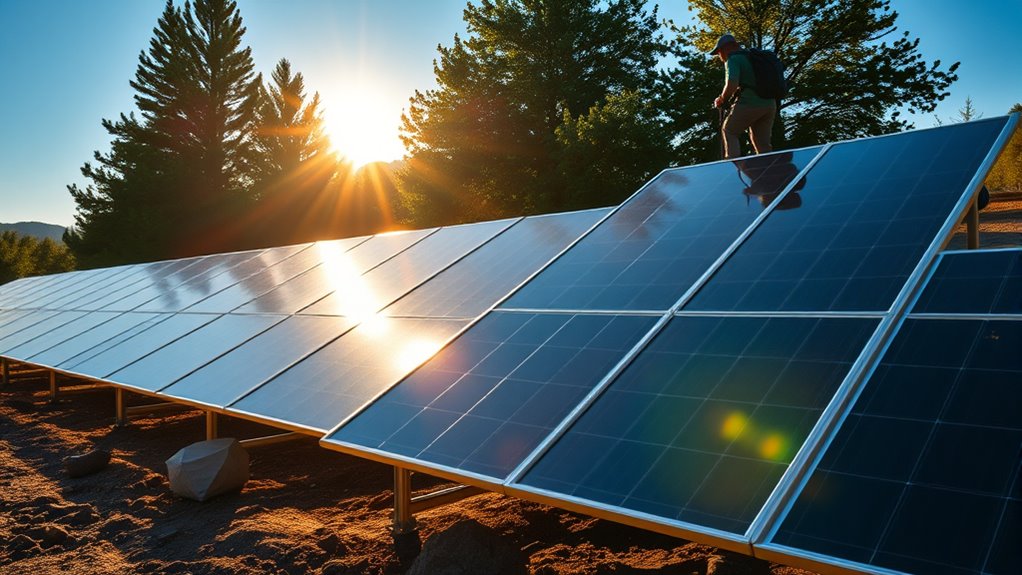

To maximize solar power at your camp, position your panels at an angle that captures the most sunlight throughout the day and seasons. Adjust the tilt based on your latitude, with steeper angles for summer and shallower ones for winter. Avoid shadows from trees or structures, and consider using adjustable mounts or microinverters to fine-tune your system. If you keep optimizing your setup, you’ll discover ways to boost your energy production even further.
Key Takeaways
- Adjust panel tilt seasonally to align with the sun’s changing position for maximum sunlight capture.
- Optimize panel orientation to face true south (in the northern hemisphere) or true north (in the southern hemisphere).
- Minimize shading by clearing obstructions and using adjustable mounts to reposition panels as needed.
- Regularly monitor system performance and fine-tune tilt angles based on energy output data.
- Use high-efficiency panels and technology like microinverters to enhance overall power generation.

Have you ever wondered how to get the most out of your solar energy system? One of the most effective ways to maximize your solar power at camp is by paying close attention to how your solar panels are positioned. Proper solar panel tilt plays a vital role in capturing the maximum amount of sunlight throughout the day. When you adjust the tilt, you guarantee that the panels are angled ideally for your geographic location, which varies depending on your latitude. During summer, a steeper tilt may be beneficial, while a shallower angle works better in winter. By fine-tuning the tilt, you help your system generate more electricity, making the most of the sun’s rays no matter the season.
Adjust your solar panel tilt seasonally to maximize sunlight and boost energy production at camp.
In addition to tilt, shading mitigation is another essential aspect to consider. Even small shadows cast on your panels can considerably reduce their efficiency, especially during peak sunlight hours. When setting up your panels, look for a location that minimizes shading from nearby trees, structures, or other obstructions. If some shading is unavoidable, you might consider mounting panels on adjustable racks so you can move them as the sun’s position shifts throughout the day. This way, you can keep the panels in direct sunlight as much as possible. Installing shading mitigation tools like microinverters or power optimizers can also help. These devices allow each panel to operate independently, so shading on one panel won’t drastically affect the entire system’s output.
Another tip is to monitor your system regularly. Keep an eye on how your panels perform during different times of the day and throughout the seasons. If you notice drops in energy production, it might be time to revisit your tilt angle or check for new shading issues caused by growing trees or new structures. In a camping setup, portability is key, so consider using adjustable mounts that make it easy to change your panel’s tilt without hassle. This flexibility allows you to adapt to changing weather patterns, the sun’s position, and seasonal variations, ensuring you’re always capturing the maximum possible sunlight.
Additionally, utilizing solar panel technology such as high-efficiency modules can improve overall energy capture and compensate for less-than-ideal positioning. Ultimately, maximizing solar at camp involves a combination of proper tilt and shading mitigation. By thoughtfully positioning your panels and making small adjustments as needed, you’ll greatly boost your energy production. It’s about being proactive and attentive to how the sun moves and how shadows fall, so you can enjoy reliable, efficient solar power wherever your adventures take you. Remember, a little planning and regular tweaking can go a long way toward harnessing the full potential of your solar energy system.

BougeRV 28in Adjustable Solar Panel Tilt Mount Brackets with Foldable Tilt Legs, Solar Panels Mounting Support up to 100 150 200 Watt Solar Panel for Roof, RV, Boat, and Off-Grid
【MORE SUNLIGHT, MORE OUTPUT】Tilting design will get up to 50% more solar energy collection compared to horizontally mounted…
As an affiliate, we earn on qualifying purchases.
As an affiliate, we earn on qualifying purchases.
Frequently Asked Questions
How Do Seasonal Changes Affect Solar Panel Positioning?
Seasonal variation affects your solar panel positioning because the sun’s angle changes throughout the year. To optimize power, you should perform tilt adjustment based on the season—raising panels in winter for better sun exposure and lowering them in summer. This guarantees your panels receive maximum sunlight, regardless of seasonal changes, helping you generate the most energy possible at your camp all year round.
Can Portable Panels Be Adjusted for Optimal Sun Exposure?
Yes, portable panels can be adjusted for ideal sun exposure. You should modify the solar panel tilt to match the sun’s angle, which varies throughout the day and seasons. Using sun tracking, either manually or with a portable tracker, helps keep panels aligned with the sun’s movement. This guarantees maximum solar efficiency, especially when camping, by consistently capturing the most sunlight possible.
What Tools Help Determine the Best Panel Angle at Camp?
You can’t beat having the right tools in your kit. Angle calculators help you determine the ideal panel tilt based on your location and season, while tilt meters give precise readings of your current setup. Think of them as your solar compass, guiding you to the best angle for maximum sun exposure. Using these tools, you’ll ensure your panels are always positioned for peak power, even in the great outdoors.
How Does Shading Impact Solar Panel Efficiency?
Shade impact substantially reduces your solar panel efficiency, as even partial shading causes efficiency reduction. When shadows fall on panels, they disrupt the flow of electricity, lowering overall power output. To maximize efficiency, you should position panels where shade is minimal, especially during peak sunlight hours. Regularly check for and trim nearby obstructions like trees or structures, ensuring shade impact stays low and your solar system operates at its best.
Are There Portable Mounting Options for Uneven Terrain?
You might think finding a flat spot is easy, but uneven terrain calls for portable mounting options like tripod mounts or flexible panels. These solutions give you stability and adaptability, even on rocky or sloped ground. With tripod mounts, you can adjust angles for maximum sun exposure, while flexible panels bend to fit uneven surfaces. So, yes, you can conquer rugged terrain without sacrificing solar efficiency.

Cosmoxstar 1200W Micro Inverter, 2 MPPT Grid Tie Solar Inverter, WiFi App Control, IP67 Waterproof, 16.4ft AC Cable, Plug and Play Solar Kit for Balcony Solar System
1200W High Power Output & 96% Efficiency – Delivers up to 1200W output with 96% conversion efficiency and…
As an affiliate, we earn on qualifying purchases.
As an affiliate, we earn on qualifying purchases.
Conclusion
Think of your solar panels as a trusty compass guiding you through a sunlit voyage. Just as a sailor adjusts their sails to catch the wind best, you position your panels to harness the sun’s peak energy. Small tweaks make a big difference, turning your campsite into a powerhouse. With attention and care, you’ll navigate toward maximum efficiency, ensuring your solar journey is smooth and bright—your own beacon of self-sufficiency shining brightly under the sun.

FlexSolar 100W Portable Solar Panel – 24% High Efficiency, IP67 Waterproof, QC3.0 USB-A/USB-C/DC Output for Small Power Station, Camping, RV & Emergency
【Ultra-Portable & 4.1Lbs Lightweight】Foldable to 12.99×10.43×2.17inches (laptop-sized!) and weighs only 4.1lbs(1.85kg) – lighter than most 100W competitors. The…
As an affiliate, we earn on qualifying purchases.
As an affiliate, we earn on qualifying purchases.

Adjustable Solar Panel Tilt Mount Brackets Aluminum Alloy Solar Panel Mounting Support up to 50 70 100 150 200 300 400 Watt Solar Panel for Flat Surface Roof RV Boat Off-Grid (Mount Only) Silver
Adjustable Tilt for Optimal Sun Exposure: This solar panel mount lets you set a 15-30 degree tilt for…
As an affiliate, we earn on qualifying purchases.
As an affiliate, we earn on qualifying purchases.