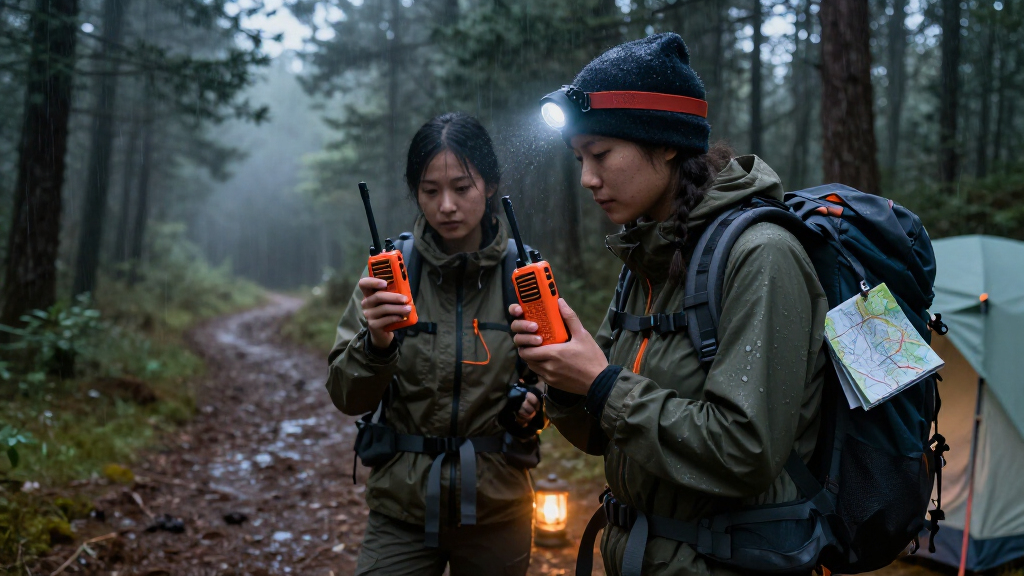
The best emergency two-way radio for most households is the Motorola Talkabout T605, pairing weather-resistant design with features suited to outdoor disruptions. For tougher conditions, the DEWALT DXFRS800 offers a rugged waterproof build, while the Motorola Talkabout T802 adds weather alerts and location-sharing features. The key choice is between simple FRS radios that work directly between nearby units and LTE or licensed-radio models that depend on service, setup, or user qualifications. Battery strategy, water protection, and how many people need to communicate matter as much as advertised range. Read on for a comparison of all 15 options and guidance on matching one to your emergency plan.

Get emergency and outdoor gear delivered free with Prime
- Fast, free delivery on millions of items
- Prime Video, Amazon Music and more included
- Member-only deals all year
Key Takeaways
- Weather protection separates the strongest outdoor picks: the DEWALT DXFRS800 has an IP67 rating, while the Motorola T605 is designed for water-related use; check each model’s limits rather than treating “weather-resistant” and “waterproof” as interchangeable.
- LTE radios solve a different problem from FRS radios: the KAYOTOM and Rapid Radios G1 use cellular networks for broader reach, so they may not help when local service is down.
- More power does not remove operating requirements: the Baofeng AR-5RM and UV-5RM offer a more configurable radio path, but buyers need to understand radio rules and setup before an emergency.
- Group size changes the best format: the four-radio Retevis RT22, WokTok M-880, and pxton PX-888S can equip more people from one purchase, while two-packs suit smaller household teams.
- Emergency readiness depends on power planning: rechargeable models need a charging routine and backup plan; models that support replaceable batteries can offer another way to keep communicating during an extended outage.
- Emergency readiness depends on power planning: rechargeable models need a charging routine and backup plan; check whether a radio accepts replaceable batteries or has another practical backup before relying on it for a long outage.
| KAYOTOM 4G LTE Push-to-Talk Walkie-Talkies, 2-Pack with SIM |  | Best for Long-Distance Cellular Coverage | Pack size: 2 radios | Connectivity: 4G LTE | Channels: 200 | VIEW LATEST PRICE | See Our Full Breakdown |
| Motorola Talkabout T802 Two-Way Radios, 2-Pack, IP54, 22 Channels |  | Best for Weather and Group Coordination | Quantity: 2 radios | Channels: 22 | Privacy codes: 121 | VIEW LATEST PRICE | See Our Full Breakdown |
| Rapid Radios G1 Nationwide LTE Push-to-Talk Two-Way Radios, 2-Pack |  | Best for Large Cellular-Based Response Teams | Quantity: 2 radios | Connectivity: LTE/POC/4G | Coverage: Nationwide US, through cellular service | VIEW LATEST PRICE | See Our Full Breakdown |
| DEWALT DXFRS800 FRS Walkie Talkies, 2W, IP67 Waterproof, 2-Pack |  | Best for Rugged Worksites and Wet Conditions | Radio service: FRS | Output power: 2W | Channels and privacy codes: 22 channels; 121 privacy codes | VIEW LATEST PRICE | See Our Full Breakdown |
| Motorola Talkabout T605 H₂O Waterproof Two-Way Radios, 2-Pack |  | Best for Water-Based Emergencies | Radio type: FRS | Quantity: 2 radios | Channels and privacy codes: 22 channels; 121 privacy codes | VIEW LATEST PRICE | See Our Full Breakdown |
| MOICO T5 Two-Way Walkie Talkies, 22-Channel FRS Radios, 2-Pack |  | Best for Simple, Battery-Backup Readiness | Channels: 22 FRS channels | Privacy codes: 99 CTCSS tone sets | Maximum claimed range: 3 miles | VIEW LATEST PRICE | See Our Full Breakdown |
| Retevis RB48 FRS Two-Way Radios, 2-Pack |  | Best for Rugged Emergency Use | Radio service: FRS | Channels: 22 | Durability: MIL-STD-810H | VIEW LATEST PRICE | See Our Full Breakdown |
| Midland LXT600VP3 FRS Walkie Talkies, Black, 2-Pack |  | Best for Weather Monitoring | Channels: 36 FRS channels | Privacy codes: 121 CTCSS codes | Maximum advertised range: Up to 30 miles in unobstructed areas | VIEW LATEST PRICE | See Our Full Breakdown |
| BAOFENG AR-5RM 10W Two-Way Handheld Radios with NOAA Weather, 2-Pack |  | Best for Feature-Rich Radio Setup | Channels: Up to 999 | Receiving frequency range: 108–136 MHz, 136–174 MHz, 220–260 MHz, 350–390 MHz, 400–520 MHz | Transmitting frequency range: 144–148 MHz, 420–450 MHz | VIEW LATEST PRICE | See Our Full Breakdown |
| Baofeng UV-5RM Dual-Band Handheld Ham Radio Walkie-Talkie (2-Pack) | 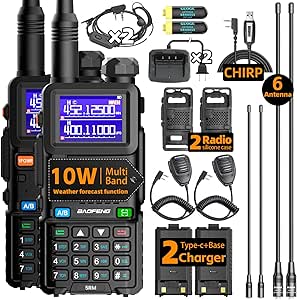 | Best for Programmable Ham-Radio Users | Pack quantity: 2 radios | Memory channels: 999 | Receiving frequency range: 108–136 MHz, 136–174 MHz, 220–260 MHz, 350–390 MHz, 400–520 MHz | VIEW LATEST PRICE | See Our Full Breakdown |
| Retevis RT22 Rechargeable FRS Walkie Talkies, 4-Pack |  | Best Compact Emergency Group Set | Pack size: 4 radios | Frequency and channels: FRS; 16 channels | Weight: 3.8 oz (108 g) each | VIEW LATEST PRICE | See Our Full Breakdown |
| Midland GXT1030VP4 GMRS Two-Way Radios with Headsets, Hi-Vis Yellow, 2 Pack |  | Best for Outdoor Crews and Weather Alerts | Pack size: 2 radios | Radio service: GMRS | Channels and privacy codes: 50 channels; 142 privacy codes | VIEW LATEST PRICE | See Our Full Breakdown |
| WokTok M-880 4-Pack Two-Way Radios |  | Best Four-Pack for Rough Outdoor Handling | Pack size: 4 radios | Channels: 22 main channels and 99 subchannels | Frequency range: 462.5625–467.7125 MHz | VIEW LATEST PRICE | See Our Full Breakdown |
| Motorola Solutions Talkabout T475 Weather-Resistant Two-Way Radios, Black/Yellow, 2-Pack |  | Best Two-Radio Emergency Kit | Pack size: 2 radios | Channels and privacy codes: 22 channels; 121 privacy codes | Frequency range: 462–467 MHz | VIEW LATEST PRICE | See Our Full Breakdown |
| pxton PX-888S Rechargeable Two-Way Radios with Earpieces, 4-Pack |  | Best for Hands-Free Team Communication | Pack size: 4 radios | Frequency and channels: UHF; 16 channels | Privacy codes: 165 | VIEW LATEST PRICE | See Our Full Breakdown |
| emergency two way radio | Water resistance | Battery life | Maximum stated range |
|---|---|---|---|
| KAYOTOM 4G LTE Push-to-Talk Wa | Water repellent | — | — |
| Motorola Talkabout T802 Two-Wa | IP54 | — | Up to 35 miles |
| Rapid Radios G1 Nationwide LTE | Water resistant | Up to 5 days | — |
| DEWALT DXFRS800 FRS Walkie Tal | — | Up to 18 hours | — |
| Motorola Talkabout T605 H₂O Wa | IP67 | 9 hours | Up to 35 miles |
| MOICO T5 Two-Way Walkie Talkie | IP65 | 12 hours | — |
| Retevis RB48 FRS Two-Way Radio | — | Listed as 18 hours and up to 20 hours | — |
| Midland LXT600VP3 FRS Walkie T | Water resistant | 6 hours | — |
| BAOFENG AR-5RM 10W Two-Way Han | Not water resistant | 6 hours | — |
| Baofeng UV-5RM Dual-Band Handh | Not water resistant | — | 8 kilometers |
| Retevis RT22 Rechargeable FRS | Not water resistant | — | 3 km |
| Midland GXT1030VP4 GMRS Two-Wa | JIS4 (IPX4) | — | 57 km (36 miles) |
| WokTok M-880 4-Pack Two-Way Ra | Water resistant; rating not specified | Listed as 4 days; battery type and charging method not specified | 5 miles |
| Motorola Solutions Talkabout T | IPX4 | — | Up to 35 miles |
| pxton PX-888S Rechargeable Two | — | 8–12 hours continuous use; up to 96 hours also stated | 2 miles |
More Details on Our Top Picks
KAYOTOM 4G LTE Push-to-Talk Walkie-Talkies, 2-Pack with SIM
The KAYOTOM is aimed at buyers who need to talk across distances that ordinary FRS radios may not cover, using 4G LTE rather than direct radio-to-radio transmission. Its included lifetime-free SIM service and 3000mAh battery make it a practical choice for coordinating dispersed teams, while USB-C charging simplifies topping up with common cables. Compared with the Rapid Radios G1, it also offers LTE push-to-talk but lists over 24 hours of continuous use rather than up to five days of battery life. The key compromise is dependence on cellular coverage: these are not a fallback when local networks are unavailable. Compatibility is also limited to devices on the same network and frequency band, so this pair is less flexible for mixed-radio groups.
Pros:- 4G LTE push-to-talk is designed for communication beyond typical local FRS range when cellular coverage is available.
- Lifetime-free SIM service is included.
- 3000mAh battery is stated to provide over 24 hours of continuous use.
- USB-C charging and noise reduction support convenient charging and clearer conversations.
Cons:- Communication depends on cellular network availability, so it cannot serve as an off-grid radio fallback.
- Compatibility is specified for devices on the same network and frequency band.
- The supplied information does not give a water-resistance rating beyond describing the radios as water repellent.
Best for: Work crews or family members who need push-to-talk across a wide area with cellular coverage and want included SIM service.
Not ideal for: Backcountry users or emergency planners who need radio communication to work when cellular networks are down, or groups using different network bands.
- Pack size:2 radios
- Connectivity:4G LTE
- Channels:200
- Battery capacity:3000mAh
- Stated battery life:Over 24 hours of continuous use
- Charging port:USB-C
- Water resistance:Water repellent
Our verdict“Choose the KAYOTOM pair for broad-area push-to-talk where LTE coverage is available, but choose a conventional radio for a cellular outage plan.”
Motorola Talkabout T802 Two-Way Radios, 2-Pack, IP54, 22 Channels
The T802 is the most useful fit here for emergency plans that combine local radio communication with weather information and phone-assisted coordination. NOAA weather alerts can give users a warning source on the radio, while Bluetooth links the pair to the TALKABOUT app for location sharing and messaging. That extra coordination layer sets it apart from the more rugged DEWALT DXFRS800, which emphasizes physical protection and rechargeable batteries instead. The T802 also works with FRS and GMRS radios, making it a more adaptable addition to an existing compatible group. Its IP54 rating provides some dust and water resistance, but not the submersion protection offered by the DEWALT or Motorola T605. The stated maximum range is condition-dependent, and three AA batteries per radio mean users should plan their battery supply.
Pros:- NOAA weather radio and alerts add a useful warning source during emergencies.
- Bluetooth and the TALKABOUT app support location sharing and messaging.
- Works with FRS and GMRS radios, helping it fit into compatible existing groups.
- IP54 protection and 121 privacy codes add practical outdoor and channel-management features.
Cons:- IP54 protection is less suited to heavy water exposure than the IP67 DEWALT DXFRS800 and Motorola T605.
- Requires three AA batteries per radio, so replacement or spare batteries are part of the plan.
- The stated range of up to 35 miles is a maximum claim and varies with conditions.
Best for: Families and small groups who want NOAA weather alerts, app-based location sharing, and compatibility with FRS or GMRS radios.
Not ideal for: People who expect radios to be submerged or need long-lasting rechargeable power without carrying spare AA batteries.
- Quantity:2 radios
- Channels:22
- Privacy codes:121
- Maximum stated range:Up to 35 miles
- Water resistance:IP54
- Connectivity:Bluetooth
- Weather alerts:NOAA weather radio and alerts
- Power:3 AA batteries per radio; included
Our verdict“Pick the T802 when weather alerts and app-assisted coordination matter more than waterproofing or rechargeable-only operation.”
Rapid Radios G1 Nationwide LTE Push-to-Talk Two-Way Radios, 2-Pack
The Rapid Radios G1 suits response groups that need to reach beyond local radio range and communicate with many people at once. Its LTE/4G push-to-talk supports private calls and groups of up to 200 people, with one year of service included for each radio. The listed up to five days of battery life is a stronger endurance claim than the KAYOTOM pair’s over 24 hours of continuous use, and the G1 adds 256-bit AES encryption. That makes it the more team-oriented cellular pick, while the Motorola T802 is a better choice for local communication with NOAA alerts and no reliance on cellular service. The G1’s nationwide coverage still depends on cellular connectivity, and service requires a plan after the included year. The charger guidance is restrictive: the manufacturer recommends using only the supplied charger.
Pros:- LTE/4G service is designed for nationwide US push-to-talk coverage where cellular networks are available.
- Supports private one-to-one calls and groups of up to 200 people.
- Up to five days of stated battery life offers longer listed endurance than the KAYOTOM pair.
- Includes one year of service per radio and 256-bit AES encryption.
Cons:- Requires cellular connectivity and a service plan after the included year.
- Cannot provide a cellular-independent communications link during network outages.
- Manufacturer recommends using only the included charger.
Best for: Coordinators of larger teams who need LTE-based group communication, private calls, and extended stated battery life.
Not ideal for: People preparing for cellular outages or buyers who want a radio that can communicate directly without a service plan.
- Quantity:2 radios
- Connectivity:LTE/POC/4G
- Coverage:Nationwide US, through cellular service
- Maximum talk-group size:200 people
- Battery life:Up to 5 days
- Encryption:256-bit AES
- Water resistance:Water resistant
- Included service:One year per radio
Our verdict“Choose the G1 for large, widely dispersed teams with cellular coverage; choose a conventional FRS set for off-grid emergency communication.”
DEWALT DXFRS800 FRS Walkie Talkies, 2W, IP67 Waterproof, 2-Pack
For emergencies around construction sites, vehicles, or wet outdoor work, the DXFRS800 prioritizes durability over wide-area reach. Its IP67 rating and stated resistance to drops up to 2 meters make it more suited to rough handling and water exposure than the Motorola T802, whose IP54 rating offers less protection. Rechargeable batteries, a dual-port charger, and included holsters also make this a ready-to-organize pair for a work crew. It remains a conventional FRS radio, though, with a stated maximum talking range of two miles; the coverage claim of up to 300,000 square feet or 25 floors does not make it a nationwide option like the LTE-based Rapid Radios G1. The radios also weigh 1.8 pounds per the supplied specs, so this is a sturdier work tool rather than a lightweight choice for every pocket.
Pros:- IP67 protection is suited to dusty and wet work environments.
- Rated to resist drops up to 2 meters.
- Rechargeable batteries and a dual-port charger simplify keeping both radios ready.
- VOX hands-free operation and vibration alerts add useful worksite functions.
Cons:- The stated maximum talking range is two miles, far short of LTE-based nationwide communication.
- Battery life is listed as up to 18 hours and may vary with use.
- The supplied item weight of 1.8 pounds makes it less appealing for buyers prioritizing a light carry.
Best for: Tradespeople and outdoor crews who need water- and dust-resistant FRS radios with rechargeable batteries and hands-free options.
Not ideal for: People who need nationwide communication, a particularly lightweight radio, or the longest possible local range.
- Radio service:FRS
- Output power:2W
- Channels and privacy codes:22 channels; 121 privacy codes
- Water and dust protection:IP67
- Maximum stated talking range:2 miles
- Drop resistance:Up to 2 meters
- Battery life:Up to 18 hours
- Included batteries:2 Li-Polymer batteries
Our verdict“Pick the DXFRS800 for a rugged local FRS pair that can handle rough conditions, not for communication across cellular-scale distances.”
Motorola Talkabout T605 H₂O Waterproof Two-Way Radios, 2-Pack
The T605 is the clearest choice in this group for boating, paddling, and other situations where a radio could end up in the water. Its IP67 waterproof rating is paired with a floating design that faces up, making a dropped radio easier to spot and retrieve than the non-floating DEWALT DXFRS800. A water-activated flashlight adds another practical feature for low-light recovery. Both are rugged FRS options with 22 channels and 121 privacy codes, but the T605’s standout is water recovery rather than worksite drop resistance. Its stated battery life is 9 hours, shorter than the DEWALT’s up to 18 hours, so it may need more frequent charging during extended outings. The advertised range of up to 35 miles is a maximum, not a dependable expectation in obstructed terrain.
Pros:- IP67 waterproof protection suits wet outdoor use.
- Floating design faces up in water to make a dropped radio easier to locate.
- Water-activated flashlight can help with visibility around water.
- USB-C charging and rechargeable batteries avoid routine disposable-battery replacement.
Cons:- Listed battery life is 9 hours, shorter than the DEWALT DXFRS800’s stated up to 18 hours.
- The stated range of up to 35 miles is a maximum and depends on conditions.
- FRS communication remains local rather than nationwide like LTE push-to-talk radios.
Best for: Boaters, paddlers, and shoreline users who want waterproof radios that float and are easier to locate if dropped.
Not ideal for: People planning long shifts between charges or needing a cellular-independent solution that reaches far beyond local FRS coverage.
- Radio type:FRS
- Quantity:2 radios
- Channels and privacy codes:22 channels; 121 privacy codes
- Water resistance:IP67
- Maximum stated range:Up to 35 miles
- Battery life:9 hours
- Charging:USB-C
- Special features:Floating design; water-activated flashlight
Our verdict“Choose the T605 for water-heavy outings where flotation and waterproofing matter more than extended battery life.”
MOICO T5 Two-Way Walkie Talkies, 22-Channel FRS Radios, 2-Pack
The MOICO T5 suits buyers who want a straightforward pair of FRS radios they can power with commonly available AAA batteries. Its 22 channels and 99 privacy-code sets help groups find a shared channel, while three-level VOX can free up hands for basic tasks. The backlit display and built-in flashlight add useful low-light functions without much setup. Compared with the rechargeable Retevis RB48, the T5 is less rugged and requires you to supply batteries, but replaceable AAA cells can be a practical backup when charging is unavailable. Its stated city range is only 0.5–1 mile, and buildings or terrain can reduce communication further. I would choose it for uncomplicated local coordination, not as a long-distance emergency link.
Pros:- Runs on replaceable AAA batteries, which can be kept as spares
- 22 FRS channels and 99 CTCSS tone sets support channel selection
- Three-level VOX allows hands-free transmission
- Backlit LCD and integrated LED flashlight support use in low light
Cons:- Four AAA batteries per radio are not included
- Listed typical range in towns is 0.5–1 mile and can shrink around obstructions
- Less protective than the IP67-rated Retevis RB48
Best for: Households wanting simple local communication and the option to replace batteries without a charger
Not ideal for: People who need rechargeable radios, tested long-range coverage, or rugged water and dust protection
- Channels:22 FRS channels
- Privacy codes:99 CTCSS tone sets
- Maximum claimed range:3 miles
- Typical urban range:0.5–1 mile
- Battery requirement:4 AAA batteries per radio; not included
- Battery life:12 hours
- Water resistance:IP65
- Pack quantity:2 radios
Our verdict“Choose the MOICO T5 for basic nearby communication with replaceable batteries, but skip it if rechargeable power or tougher weather protection is a priority.”
Retevis RB48 FRS Two-Way Radios, 2-Pack
For emergency use where radios may face rain, dust, or rough handling, the RB48 has the strongest protection in this group: IP67 water and dust resistance plus MIL-STD-810H durability. Rechargeable 2000mAh batteries, USB-C charging, and a dock make routine power management easier than with the AAA-powered MOICO T5. The RB48 also adds weather alerts and dual PTT, useful features when a user needs to monitor conditions or operate the radio with different grips. Its stated coverage of up to 300,000 square feet or 25 floors is not a promise of reliable outdoor distance; buildings, terrain, and interference still matter. At 730 g, the listed weight is substantial for a handheld pair, and the battery-life data varies between 18 and up to 20 hours. I’d favor it for durability over compactness.
Pros:- IP67 water and dust resistance
- MIL-STD-810H durability rating
- Rechargeable 2000mAh batteries with USB-C charging and a dock
- Weather alerts and dual PTT controls
Cons:- The 300,000-square-foot coverage figure is a claim, not a guaranteed real-world range
- Listed battery life is inconsistent, with both 18-hour and up-to-20-hour figures
- At 730 g, the listed weight may be cumbersome for extended handheld use
Best for: Outdoor work crews and households that need rechargeable radios with strong water, dust, and impact protection
Not ideal for: Buyers prioritizing a light carry, small emergency kit, or a confirmed long-distance communication range
- Radio service:FRS
- Channels:22
- Durability:MIL-STD-810H
- Water and dust resistance:IP67
- Battery capacity:2000mAh
- Battery life:Listed as 18 hours and up to 20 hours
- Charging:USB-C and charging dock
- Temperature range:-20 to 60 °C
- Pack quantity:2 radios
Our verdict“Pick the RB48 when rugged protection and rechargeable convenience matter more than low weight or a dependable long-range claim.”
Midland LXT600VP3 FRS Walkie Talkies, Black, 2-Pack
The Midland LXT600VP3 is the clearest choice here for buyers who want weather information built into an FRS radio. Its NOAA weather scan and alert can help users monitor conditions, while channel scanning and 121 privacy codes make it easier to locate a channel for a group. Unlike the MOICO T5, it includes rechargeable battery packs and a desktop charger, yet it can also run on AAA batteries if the packs are depleted. That flexibility adds options for a household emergency kit, though the six-hour listed battery life is shorter than the RB48’s stated runtime. The advertised 30-mile range applies to unobstructed conditions, not typical streets or buildings. I’d pick this Midland for weather awareness and backup battery choices, rather than for sustained operation far from charging.
Pros:- NOAA weather scan and alert provide access to weather broadcasts
- Includes rechargeable battery packs and a desktop charger
- Can also use three AAA batteries per radio
- Channel scanning and 121 privacy codes support group channel setup
Cons:- Listed battery life is six hours
- AAA backup batteries are not included
- The 30-mile maximum range is for unobstructed conditions and can drop around obstacles
Best for: Families and campers who want NOAA weather alerts, channel scanning, and a choice of rechargeable packs or AAA batteries
Not ideal for: Users needing long operating time between charges or dependable communication across obstructed terrain
- Channels:36 FRS channels
- Privacy codes:121 CTCSS codes
- Maximum advertised range:Up to 30 miles in unobstructed areas
- Power options:Rechargeable battery packs or 3 AAA batteries per radio
- Weather features:NOAA weather scan and alert
- Battery life:6 hours
- Water resistance:Water resistant
- Pack quantity:2 radios
Our verdict“Choose the LXT600VP3 if built-in weather monitoring and dual battery options matter more than longer listed battery life.”
BAOFENG AR-5RM 10W Two-Way Handheld Radios with NOAA Weather, 2-Pack
The BAOFENG AR-5RM offers far more channel and programming complexity than the FRS models in this roundup. It stores up to 999 channels, supports frequency copying, and includes a color screen, NOAA weather reception, USB-C charging, and a base charger. Speaker microphones and earpieces in the package give buyers more ways to handle communication than the simpler Midland LXT600VP3. That flexibility comes with a major emergency-use caveat: this radio is not water resistant, and its listed six-hour battery life calls for a charging plan. Its transmitting frequencies are limited to specified bands, so buyers should understand the applicable licensing and operating rules rather than assume it works like a license-free FRS set. This is better for radio users prepared to configure their equipment than for families seeking instant, simple contact.
Pros:- Stores up to 999 channels and supports frequency copying
- Receives NOAA weather broadcasts
- Supports USB-C and base-charger charging
- Includes speaker microphones, earpieces, and a programming cable
Cons:- Not water resistant
- Listed battery life is six hours
- Transmitting is limited to specified frequency bands and requires users to follow applicable rules
Best for: Radio hobbyists and prepared users comfortable with frequency setup who want extensive channel memory and included audio accessories
Not ideal for: Families seeking simple license-free FRS operation or anyone needing a water-resistant radio for wet conditions
- Channels:Up to 999
- Receiving frequency range:108–136 MHz, 136–174 MHz, 220–260 MHz, 350–390 MHz, 400–520 MHz
- Transmitting frequency range:144–148 MHz, 420–450 MHz
- Battery capacity:2500mAh
- Battery life:6 hours
- Charging:USB-C cable and US base charger
- Display:1.77-inch color screen
- Water resistance:Not water resistant
- Pack quantity:2 radios
Our verdict“Choose the AR-5RM for configurable radio use and accessory flexibility, not for a simple, weather-resistant emergency pair.”
Baofeng UV-5RM Dual-Band Handheld Ham Radio Walkie-Talkie (2-Pack)
The UV-5RM is aimed at buyers who want a configurable ham-radio-style handheld rather than a ready-to-use FRS walkie-talkie. It pairs 999 memory channels with frequency cloning, a color display, NOAA weather alerts, USB-C charging, and a desktop base. CHIRP software support also gives technically confident users a route to organize channel settings. Compared with the similar BAOFENG AR-5RM, it offers the same broad channel capacity and battery size, while explicitly listing CHIRP compatibility and an eight-kilometer maximum stated range. Neither specification makes it an easy family emergency radio: the device is not water resistant, and transmitting is limited to specified ham bands that require appropriate authorization. I’d reserve it for licensed users who already know how they will program and operate it.
Pros:- 999 memory channels and frequency cloning support customized setups
- Compatible with CHIRP programming software
- NOAA weather alerts and a 1.77-inch color display
- Includes USB-C charging, a desktop base, and a speaker microphone
Cons:- Not water resistant
- Transmitting is limited to specified licensed ham bands
- The stated eight-kilometer maximum range is not a guarantee of coverage in obstructed areas
Best for: Licensed ham-radio users who want programmable handhelds with cloning, CHIRP support, and included charging bases
Not ideal for: Unlicensed beginners seeking simple FRS radios, or outdoor users who need water-resistant equipment
- Pack quantity:2 radios
- Memory channels:999
- Receiving frequency range:108–136 MHz, 136–174 MHz, 220–260 MHz, 350–390 MHz, 400–520 MHz
- Transmitting frequency range:144–148 MHz, 420–450 MHz
- Battery capacity:2500mAh
- Charging:USB-C cable and desktop charging base
- Maximum stated range:8 kilometers
- Water resistance:Not water resistant
- Programming compatibility:CHIRP
Our verdict“Choose the UV-5RM if you are a licensed user prepared to program it; choose an FRS model for simpler emergency contact.”
Retevis RT22 Rechargeable FRS Walkie Talkies, 4-Pack
The Retevis RT22 suits households or small groups that want four lightweight radios ready for short-range coordination. At 3.8 ounces each, they are easier to keep in a go-bag than the larger WokTok M-880, and USB-C charging gives you a familiar way to top them up. Each radio offers 16 FRS channels, VOX, and up to 10 hours of continuous use, making the set practical for a day of shared errands or local disruptions. The tradeoff is limited preparedness for harsh weather: the RT22 is not water resistant, while the WokTok M-880 adds water resistance and drop protection. Its stated range is up to 3 km, so I would choose it for nearby communication, not for wide-area coverage. You will also need to keep the radios charged before an outage.
Pros:- Four radios support communication among a small group
- Light 3.8-ounce design is easy to carry or pack
- USB-C charging and up to 10 hours of continuous-use battery life
- VOX allows hands-free communication
Cons:- Not water resistant, limiting use in rain or wet conditions
- Stated maximum range of 3 km is suited to nearby communication rather than broad coverage
Best for: Families or neighborhood groups who need four lightweight, license-free radios for nearby coordination and can charge them ahead of time.
Not ideal for: People expecting rain, wet outdoor work, or communication across long distances, since these radios lack water resistance and list a 3 km maximum range.
- Pack size:4 radios
- Frequency and channels:FRS; 16 channels
- Weight:3.8 oz (108 g) each
- Maximum stated range:3 km
- Battery:1,000 mAh; up to 10 hours continuous use
- Charging:USB-C
- Water resistance:Not water resistant
- Hands-free feature:VOX
Our verdict“Choose the RT22 for a compact, rechargeable four-radio set for local emergencies, but skip it if weather protection is a priority.”
Midland GXT1030VP4 GMRS Two-Way Radios with Headsets, Hi-Vis Yellow, 2 Pack
The Midland GXT1030VP4 is the more work-oriented choice here: its high-visibility yellow finish helps crews find a misplaced unit, and NOAA weather alerts add useful hazard information beyond radio-to-radio contact. It also includes headsets, rechargeable packs, and AA backup power, so a team has more than one way to keep communicating. Compared with the Motorola Talkabout T475, Midland offers 50 channels and 142 privacy codes, plus an SOS siren and keypad lock; the T475 is a simpler two-radio alternative with a built-in flashlight. The tradeoff is the GMRS requirement: legal operation requires an appropriate license in the U.S. Its stated 57 km range is a maximum, not a dependable distance in every setting, and the AA backup batteries add weight and upkeep.
Pros:- High-visibility yellow makes radios easier to locate on a busy site
- NOAA weather alerts and SOS siren add emergency-use features
- Rechargeable battery packs plus AA backup offer alternative power
- Includes headsets, 50 channels, and 142 privacy codes
Cons:- GMRS operation requires a license in the United States
- AA backup power adds battery weight and replacement needs
- The 57 km maximum range should not be treated as guaranteed coverage
Best for: Construction crews, event staff, and outdoor teams who want visible radios, weather alerts, headset support, and backup battery options.
Not ideal for: Unlicensed users seeking simple, license-free family radios, or buyers prioritizing a lightweight, low-maintenance kit.
- Pack size:2 radios
- Radio service:GMRS
- Channels and privacy codes:50 channels; 142 privacy codes
- Maximum stated range:57 km (36 miles)
- Water resistance:JIS4 (IPX4)
- Power:Rechargeable NiMH packs and 8 AA batteries
- Average battery life:8 hours
- Emergency features:NOAA weather alerts, SOS siren, keypad lock, silent mode
Our verdict“Pick the Midland for licensed crews who value weather alerts and backup power, rather than a simple license-free household set.”
WokTok M-880 4-Pack Two-Way Radios
The WokTok M-880 makes sense when four people need radios that can handle more than indoor household use. Its water-resistant build and drop protection address two common outdoor mishaps, while hands-free calling and noise reduction help when users are moving or working. Compared with the Retevis RT22, the M-880 is better suited to damp conditions and rougher handling; the RT22 is lighter and gives clearer charging information with USB-C. WokTok lists 22 main channels and 99 subchannels, but the product data does not specify a battery type or charging method. That gap matters for emergency planning, where buyers need to know how to replenish power. The stated five-mile range is also not a promise of coverage through buildings or difficult terrain.
Pros:- Four radios support group communication
- Water resistance and drop protection suit outdoor handling
- Hands-free calling and noise reduction support active use
- Includes 22 main channels and 99 subchannels
Cons:- Product data does not identify the battery type or charging method
- Five-mile maximum stated range can be reduced by terrain and obstructions
- Operating temperature is listed as -10 to 40 °C
Best for: Small outdoor teams or families who need four water-resistant radios for short-range coordination and value drop protection.
Not ideal for: Preparedness planners who need a clearly specified charging system, a documented battery type, or dependable long-distance coverage.
- Pack size:4 radios
- Channels:22 main channels and 99 subchannels
- Frequency range:462.5625–467.7125 MHz
- Maximum stated range:5 miles
- Water resistance:Water resistant; rating not specified
- Battery life:Listed as 4 days; battery type and charging method not specified
- Operating temperature:-10 to 40 °C
- Included items:4 radios, 4 lanyards, user manual
Our verdict“Choose the M-880 for a four-person group needing water resistance and drop protection, but not if clear charging details are a must.”
Motorola Solutions Talkabout T475 Weather-Resistant Two-Way Radios, Black/Yellow, 2-Pack
The Motorola Talkabout T475 is a balanced two-radio pick for people who want basic emergency aids built into the set. NOAA weather alerts, IPX4 water resistance, and an LED flashlight cover several practical needs without requiring a separate weather radio or light. It also includes rechargeable batteries, a charger, carry case, earpiece, and lanyards, making the pair more ready to pack than the WokTok M-880, which comes with fewer accessories and four units. The T475 has 22 channels and 121 privacy codes, but its stated range of up to 35 miles is conditional and should not guide expectations for obstructed areas. Battery-life information is inconsistent: one listing says up to 12 hours, while another says 8. I would plan around the shorter figure.
Pros:- NOAA weather radio and alerts support storm awareness
- IPX4 water resistance helps with splashes and light rain
- Built-in LED flashlight adds a useful emergency tool
- Includes rechargeable batteries, charger, case, earpiece, and lanyards
Cons:- Battery-life information conflicts, listing both 8 and up to 12 hours
- IPX4 is not protection for submersion
- The 35-mile maximum stated range may not reflect real-world coverage
Best for: Couples, hiking partners, or household members who want two rechargeable radios with weather alerts, a flashlight, and useful included accessories.
Not ideal for: Groups needing four radios, or buyers who need a clearly consistent battery-life estimate or protection for full submersion.
- Pack size:2 radios
- Channels and privacy codes:22 channels; 121 privacy codes
- Frequency range:462–467 MHz
- Maximum stated range:Up to 35 miles
- Water resistance:IPX4
- Weather and light features:NOAA weather radio and alerts; built-in LED flashlight
- Battery:Two included 800 mAh NiMH rechargeable batteries
- Listed battery life:Up to 12 hours in description; 8 hours in product information
Our verdict“Choose the T475 for a well-equipped two-person emergency kit with weather alerts and a flashlight, while planning for the shorter stated battery life.”
pxton PX-888S Rechargeable Two-Way Radios with Earpieces, 4-Pack
The pxton PX-888S is aimed at a small team that needs four radios and wants to keep communication discreet or hands-free. Matching earpieces and charging stations for each unit simplify setup compared with the WokTok M-880, which does not specify its charging method or battery type. The PX-888S also includes VOX, scanning, a low-battery alarm, and a flashlight, so users get more operating tools than the more compact Retevis RT22. Its stated battery life needs careful reading: up to 96 hours appears alongside a more actionable 8–12 hours of continuous use. The listed two-mile maximum range is modest, and the supplied details do not give a water-resistance rating despite describing the radios as water resistant. This set fits coordinated local work better than extended, exposed emergencies.
Pros:- Four radios come with matching earpieces and charging stations
- VOX supports hands-free use
- Scanning, low-battery alarm, and flashlight add practical functions
- Rechargeable 1,500 mAh lithium-ion batteries with 3–4 hour charging time
Cons:- Maximum stated range is 2 miles and may fall with obstructions
- Continuous-use battery life is 8–12 hours despite a separate 96-hour claim
- Water resistance is claimed without a rating in the supplied specifications
Best for: Small work teams or event groups who need four rechargeable radios with individual earpieces, charging stations, and hands-free features.
Not ideal for: People who need verified weather protection, long-distance coverage, or a compact kit with a clearly stated per-radio weight.
- Pack size:4 radios
- Frequency and channels:UHF; 16 channels
- Privacy codes:165
- Maximum stated range:2 miles
- Battery:1,500 mAh lithium-ion, 3.7 V
- Battery life:8–12 hours continuous use; up to 96 hours also stated
- Charging time:3–4 hours
- Included accessories:4 charging stations, 4 earpieces, 4 belt clips, 4 hand straps
Our verdict“Choose the PX-888S for a four-person team that values earpieces and hands-free operation, but look elsewhere for confirmed water protection or greater range.”

How We Picked
I ranked these emergency two-way radios by how well their communication method, controls, and power options fit realistic disruptions—not by maximum advertised range alone. I weighed weather and impact protection, battery approach, ease of sharing radios across a household, and whether the model depends on cellular coverage, a license, or more involved setup. A radio that is easy to operate and keep charged can be a better emergency choice than a more powerful unit that is unfamiliar or incompatible with the rest of the group.
The order favors practical readiness and clear tradeoffs. The Motorola T605 leads as a broadly approachable outdoor pick; the DEWALT DXFRS800 ranks close behind for rugged protection, while the T802 earns attention for household-oriented features. LTE models can extend communication where cellular service is available, but that dependency lowers their value as a standalone outage tool. Multi-pack and ham or GMRS options serve distinct needs, so their ranking reflects who can use them well rather than assuming every buyer wants the same kind of radio.
Factors to Consider When Choosing Emergency Two Way Radios
Before choosing a set, decide what failure you need it to handle: a short-range household separation, an outdoor trip, or a wider-area communications plan. These factors can matter more than the number printed on the box.
Match the Radio Network to the Outage
FRS radios communicate directly over radio, so they do not need a cell tower or internet connection, though buildings, terrain, and distance can limit contact. LTE push-to-talk models can connect people across a much wider area when their network and service are active. That reach is not a substitute for offline communication: a storm or power emergency may also disrupt cellular service. Some buyers mistakenly treat LTE radios and conventional walkie-talkies as interchangeable. Choose a primary radio based on the failure you expect, and treat network-dependent devices as a complement unless your plan includes an offline backup.
Treat Range Claims as Conditions, Not Guarantees
Advertised range usually reflects favorable conditions, not a home, wooded trail, or hilly neighborhood. Walls, elevation, interference, and where each person carries the radio all affect whether a message gets through. A useful plan tests communication between the actual places your group may use the radios. Do not assume that choosing a higher-power unit guarantees contact or makes it legal to transmit on every channel. If reliable coverage matters, identify a meeting point, test call locations, and agree on what to do when you cannot raise someone.
Plan for Batteries Before an Emergency
Charging convenience and outage endurance can pull in different directions. Rechargeable radios are simple to maintain when power is available, but a depleted battery can become a single point of failure during a prolonged outage. Models that support replaceable batteries may offer flexibility, though you will need to store the correct type and keep spares fresh. Check whether charging requires a special cradle, a common cable, or a power source you can run from a vehicle or backup battery. Set a routine to charge radios, inspect battery condition, and keep accessories together rather than waiting for an alert to find a dead unit.
Choose Protection for the Places You Will Use Them
Water and impact ratings describe different protections, and a weather-resistant label does not mean a radio can be submerged. If radios may be used in rain, near water, or during cleanup, check the exact rating and the manufacturer’s limits for port covers and accessories. A rugged casing can help on a worksite or in a go-bag, but it may add bulk compared with a compact family model. Consider gloves, visibility, and whether the controls are easy to distinguish under stress. Match protection to your likely conditions instead of paying for ruggedness you will not use—or assuming basic splash resistance covers every hazard.
Check Licensing, Channels, and Group Compatibility
More capable radios can bring more setup and rule-checking. FRS is designed for straightforward personal use, while GMRS and amateur-radio equipment can involve licensing requirements and specific operating rules in the United States. A radio’s channel count does not mean it can communicate with every other radio: units must share compatible frequencies and settings. Before buying a mixed set, verify channel compatibility and agree on channel, privacy-code, and call procedures. If nobody in the group wants to learn programming or licensing, a simpler matching set may be more useful than a configurable radio left unused.
Buy for the Whole Group, Not Just the Main User
A radio plan works only when every user can operate it. A two-pack may fit a couple or a parent-and-child team, while a four-pack can equip a household or work crew without mixing models. Earpieces help in noisy settings and can keep communication private, but they add small parts that can be misplaced and may complicate use for people unfamiliar with them. Check whether intended users can read the display, manage the controls, and recognize a low-battery warning. Practice a brief check-in routine with everyone, including a fallback meeting place, so the radios support a plan rather than replace one.
Frequently Asked Questions
Will LTE push-to-talk radios work if cell service is down?
Not reliably if they depend on a cellular network. LTE models such as the KAYOTOM and Rapid Radios G1 can offer broader communication when service is available, but a local outage or network congestion can prevent calls. Ask the seller or manufacturer what network, subscription, and coverage conditions apply to the exact model. For emergency planning, pair network-dependent radios with a direct radio option or another offline communication plan. Test service in the places where your group expects to use them.
Should I buy FRS, GMRS, or ham radios for a household emergency kit?
Choose based on how much setup and operating responsibility your household will accept. FRS models are generally the simpler direct-radio option for casual household use. GMRS and amateur-radio equipment can offer different capabilities, but licensing and operating rules may apply, and more configurable models take practice to use well. A higher-power handheld does not automatically provide a dependable connection or permission to transmit on every frequency. If you choose a regulated radio service, check current rules and make sure the intended users know how to operate within them.
Are waterproof radios necessary for emergency use?
They are most useful when exposure to rain, water, or wet cleanup is part of your plan. The DEWALT DXFRS800’s IP67 rating and the water-oriented design of the Motorola T605 make them different from models described only as weather-resistant. Still, ratings have limits, and accessories or open ports may change how a radio should be handled. For an indoor backup kit, basic weather protection may be enough; for boating or outdoor work, stronger water protection can reduce the risk of losing communication gear. Read the model’s precise instructions rather than relying on a broad waterproof label.
How many radios should I buy for a family or group?
Buy enough for the people who may need to separate**, not just enough for the adults who usually manage the kit. Two-packs suit a small team, while four-packs such as the Retevis RT22, WokTok M-880, or pxton PX-888S can cover a larger group. A spare unit can help if one is lost or its battery fails, but only if the group has a charging or battery plan. Check that every radio can use compatible channels and that each person can operate it. Agree on who carries each unit and how often the group checks in.
Can I rely on advertised maximum range to choose a radio?
No—range claims are not a dependable prediction for your route or neighborhood. Buildings, hills, trees, antenna position, and interference can all shorten communication distance. Higher power may help in some situations, but it does not remove obstacles, guarantee a connection, or override radio rules. Test the radios between the actual locations where your group may be, then set a fallback such as a meeting point or scheduled check-in. That trial can reveal whether you need a different communication method more clearly than a box specification can.
Conclusion
For most households, I recommend the Motorola Talkabout T605 as the best overall choice for a practical outdoor-ready emergency set. The DEWALT DXFRS800 is my pick for demanding wet or rough conditions, while the Motorola Talkabout T802 suits buyers who want household-focused features in a familiar two-radio format. For a larger group, I would compare the four-packs—especially the Retevis RT22—against buying several two-packs. The best value depends on whether you prioritize simple direct communication or need a particular feature; do not choose on pack size alone. For beginners, start with a straightforward FRS pair such as the MOICO T5 and practice using it. Choose KAYOTOM or Rapid Radios only when LTE coverage is part of the plan, and consider the Baofeng models or Midland GMRS set only if you are prepared to learn their operating requirements. My final advice is to match the radio to your outage scenario, then test it with every person who may need it.
Fall Picks
fall essentials
As an affiliate, we earn on qualifying purchases.