TL;DR

Get emergency and outdoor gear delivered free with Prime
- Fast, free delivery on millions of items
- Prime Video, Amazon Music and more included
- Member-only deals all year
The best mobile grey water system for camps depends on how much wastewater your group produces, how often you can reach an approved disposal point, and how safely you can move a full tank. A wheeled tote can work for a small camp with modest sink use, while larger or longer-running camps often need a holding tank or temporary plumbed system. Check local rules before setup, and remember that a filter does not make wastewater safe to dump.
A quiet campsite can change fast when a sink drains into a bucket that is already full. Grey water adds up from dishwashing, handwashing, and showers, and the job is not finished until you can move and dispose of it safely. A tank that looks easy to handle when empty can weigh more than 25 kilograms once filled with 25 litres of water.
This guide helps you choose the best mobile grey water system for camps by matching capacity, fittings, transport, cleaning, and disposal plans to your actual site. You’ll see where a small wheeled tote makes sense, when a larger tank or temporary plumbing is a better fit, and which product details deserve a close check before you buy.
You’ll also get a simple way to estimate your storage needs and questions to ask the campground or local authority. Rules vary, and grey water is not automatically harmless just because it came from a sink. A good setup contains it from drain to disposal point, without spills, guesswork, or a last-minute scramble.
Estimate daily wastewater and the days between disposal trips before selecting tank capacity.
A 25-litre tank holds about 25 kilograms of water before you add the container’s weight.
Choose wheels and handles for your actual terrain and route; a full tank may be difficult to move over sand or slopes.
Confirm an authorized disposal point before setup; basic filtration does not make grey water safe to discharge.
Verify current model capacity, fittings, intended use, and cleaning directions when product titles and specifications disagree.
Start with the wastewater your camp actually produces
The best mobile grey water system for camps starts with a realistic estimate of daily wastewater and the time between approved disposal trips. A small tote may suit a few campers who wash dishes in a basin, while a staffed camp with showers may fill a modest tank quickly. Count actual drain sources before choosing a capacity.
A mobile grey water system collects wastewater from sinks, showers, and washing areas so you can contain, transport, and dispose of it responsibly. It generally does not include toilet waste, which is usually handled as black water through a separate system. The distinction matters because the two streams can require different equipment, service providers, and disposal routes. A tank sized or connected for sink water should not be assumed suitable for toilet waste.
For example, imagine a family of four spending a weekend at a site without a direct sewer connection. They wash dishes in a small tub, use a handwashing station, and skip showers at camp. Their needs differ sharply from a youth group of 20 using sinks and showers throughout the day. Headcount alone can mislead: a smaller group with long showers may produce more wastewater than a larger group using basins and brief rinses.
There is no universal daily allowance that predicts every camp’s grey water. Instead, measure a typical day if you can: note how many litres go through each sink or shower, then multiply by the days until disposal. If you do not have measurements, begin conservatively and add a buffer for busy periods. That buffer buys time if use rises or a service trip is delayed; without it, the tank can become the camp’s limiting factor, forcing people to stop washing or risking overflow.
Key fact: Water weighs about 1 kilogram per litre. A 25-litre tank can contain roughly 25 kilograms of water, plus the weight of the tank and fittings.
As an affiliate, we earn on qualifying purchases.
Choose between a tote, holding tank, and temporary plumbing
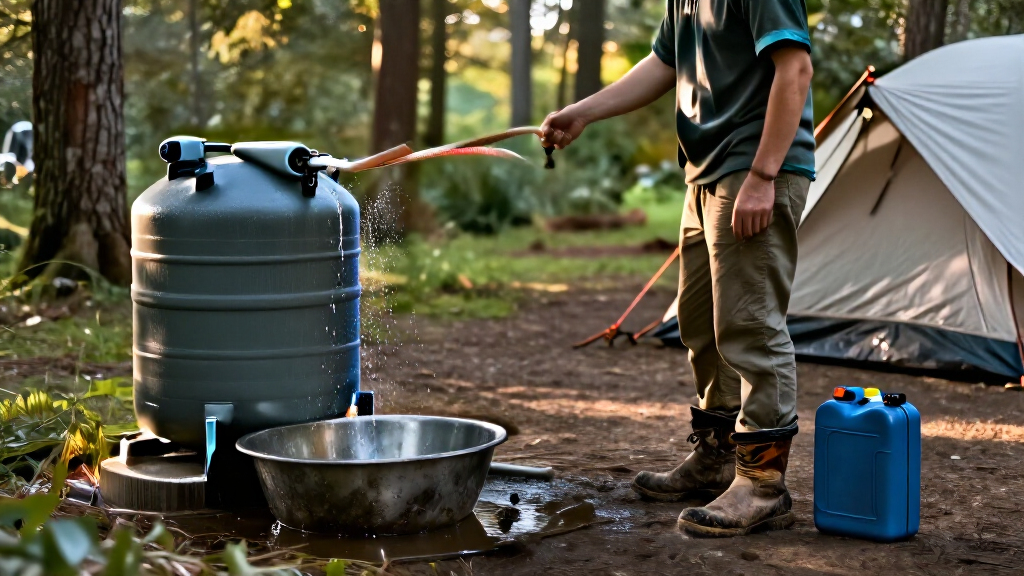
The best mobile grey water system for camps is the one that fits your capacity, route, and emptying method. A tote is compact and simple, a larger holding tank reduces emptying trips, and temporary plumbing can gather wastewater from several outlets into one managed location. Each setup asks you to trade portability for storage or installation effort.
| System type | Works well when | Watch for |
|---|---|---|
| Portable collection tank | A small camp has one sink or washing station and frequent access to disposal | Manual lifting, limited capacity, and secure inlet connections |
| Wheeled grey water tote | You can roll the tank along a firm, accessible route | Filled weight, wheel stability, and whether the drain fits the disposal point |
| Large holding tank | A group camp needs more capacity between service visits | Vehicle or pump access, level monitoring, and safe emptying arrangements |
| Temporary plumbed system | Several sinks need to drain to one central tank or authorized connection | Hose routing, secure fittings, blockages, and leak checks |
| Treatment and reuse system | A permitted reuse is planned and system performance meets local rules | Certification, maintenance, and limits on where treated water may go |
Consider a camp with a single dishwashing sink 30 metres from the disposal point. A wheeled tote may be handy if the route is smooth and short enough to move a full load safely. If the route crosses deep gravel or a steep slope, wheels may not solve the problem; a central holding tank serviced by an appropriate vehicle could be safer. The tradeoff is fewer manual trips in exchange for needing vehicle access and a reliable service arrangement.
Temporary plumbing can reduce the number of containers scattered around camp, but each hose and joint becomes part of the containment system. A central tank can simplify monitoring because one person can check one level, yet a blockage or failed joint may affect several wash stations at once. Secure lines away from footpaths, check them after setup, and plan how you will clear a blockage without opening a leaking connection. Treat capacity and route as a pair: a big tank is only useful if you can service it.
wheeled camping water disposal system
As an affiliate, we earn on qualifying purchases.
As an affiliate, we earn on qualifying purchases.
Compare replacement totes by the details that affect camp use
When you compare alternatives to a VINGLI Tote Tank listing, focus on capacity, material, wheels, handles, and connections, then confirm current specifications with the seller. The original 10-gallon/20-gallon product title does not match the supplied 6.6-gallon spec, so do not assume its title tells you the usable capacity. Product listings and availability can change.
| Option in the supplied specs | Capacity | Material | Transport details |
|---|---|---|---|
| VINGLI Tote Tank 10 Gal/20 Gal | 6.6 gallons | HDPE, plastic #2 | Wheels; integrated handle; listed weight 9.3 lb |
| VINGLI 10-Gallon Portable Wheeled Water Tank | 10.6 gallons | HDPE | Two large wheels; listed weight 9.3 lb |
| Portable RV Grey Water Tote Tank | 25 L / 6.6 gallons | Food-grade HDPE | Two large rolling wheels; listed weight 8 lb |
| RV Tote Grey Water Tank | 25 L / 6.6 gallons | HDPE, food-grade plastic | Large rolling wheels; collapsible handle; weight not specified |
| ZeHuoGe 24L Portable Water Tank | 24 L / 6.3 gallons | Food-grade HDPE | Wheels not specified; listed net weight 3.97 lb |
These entries are spec-match leads, not a guarantee that a particular listing is current, identical, or intended for your wastewater setup. The VINGLI wheeled 10-gallon option shares several listed characteristics with the older tote, while two 25-litre tote entries offer similar storage and rolling wheels. The ZeHuoGe listing is lighter on paper, but the supplied details do not specify wheels, so a full tank may be awkward to move. A few litres of capacity difference can also change how often you travel to disposal, so compare usable volume against your actual schedule rather than treating similar product names as equivalent.
Before ordering, ask whether the tank is designed for grey water, what the inlet and outlet dimensions are, whether a cap seals securely, and whether the listed capacity is usable volume. Also check the actual filled weight, included fittings, and replacement-part support. For instance, a 25-litre tank may match your storage plan, but a narrow drain connection can make emptying slow or incompatible with your approved disposal point. A small mismatch can turn a theoretically suitable tank into extra adapters, slower service, or an unreliable seal.
Food-grade material does not by itself prove that a container is appropriate for waste storage. Verify the manufacturer’s intended use and cleaning instructions. If a listing’s title, images, and specification table disagree, treat that as a reason to confirm details before basing your camp plan on it.
As an affiliate, we earn on qualifying purchases.
Size capacity around your group and emptying schedule
Choose capacity by multiplying your estimated daily grey water volume by the number of days between disposal trips, then adding room for normal variation. Your tank should not be planned to brim at the exact moment you expect to empty it. Busy dishwashing, an unexpected shower, or a delayed service run can change the day’s total.
Suppose a small camp estimates 18 litres of sink water a day and can reach an approved dump point each evening. A 25-litre tote might cover one day with some headroom, but it would not comfortably hold two full days. If the camp cannot empty it daily, it needs more capacity, less water use, or a different service arrangement. This makes the emptying schedule a design constraint: choosing a larger tank can reduce trips, but only if the crew can safely move or service the extra loaded weight.
For a group camp, use a simple worksheet rather than guessing from the tank label:
- List every drain source: sinks, showers, and wash stations.
- Estimate or measure daily flow: use a marked bucket or meter where practical.
- Multiply by the days between disposal trips: include the longest likely interval.
- Add a reserve: leave space for peak use, delays, or a measurement error.
- Check service capacity: confirm that your vehicle, pump, route, and disposal point can handle the chosen tank.
A modular approach can work well when demand changes. A camp might use one tote for a weekend crew and add a second sealed tank for a larger event, provided the connections and handling procedures stay manageable. More containers mean more caps, hoses, and cleaning tasks, so modular storage only helps when someone tracks each unit. Its advantage is that you can scale capacity without committing to one very large tank; its cost is the added inspection and coordination.
Capacity also interacts with weight. A 50-litre tank holds roughly 50 kilograms of water before the container weight. That may be a sensible buffer for a fixed holding location but a poor choice for a person expected to roll it over soft ground. Size the tank to the entire job, including how it will be emptied.
camp grey water disposal container
As an affiliate, we earn on qualifying purchases.
As an affiliate, we earn on qualifying purchases.
Keep the system sealed, stable, and easy to inspect
A reliable camp grey water system keeps wastewater inside the tank and hoses from the moment it leaves a drain until authorized disposal. Look for a sturdy tank, secure caps, compatible fittings, and a stable base. A leak can create slippery ground, unpleasant smells, and contact with wastewater around a busy camp kitchen. These details are linked: a strong tank body does little good if a loose inlet lets water escape whenever the hose shifts.
Think of the setup like a chain: the sink adapter, hose, tank inlet, tank body, cap, and drain all need to hold. One weak connection can undo the rest. For example, a hose that fits loosely may stay in place during a quiet afternoon but pull free when someone nudges it while carrying a crate past the sink. Checking the connection under actual flow before camp use can expose that weakness while there is still time to secure or replace it.
Place the tank on level ground where people will not trip over the hose. Keep the path to it visible and avoid routing hoses through tent doors or across a cooking area. If gravity carries water to the tank, check that the line slopes as intended and does not sag into a low pocket where residue can collect. Secure the fittings, then run a small amount of clean water through the line and inspect every joint before regular use. A poor slope can slow drainage and leave standing water, while an exposed route increases the chance of a trip or accidental disconnection.
Choose a drain you can operate without tipping a full tank or putting your hands near the discharge. A rotating spout or accessible outlet can make emptying easier, but verify that it connects to the hose or receiving fitting you actually use. A handle should feel secure under load, and wheels should roll over the surface at your camp. Large wheels that work on packed dirt may still struggle in sand, mud, or deep gravel. A feature is useful only if it reduces handling risk on your actual route.
Inspect the system at setup and at regular intervals during use. Look for damp spots, cracked caps, loose clamps, bulging sides, and hoses that have shifted. Write down who checks the system and what they do if it starts leaking; clear responsibility helps prevent a small drip from becoming a campsite cleanup.
Control smells with cleaning, airflow, and sensible handling
To control odour, keep the tank sealed between uses, clear food residue before it enters the drain, and clean the tank according to its manufacturer’s instructions. Grey water can contain grease, bits of food, soap, hair, and microorganisms. It may look like cloudy dishwater, but that does not make it safe to handle casually or leave open. Residue gives odour-causing material time to build up, so managing what enters the tank often works better than trying to cover the smell afterward.
Picture a sunny afternoon at a camp kitchen: a greasy frying pan gets rinsed straight into the sink, and the tank sits in warm air for several hours. By evening, that residue can smell stronger and make the area unpleasant. Scrape food into the correct rubbish or compost stream where local rules allow, and wipe excess grease into an appropriate waste container rather than washing it into the tank. This also reduces the chance that grease will coat fittings or contribute to a clog.
Use a screen or filter if the system’s design calls for one. A removable screen can catch hair and larger food particles before they clog a hose or spout, which makes cleaning easier. But basic filtration only removes some solids; it does not disinfect wastewater or make it safe for ground discharge, irrigation, or contact with people. That distinction matters because a clearer-looking tank can still contain contaminants and remain subject to the same disposal rules.
After emptying, rinse and clean the tank as directed, paying attention to the inlet, outlet, cap threads, and any removable screen. Let components dry as the manufacturer recommends before storage. Avoid mixing cleaning chemicals or improvising treatments, since some products can damage seals or create unsafe fumes. Keep cleaning supplies and gloves available at the service point so maintenance does not become an afterthought. Cleaning costs time, but skipping it can leave residue that makes the next setup harder and shortens the useful life of seals and fittings.
Heat can intensify smells, while cold can freeze water trapped in a tank or hose. In warm weather, shorten the time wastewater sits in storage and check the system more often. In freezing conditions, use a plan consistent with the product instructions and site rules; a cracked hose or tank can turn a contained system into a spill.
Find your approved disposal route before camp opens
Before connecting a sink, confirm where and how your camp may dispose of grey water. That could mean an approved sewer connection, a campground dump station, or another authorized route named by the site or local authority. Rules differ by location, land manager, and system, so never assume that pouring water onto the ground is allowed. Disposal access affects the equipment choice: a distant or restricted dump point can require more storage, transport support, or scheduled service.
Call the campground or land manager before arrival and ask about permitted discharge, operating hours, access for a vehicle, and any connection requirements. A site may permit a particular dump station but prohibit moving wastewater across certain paths or using an unapproved drain. If the disposal point is far away, that distance should shape your tank size and transport plan before you set up.
For example, a camp organizer may find that the dump station is open only during staffed hours and sits beyond a narrow gravel track. A 25-litre tote might be manageable in daylight on firm ground, but repeated trips after dark would add risk and disruption. The organizer could schedule a service window, reduce water use, or arrange a larger tank and approved pump service instead. Each option shifts the burden: water conservation reduces volume, while a larger tank reduces trip frequency but requires safe pump or vehicle access.
Grey water can carry soap, grease, food residue, and microorganisms. Releasing it into a stream, storm drain, or onto soil can harm the site or break local rules. Even when a system includes a filter, that filter does not automatically make discharge legal or environmentally safe. Reuse, such as subsurface irrigation, depends on treatment performance and local permission.
Write down the disposal location, contact person, route, and backup plan. Tell the people using the wash station what belongs in the sink and who to call if the tank nears capacity. A clear plan turns disposal into a routine task instead of a hurried decision when the tank is already full.
Match the system to your site, weather, and crew
The right system must fit the ground, weather, vehicle access, and available staff, not just the number printed on its label. Uneven campsites can make a tank unstable, and soft sand can stop small wheels from rolling. Cold can freeze trapped water; heat can make odours stronger and increase the need for frequent checks. Site conditions determine whether portability is a real benefit or simply another feature that will not work on the route.
Imagine a volunteer team setting up a wash station on a sloped field. A wheeled tote might look convenient on a product page, but it could roll when left unsecured, while the hose drains poorly if the tank sits too high. A level, stable placement and a marked path matter as much as the wheel count. If the surface is rough, a tank that stays in one accessible location with a planned pump-out may be safer. That arrangement trades frequent manual movement for a need to coordinate service access.
Staffing changes the answer too. A small family can assign one adult to inspect the tank after meals, while a camp of 40 needs a named operator and a written check schedule. Make sure the person responsible can lift, roll, or operate the equipment safely. Progressive loading helps when a new crew is learning a system: start with low flow, check for leaks, and add normal use once the fittings and route behave as expected. This catches setup problems before the tank is full and difficult to reposition.
For outdoor activities, place the tank away from fire, food preparation, and sleeping areas while keeping it reachable for service. Mark hoses that cross shared space, and protect them from vehicles and foot traffic. If freezing nights are expected, drain or protect components according to the manufacturer’s directions and local site requirements. Do not rely on a warm daytime forecast to protect water left in a low hose overnight.
More features can help, but they add tasks. A level indicator may make monitoring easier; a pump can reduce manual handling; modular tanks can expand capacity. Each still needs inspection, cleaning, power or service planning, and an approved destination for the wastewater. Choose features that address a specific site problem, since unused complexity still takes time to maintain.
Use this pre-purchase checklist to avoid a poor fit
Before choosing the best mobile grey water system for camps, check the whole route from drain to disposal, not just the container’s size. A tank can have the right capacity and still fail your setup if its inlet, drain, wheel design, or emptying method does not match the site. Confirm the written specifications and instructions for the exact model you plan to use; each mismatch can add labour, delay, or a leak risk after camp begins.
- Wastewater use: Is the tank intended for grey water, and does the manufacturer describe suitable cleaning?
- Usable capacity: Is the listed volume clear, and does it leave practical headroom for your schedule?
- Filled weight: Can your crew move the tank safely when full?
- Transport: Do the wheels, handle, and tank shape suit your terrain and route?
- Connections: Do the inlet, cap, outlet, and drain fit your hose and approved disposal point?
- Maintenance: Can you inspect, rinse, and dry the tank without awkward handling?
- Support: Are instructions, replacement seals, and fittings available for the current product?
Suppose two options both list about 25 litres. One includes a collapsible handle and rolling wheels, while the other gives no wheel details. If your disposal point lies 100 metres away across packed gravel, the handling information may matter more than a small difference in empty weight. If a pump or vehicle will do the moving, portability may matter less than accessible fittings and easy cleaning. The checklist helps rank features by the work your camp actually has to do.
Ask the seller about inconsistencies between the title and specification table. The supplied VINGLI Tote Tank entry, for instance, has a title mentioning 10 and 20 gallons but a capacity listed as 6.6 gallons. That mismatch is a practical reason to verify the exact model and capacity rather than infer it from marketing text. Choosing based on the title could leave too little capacity and force unplanned trips or a second purchase.
Finally, count operating costs beyond purchase: cleaning supplies, replacement parts, staff time, transport, and disposal charges. No price or single feature can identify the right choice for every camp. A system that is easy to inspect and empty can save work throughout a season, especially when several people share responsibility.
Make a simple operating plan for every camp day
A mobile system stays manageable when you set a check-and-empty routine before wastewater starts flowing. Assign one person to inspect the level, verify connections, and record emptying. For a short family camp, a check after dinner may be enough; a busy group kitchen or shower area may need several checks throughout the day. The schedule should follow the rate of use, because a check interval that suits a quiet camp can be too long during a busy event.
Use a visible mark or a level indicator if the tank supports one, and agree on a threshold that triggers an emptying trip before the tank is full. Do not wait for wastewater to back up into a sink. If the tank has no gauge, estimate use from measured daily flow and inspect at predictable intervals. A small clipboard near the wash station can track time, approximate level, leaks, and service trips. Records reveal whether your original volume estimate was realistic and help you adjust staffing or capacity for the next day.
Consider a Saturday camp with 12 participants. The kitchen lead checks the tank after breakfast and lunch, while the site operator confirms the disposal route is open before the evening trip. When the level rises faster than expected after a muddy hike, the crew can reduce nonessential water use and schedule an earlier emptying run. That is easier than discovering a full tank during dish cleanup. A named backup operator also matters if the primary person is unavailable.
Give campers a few plain instructions: scrape food into the proper waste bin, keep wipes and solids out of the sink, report drips, and do not disconnect hoses. Post the instructions where people wash dishes, using a short list rather than a dense warning sheet. Good habits at the source reduce clogs, smells, and cleaning work later.
At the end of the stay, confirm the tank is emptied at an authorized point, clean it according to its instructions, inspect seals and hoses, and store it dry as directed. Record any cracks, loose fittings, or problems while they are fresh. That small record helps you spot recurring issues and choose better replacement parts before the next camp.
Frequently Asked Questions
What counts as grey water at a camp?
Grey water is wastewater from sources such as sinks, showers, and washing areas. It is separate from toilet waste, which is generally classed as black water and needs separate handling. Sink water can still contain grease, food particles, soap, and microorganisms.
How much grey water will a camp produce per person each day?
There is no single reliable amount for every camp because showers, dishwashing habits, and water-saving practices vary. Measure a typical day where possible by tracking how much water flows through each drain, then use that figure for your group and schedule. If you cannot measure, plan conservatively and leave capacity for busy periods.
Can I pour camp grey water onto the ground?
Only if the land manager or local rules explicitly allow that method and your system meets any stated conditions. Discharge onto soil, into a storm drain, or into a waterway may be prohibited and can harm the site. Ask the campground or relevant authority for an approved disposal route before camp begins.
Do I need a filter or treatment unit?
A screen can catch hair and larger food particles, helping reduce clogs and making cleaning easier. Basic filtration does not disinfect grey water or automatically make it safe for discharge or reuse. Treatment needs depend on the intended use, system certification, and local requirements.
Can I use an ordinary water container for grey water?
Use a container that the manufacturer says is suitable for wastewater and that can seal securely, withstand handling, and be cleaned as directed. A container marketed for potable water is not automatically the right choice for waste storage. Check its intended use, fittings, and cleaning instructions before connecting it to a camp drain.
How often should I empty a mobile grey water tank?
Empty it before it reaches capacity, using your measured daily volume and the permitted disposal schedule to set checks. A small camp may empty a tote each day, while a group site with a larger holding tank may use planned service intervals. Inspect more often when use increases, weather is hot, or disposal access is limited.
Conclusion
Choose your system by tracing the whole job: where wastewater leaves the sink, how much collects, who moves it, and where it can legally go. A compact wheeled tote can serve a small camp with a short, firm route and frequent disposal; larger groups may need a holding tank or temporary plumbing. Match capacity to measured use, and confirm current product details before buying.
Then give one person responsibility for checks and cleaning. A sealed tank, a clear route, and an approved disposal point keep the wash station calm—so the only water running through camp is the water you meant to use.
Halloween Picks
halloween
As an affiliate, we earn on qualifying purchases.