Water purification tablets vary most in treatment chemistry, dose instructions, and how well they fit a travel or emergency kit. My best overall pick is Aquatabs 49 mg, 100 Count for its familiar tablet format and larger pack size; Potable Aqua is a compact alternative, while the Chlorine Dioxide Water Treatment Kit suits buyers seeking a different treatment approach. The main tradeoffs are pack size, treatment time, water volume per dose, taste, and whether the product addresses the contaminants you may encounter. Several listings share similar names or tablet counts, so checking the exact formulation and label directions matters more than choosing by name alone. Read on for the full comparison and guidance on matching a treatment to your water source.

Get emergency and outdoor gear delivered free with Prime
- Fast, free delivery on millions of items
- Prime Video, Amazon Music and more included
- Member-only deals all year
Key Takeaways
- Aquatabs 49 mg, 100 Count leads the tablet options for buyers who want a larger pack, while the 50-count version favors a smaller kit; neither pack size alone tells you how much water each tablet treats.
- The lineup includes tablets labeled at 49 mg, 397 mg, and 500 mg; these figures should not be treated as directly comparable doses without checking active ingredient, intended water volume, and package instructions.
- Several entries repeat Oreno AquaDose or generic 500 mg tablet descriptions, making label verification and seller-specific packaging details important before purchase.
- Chlorine dioxide treatment offers a different treatment format from the listed tablets, while the LifeStraw Go bottle is a filter-based option rather than a chemical tablet.
- The strongest choice depends on the water source and use case: a travel pack, emergency storage, and cloudy backcountry water can call for different treatment steps and backup plans.
| Portable Water Purification Tablets, 500 mg, 100 Count |  | Best Compact Emergency-Kit Pick | Brand: Oreno AQUADOSE | Tablet count: 100 | Weight per tablet: 500 mg | VIEW LATEST PRICE | See Our Full Breakdown |
| Aquatabs 49 mg Water Purification Tablets, 100 Count | 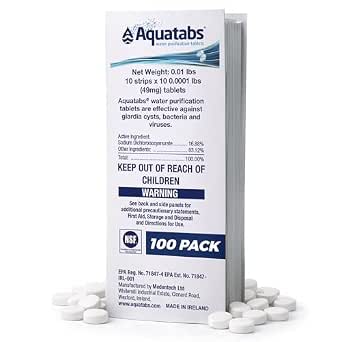 | Best for Lightweight Travel | Brand: Aquatabs | Tablet strength: 49 mg | Quantity: 100 tablets | VIEW LATEST PRICE | See Our Full Breakdown |
| Oreno AQUADOSE Water Purification Tablets, 100 Tablets, 500 mg Each |  | Best for Label-Directed Outdoor Use | Brand: Oreno AQUADOSE | Quantity: 100 tablets | Tablet strength: 500 mg each | VIEW LATEST PRICE | See Our Full Breakdown |
| SHOU MENG Water Purification Tablets, 397 mg, 100 Count |  | Best High-Capacity Bottle | Brand: SHOU MENG | Tablet strength: 397 mg | Quantity: 100 tablets | VIEW LATEST PRICE | See Our Full Breakdown |
| Aquatabs Water Purification Tablets, 397 mg, 100 Pack |  | Best for Treating Larger Batches | Brand: Aquatabs | Tablet strength: 397 mg | Quantity: 100 tablets | VIEW LATEST PRICE | See Our Full Breakdown |
| 500 mg NaDCC Water Purification Tablets, 100 Count |  | Best Iodine-Free Option | Active ingredient: Sodium Dichloroisocyanurate (NaDCC) | Tablet strength: 500 mg | Count: 100 tablets | VIEW LATEST PRICE | See Our Full Breakdown |
| Potable Aqua Water Purification Tablets, 50 Count | 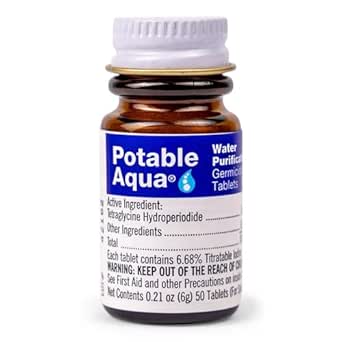 | Best for Familiar, Specified Treatment | Active ingredient: 20 mg tetraglycine hydroperiodide (TGHP) per tablet | Quantity: 50 tablets | Water capacity: Up to 25 quarts | VIEW LATEST PRICE | See Our Full Breakdown |
| Oreno AquaDose Water Purification Tablets, 100 Count |  | Best for Simple, No-Power Treatment | Count: 100 tablets | Treatment capacity: Up to 4 gallons per tablet | Listed capacity: 1 gallon | VIEW LATEST PRICE | See Our Full Breakdown |
| Portable Water Purification Tablets, 100 Count, 500 mg Each |  | Best for Label-Led Emergency Storage | Brand: Halpilt | Purification method: Chemical water treatment | Tablet count: 100 | VIEW LATEST PRICE | See Our Full Breakdown |
| Chlorine Dioxide Water Treatment Kit |  | Best for Long-Term Emergency Supply | Brand: 1NESS PRODUCTS | Material: Chlorine dioxide | Purification method: Oxidation reduction potential | VIEW LATEST PRICE | See Our Full Breakdown |
| Aquatabs 49 mg Water Purification Tablets, 50 Count |  | Best for Lightweight Emergency Kits | Tablet strength: 49 mg | Count: 50 tablets | Water treated per tablet: 0.75–2 liters | VIEW LATEST PRICE | See Our Full Breakdown |
| Oreno AquaDose Water Purification Tablets, 100 Count |  | Best for High-Volume Batch Treatment | Brand: SCEZROB | Purification method: Chemical water treatment | Treatment capacity: Up to 4 gallons per tablet | VIEW LATEST PRICE | See Our Full Breakdown |
| LifeStraw Go Series BPA-Free Water Filter Bottle, 22 oz, Kyoto Orange |  | Best Tablet Alternative for Everyday Travel | Capacity: 650 ml (22 oz) | Filtration method: Two-stage membrane microfilter and carbon filter | Contaminants reduced: Bacteria, parasites, microplastics, chlorine, odors, organic chemical matter, sand, dirt, silt, and cloudiness | VIEW LATEST PRICE | See Our Full Breakdown |
| water purification tablet | Brand | Purification method |
|---|---|---|
| Portable Water Purification Ta | Oreno AQUADOSE | Not specified |
| Aquatabs 49 mg Water Purificat | Aquatabs | — |
| Oreno AQUADOSE Water Purificat | Oreno AQUADOSE | Listed as 1 |
| SHOU MENG Water Purification T | SHOU MENG | Oxidation Reduction Potential |
| Aquatabs Water Purification Ta | Aquatabs | — |
| 500 mg NaDCC Water Purificatio | Fastimals | NaDCC |
| Potable Aqua Water Purificatio | — | Iodine |
| Oreno AquaDose Water Purificat | SCEZROB | Chemical water treatment |
| Portable Water Purification Ta | Halpilt | Chemical water treatment |
| Chlorine Dioxide Water Treatme | 1NESS PRODUCTS | Oxidation reduction potential |
| Aquatabs 49 mg Water Purificat | — | — |
| Oreno AquaDose Water Purificat | SCEZROB | Chemical water treatment |
| LifeStraw Go Series BPA-Free W | — | — |
More Details on Our Top Picks
Portable Water Purification Tablets, 500 mg, 100 Count
The Oreno AQUADOSE 100-count bottle is a straightforward choice for buyers who want a small, power-free backup for suitable freshwater. Its compact listed dimensions and one-ounce container make it easier to tuck into a backpack or emergency kit than a bulkier treatment setup. Unlike the Aquatabs 49 mg tablets, the product information here does not specify water volume per tablet, treatment time, or a purification method, so I would not choose it when a clearly stated treatment protocol is a priority. The tradeoff is that buyers must rely on the label for dosage and waiting time, and the stated use is limited to suitable freshwater. It makes most sense as a portable backup when you can follow the product directions carefully.
Pros:- Compact one-ounce bottle is suited to backpacks and emergency kits.
- Requires no batteries, charging, or electricity.
- Designed for camping, hiking, boating, RV travel, and emergency use.
Cons:- Dosage and treatment time are not specified in the supplied product details.
- Use is described for suitable freshwater only; other water types are not specified.
- No purification method or treatment capacity is listed.
Best for: Hikers and emergency-kit planners who want a compact, battery-free tablet bottle for suitable freshwater.
Not ideal for: Travelers who need published per-tablet treatment capacity or a stated wait time before packing their water-treatment supplies.
- Brand:Oreno AQUADOSE
- Tablet count:100
- Weight per tablet:500 mg
- Container type:Bottle
- Container capacity:1 ounce
- Dimensions:1 × 1 × 1 in
- Purification method:Not specified
- Part number:RA001
Our verdict“Choose this compact Oreno AQUADOSE bottle as a power-free freshwater backup if you are comfortable following the label for dosage and treatment time.”
Aquatabs 49 mg Water Purification Tablets, 100 Count
For packers who value clear treatment directions and minimal carry weight, these Aquatabs are the most clearly specified option in this group. Each individually foil-wrapped tablet treats 0.75–2 liters, with a stated 30-minute wait; the supplied claims also cover bacteria, viruses, and Giardia cysts. That makes the protocol easier to plan around than the Oreno AQUADOSE bottles, whose supplied details leave dosage and timing to the label. The foil wrapping and stated shelf-life information also suit a travel or emergency reserve. The tradeoff is the wait, plus the possibility that sediment-heavy water needs separate filtration. Compared with the 397 mg Aquatabs, these tablets treat a smaller stated volume per tablet, so they suit personal-use quantities better than larger batches.
Pros:- Individually foil-wrapped tablets are convenient for portioning and storage.
- Stated treatment capacity is 0.75–2 liters per tablet.
- Specifies a 30-minute treatment time.
- Describes treated water as having no unpleasant taste, color, or odor.
Cons:- Requires a 30-minute wait after treatment.
- Sediment-heavy water may need a separate filtration step.
- Lower stated volume per tablet than the 397 mg Aquatabs option.
Best for: Backpackers and travelers who want individually wrapped tablets with a stated treatment volume and wait time.
Not ideal for: Groups treating large volumes quickly, or anyone relying on tablets alone for sediment-heavy water.
- Brand:Aquatabs
- Tablet strength:49 mg
- Quantity:100 tablets
- Water treated per tablet:0.75–2 liters
- Treatment time:30 minutes
- Packaging:Individually sealed foil strips
- Product shelf life:900 days
- Stated expiration date:September 2031
- Manufacturer:Medentech
Our verdict“Pick these Aquatabs for lightweight travel when individually wrapped doses and clearly stated treatment directions matter more than treating several gallons at once.”
Oreno AQUADOSE Water Purification Tablets, 100 Tablets, 500 mg Each
This Oreno AQUADOSE bottle is aimed at the same basic use as the Portable Water Purification Tablets, 500 mg, 100 Count: carrying a compact, power-free treatment option for suitable freshwater on trips or in an emergency kit. Its listed 100-tablet count and one-ounce bottle keep the format simple, while the supplied details specifically direct buyers to follow the label for dosage and treatment time and to store the bottle sealed in a dry place. That storage instruction gives this listing a little more practical guidance than the other Oreno entry, but neither listing supplies a clear per-tablet water capacity or wait time. Compared with the Aquatabs 49 mg, it offers less published treatment information. I would choose it only when label directions are available and easy to follow.
Pros:- 100-tablet bottle is compact for travel and emergency storage.
- Does not require electricity, charging, or batteries.
- Directions include sealed, dry storage guidance.
- Designed for camping, hiking, boating, travel, and RV use.
Cons:- Dosage and treatment time depend on the product label.
- No per-tablet water capacity is provided in the supplied details.
- Intended for suitable freshwater; other water types are not specified.
Best for: Campers and RV travelers who want a small bottle for suitable freshwater and can consult the full label before use.
Not ideal for: Buyers who need treatment capacity, method, or wait time stated up front, or who want detailed performance claims.
- Brand:Oreno AQUADOSE
- Quantity:100 tablets
- Tablet strength:500 mg each
- Container:Bottle
- Container capacity:1 ounce
- Dimensions:1 × 1 × 1 inch
- Purification method:Listed as 1
- Part number:RMD001
Our verdict“Choose this Oreno AQUADOSE listing for compact outdoor backup use only if you can check its label for the complete treatment instructions.”
SHOU MENG Water Purification Tablets, 397 mg, 100 Count
The SHOU MENG bottle stands out on stated batch capacity: each tablet is described as treating up to four gallons of suitable freshwater, for up to 400 gallons across the 100-count bottle under specified conditions. That makes it more suited to group supplies or a home emergency kit than the Aquatabs 49 mg, which treats a much smaller stated volume per tablet. Its premeasured format also avoids carrying powered equipment. The tradeoff is that the supplied information does not give a specific treatment time, so buyers must follow the label and wait the full recommended period. The listed oxidation-reduction-potential method is another point to verify against the label rather than assume it covers every water source. I would skip it if precise, independently clear directions are unavailable.
Pros:- States up to four gallons of treatment capacity per tablet under specified conditions.
- 100 tablets provide a stated maximum capacity of up to 400 gallons.
- Premeasured tablets need no electricity or bulky equipment.
- Includes a carrying case.
Cons:- Full recommended treatment time must be followed, but no duration is supplied here.
- Treatment capacity is conditional and intended for suitable freshwater.
- Bottle format is less individually portioned than foil-wrapped Aquatabs.
Best for: Households and camping groups preparing to treat larger batches of suitable freshwater with a compact tablet supply.
Not ideal for: Solo travelers who prioritize individually wrapped doses, or buyers who need a stated treatment time and detailed directions in the product listing.
- Brand:SHOU MENG
- Tablet strength:397 mg
- Quantity:100 tablets
- Treatment capacity:Up to 4 gallons per tablet; up to 400 gallons per bottle under specified conditions
- Purification method:Oxidation Reduction Potential
- Container type:Bottle
- Included components:Carrying case
- Dimensions:1.92 × 1.92 × 3.93 in
Our verdict“Choose SHOU MENG for a larger stated freshwater-treatment capacity if you can confirm and follow the label’s full treatment directions.”
Aquatabs Water Purification Tablets, 397 mg, 100 Pack
These Aquatabs suit buyers who want a large stated treatment volume per tablet: the product says one tablet treats up to four gallons in 30 minutes. That combination of batch capacity and a specified wait time makes the directions more actionable than the SHOU MENG 397 mg listing, which gives a similar per-tablet capacity but no time in the supplied details. Aquatabs also provides stated bacteria, virus, and cyst reduction claims and describes treated water as free of bad taste, color, or odor. The tradeoff is practical: a tablet treats a whole batch, so it is less tailored to small personal bottles than the Aquatabs 49 mg. The bag is portable, but sediment may still call for a separate filter, and the stated expiration date is September 2029.
Pros:- Treats up to four gallons per tablet according to the product details.
- Specifies a 30-minute treatment time.
- Includes stated bacteria, virus, and cyst reduction claims.
- Described as leaving no bad taste, color, or odor.
Cons:- Sediment-heavy water may require a separate filter.
- Four-gallon treatment volume can be excessive for small personal quantities.
- Stated expiration date is September 2029.
Best for: Campers, RV users, and emergency planners who need to treat larger batches of suitable freshwater with a stated 30-minute wait.
Not ideal for: Solo hikers treating small drinking bottles, or anyone expecting tablets to remove sediment without a separate filter.
- Brand:Aquatabs
- Tablet strength:397 mg
- Quantity:100 tablets
- Treatment capacity:Up to 4 gallons
- Treatment time:30 minutes
- Claimed bacteria removal:99.9999%
- Claimed virus removal:99.99%
- Claimed cyst removal:99.9%
- Container type:Bag
Our verdict“Choose these Aquatabs when you need a stated four-gallon batch capacity and 30-minute treatment time, and have a separate plan for sediment.”
500 mg NaDCC Water Purification Tablets, 100 Count
Iodine-free treatment is the main reason I’d choose these NaDCC tablets over Potable Aqua, which uses iodine and treats up to 25 quarts per bottle. The Fastimals bottle holds 100 tablets and is designed for use across bottles, canteens, and larger water-storage containers, giving it flexibility for both outings and preparedness supplies. Its 30-minute wait is straightforward but still requires planning ahead, and dosage depends on water volume, so this is not a measure-and-forget option. The compact, one-ounce bottle is easier to stash than a larger kit such as the 1NESS chlorine dioxide system, though it does not provide that product’s on-demand preparation format. I’d pick this when avoiding iodine matters and the label’s dosing instructions suit the water container at hand.
Pros:- Iodine-free NaDCC formula is an alternative to iodine-based tablets.
- Compact one-ounce bottle is easy to carry and store.
- Designed for bottles, canteens, and larger water-storage containers.
Cons:- Requires a 30-minute treatment wait.
- Dosage varies with water volume, so label instructions must be followed carefully.
Best for: Hikers and emergency-kit planners who want an iodine-free tablet format for treating different water-container sizes.
Not ideal for: People who need treated water immediately or want a fixed, simple dose without checking water volume and label directions.
- Active ingredient:Sodium Dichloroisocyanurate (NaDCC)
- Tablet strength:500 mg
- Count:100 tablets
- Purification method:NaDCC
- Wait time:30 minutes
- Container:Bottle
- Container capacity:1 ounce
- Brand:Fastimals
Our verdict“Choose Fastimals if you want a compact, iodine-free tablet supply and can plan around its wait time and volume-based dosing.”
Potable Aqua Water Purification Tablets, 50 Count
Potable Aqua is the clearest pick here for buyers who want a named active ingredient, stated treatment capacity, and a specific pathogen claim: the iodine tablets are listed as effective against Giardia lamblia when used as directed. One bottle treats up to 25 quarts, while the 30–35-minute wait makes it a planned treatment rather than an instant solution. Compared with the 100-count Fastimals NaDCC tablets, this bottle has fewer tablets and uses iodine, but its water capacity and treatment timing are more explicitly stated in the product details. The formula is designed to neutralize iodine aftertaste and color, though buyers sensitive to iodine or its residual taste should look elsewhere. I’d reserve it for short-term outdoor or emergency use, consistent with the product’s stated limitation.
Pros:- One bottle is stated to treat up to 25 quarts.
- Product information specifies effectiveness against Giardia lamblia when used as directed.
- Designed to neutralize iodine aftertaste and color.
- Portable 1.4-ounce bottle suits outdoor and emergency kits.
Cons:- Treatment takes about 30–35 minutes.
- Intended for short-term or limited emergency use only.
- Iodine-based treatment may not suit buyers seeking an iodine-free option.
Best for: Campers and travelers who want a portable iodine tablet with stated capacity and Giardia effectiveness.
Not ideal for: People seeking routine long-term treatment, avoiding iodine, or unwilling to wait 30–35 minutes before drinking.
- Active ingredient:20 mg tetraglycine hydroperiodide (TGHP) per tablet
- Quantity:50 tablets
- Water capacity:Up to 25 quarts
- Purification method:Iodine
- Treatment time:30–35 minutes
- Effective against:Giardia lamblia when used as directed
- Maximum supported water TDS:1000 ppm
- Weight:1.4 oz
Our verdict“Choose Potable Aqua for a portable iodine option with stated Giardia effectiveness, but skip it for long-term use or if you want to avoid iodine.”
Oreno AquaDose Water Purification Tablets, 100 Count
Oreno AquaDose offers a simple chemical-treatment routine: add a tablet to suitable water, let it dissolve, then wait 30 minutes, with no boiling or electricity. That makes it a practical fit for camping and emergency kits where power is unavailable. Compared with Potable Aqua, whose listing specifies iodine and Giardia effectiveness, Oreno’s supplied details identify only chemical water treatment and do not name an active ingredient or a pathogen claim. Its stated capacity is also presented as up to 4 gallons per tablet, while the listed capacity field says 1 gallon; I’d check the product label rather than assume the larger figure applies to every use. The compact bottle is easy to pack, but this pick is less informative on treatment specifics than the alternatives with defined ingredients and capacities.
Pros:- No boiling or electricity is required.
- Compact bottle is suited to backpacks and emergency kits.
- Simple stated 30-minute treatment process.
- Designed for camping, travel, RV trips, and emergency preparedness.
Cons:- Requires a 30-minute wait before use.
- Product details do not specify an active ingredient or named pathogen effectiveness.
- Capacity information is inconsistent, listing up to 4 gallons per tablet and a 1-gallon listed capacity.
Best for: Campers and RV travelers who want a compact, no-electricity treatment option and are comfortable checking the label for water suitability and dosing.
Not ideal for: Buyers who need clearly specified active ingredients, pathogen claims, or an unambiguous treatment capacity before choosing a tablet.
- Count:100 tablets
- Treatment capacity:Up to 4 gallons per tablet
- Listed capacity:1 gallon
- Treatment time:30 minutes
- Purification method:Chemical water treatment
- Container type:Bottle
- Dimensions:1.8 × 1.8 × 3 inches
- Brand:SCEZROB
Our verdict“Choose Oreno for a portable, no-power routine only if the label confirms the dosage and water capacity you need.”
Portable Water Purification Tablets, 100 Count, 500 mg Each
Halpilt’s 100-tablet bottle is a basic, compact option for people building a camping or emergency kit, with no batteries or electricity needed. Its 500 mg tablet weight is stated, but the supplied details identify only chemical water treatment; they do not name the active ingredient, treatment time, or a specific pathogen target. That leaves more unanswered questions than with Potable Aqua, which specifies iodine, a 30–35-minute wait, and a Giardia claim. The stated capacity is 1 gallon, but buyers should follow the product label for the actual dosage and treatment instructions rather than infer a tablet-to-volume rate. Compared with Oreno AquaDose, Halpilt also has fewer treatment details in the listing. I’d treat it as a compact, label-dependent backup—not a choice for anyone who needs clearly documented treatment parameters before packing.
Pros:- 100 tablets in a bottle suited to backpacks, travel bags, and emergency kits.
- 500 mg tablet weight is specified.
- No batteries or electricity are required.
- Compact 2 × 2 × 5-inch format is easy to pack.
Cons:- Product details do not name the active ingredient or a specific pathogen target.
- Treatment time and dosing instructions are not specified in the supplied data.
- The stated 1-gallon capacity needs confirmation against the label’s dosage directions.
Best for: Preparedness planners who want a compact, power-free bottle and are willing to verify dosage and treatment details on the label.
Not ideal for: Travelers who need a stated treatment time, named active ingredient, or specific pathogen effectiveness before relying on a product.
- Brand:Halpilt
- Purification method:Chemical water treatment
- Tablet count:100
- Tablet weight:500 mg each
- Container type:Bottle
- Dimensions:2 × 2 × 5 inches
- Stated capacity:1 gallon
- Part number:001
Our verdict“Choose Halpilt only if its label provides the treatment details you need; otherwise, Potable Aqua is clearer about its method and timing.”
Chlorine Dioxide Water Treatment Kit
This is the lineup’s on-demand chlorine dioxide kit, not a conventional ready-to-use tablet bottle. It includes two amber glass bottles and two droppers, with citric activator used to prepare solution by hand. That format may appeal to people storing treatment supplies for emergencies, and the product states a maximum supported water TDS of 3000 ppm. Compared with Fastimals NaDCC tablets, it takes more preparation and is less convenient to dose on the move; in return, it is designed for long-term stability and lets users generate solution as needed. Each bottle holds only two fluid ounces, so it is a concentrated supply rather than a large water container. I’d choose it for planned preparedness storage, not for hikers seeking the lightest, simplest tablet-based treatment.
Pros:- Generates chlorine dioxide solution on demand.
- Includes two amber glass bottles and two glass droppers.
- Designed for long-term stability and emergency-supply storage.
- Maximum supported water TDS is listed as 3000 ppm.
Cons:- Requires hand-powered preparation with citric activator.
- Each bottle holds only 2 fluid ounces.
- Glass bottles and droppers are less convenient to carry than tablet bottles such as Fastimals.
Best for: Emergency-preparedness planners who want a hand-prepared chlorine dioxide solution stored in amber glass bottles.
Not ideal for: Backpackers who want ready-to-use tablets, quick dosing, or a compact kit without glass components and preparation steps.
- Brand:1NESS PRODUCTS
- Material:Chlorine dioxide
- Purification method:Oxidation reduction potential
- Activation:Citric activator
- Power source:Hand powered
- Bottle capacity:2 fluid ounces each
- Approximate drops per bottle:1150
- Maximum supported water TDS:3000 ppm
- Included components:2 amber glass bottles and 2 glass droppers
Our verdict“Choose this kit for stored, hand-prepared chlorine dioxide treatment, not for the convenience of ready-to-use tablets.”
Aquatabs 49 mg Water Purification Tablets, 50 Count
Individually foil-sealed tablets and a listed item weight of just 9.07 g make this a compact choice for hikers and emergency kits. Each tablet treats 0.75–2 liters, so it suits measured, smaller batches better than the Oreno AquaDose tablets, which are described as treating up to 4 gallons per tablet. The stated treatment claims cover bacteria, viruses, and Giardia cysts, while the product description says treated water has no unpleasant taste, color, or odor. That taste profile may be welcome when carrying treated water on a trip. The tradeoff is a 30-minute wait, and sediment-heavy water calls for a filter pairing. With 50 tablets, it also provides fewer doses than the 100-count Aquatabs option in this roundup.
Pros:- Individually foil-sealed packaging supports compact storage.
- Treats 0.75–2 liters per tablet, useful for measured personal or small-group batches.
- Product description says treated water has no unpleasant taste, color, or odor.
- Listed item weight is 9.07 g.
Cons:- Requires a 30-minute wait before drinking.
- The product recommends pairing with a filter for sediment-heavy water.
- The 50-tablet pack supplies fewer treatments than the 100-count Aquatabs option.
Best for: Hikers and emergency-kit planners who want individually wrapped tablets for treating small, measured water batches.
Not ideal for: Groups treating large volumes at once, or anyone who needs a tablet-only solution for visibly sediment-heavy water.
- Tablet strength:49 mg
- Count:50 tablets
- Water treated per tablet:0.75–2 liters
- Treatment time:30 minutes
- Packaging:Individually sealed foil strips
- Purification claims:99.9999% of bacteria, 99.99% of viruses, and 99.9% of Giardia cysts
- Item weight:9.07 g
- Expiration date:October 2027
Our verdict“Choose these Aquatabs for a compact kit and small-batch treatment, but pick a higher-capacity option if you routinely purify water for a group.”
Oreno AquaDose Water Purification Tablets, 100 Count
Up to 4 gallons per tablet is the defining advantage here: the stated capacity makes AquaDose better suited to treating a larger container than Aquatabs 49 mg, which treats 0.75–2 liters per tablet. The compact bottle and 100-tablet count also make it a practical candidate for a household emergency kit or outdoor group supplies. Treatment is straightforward—dissolve a tablet and wait 30 minutes—without boiling or electricity. The tradeoff is that the directions specify use with suitable water, and the supplied details do not describe individual tablet packaging or list contaminant-specific reduction claims. Unlike the LifeStraw Go bottle, this is a batch-treatment option rather than a reusable personal filtration bottle, so users need a separate clean container and must follow the product directions.
Pros:- Listed treatment capacity is up to 4 gallons per tablet.
- 100-tablet count suits emergency storage and repeated use.
- Compact 1.8 × 1.8 × 3-inch bottle is easy to store or pack.
- Treatment requires no boiling or electricity.
Cons:- Requires a 30-minute wait before the treated water is ready.
- Directions specify use with suitable water.
- Supplied product details do not identify individual tablet wrapping or contaminant-specific reduction claims.
Best for: Households and outdoor groups that want a compact stock of tablets for treating larger batches of suitable water.
Not ideal for: Solo travelers who want a ready-to-drink personal bottle, or buyers who need detailed contaminant claims in the supplied product information.
- Brand:SCEZROB
- Purification method:Chemical water treatment
- Treatment capacity:Up to 4 gallons per tablet
- Treatment time:30 minutes
- Unit count:100 tablets
- Container type:Bottle
- Dimensions:1.8 × 1.8 × 3 inches
- Number of items:3
Our verdict“Pick AquaDose for larger batch treatment and a compact 100-tablet supply, provided your water source fits the product directions.”
LifeStraw Go Series BPA-Free Water Filter Bottle, 22 oz, Kyoto Orange
This is not a purification tablet; it earns a place as a reusable filtration alternative for travelers who prefer to drink through a bottle rather than dissolve a treatment dose and wait. Its two-stage system pairs a membrane microfilter for bacteria, parasites, and microplastics with a carbon filter for chlorine, odors, and organic chemical matter. Compared with Aquatabs 49 mg, it offers filtration in a 650 ml bottle and adds taste-focused carbon treatment, but it does not provide the same batch-treatment format. The membrane is listed for up to 4,000 L, while the carbon filter lasts up to 100 L or about two months, creating an ongoing replacement task. Its 247 g weight and 500 ppm maximum supported TDS also make it less flexible than a simple tablet kit for some emergency uses.
Pros:- Two-stage filtration targets microbes, microplastics, chlorine, odors, and organic chemical matter.
- Membrane microfilter is listed for up to 4,000 L.
- 650 ml bottle provides a portable personal-drinking format.
- Bottle is made from 50% post-consumer recycled plastic.
Cons:- Carbon filter needs replacement after up to 100 L or about two months.
- The 247 g bottle is heavier and less compact than a tablet supply.
- Maximum supported water TDS is listed as 500 ppm.
Best for: Frequent travelers and daily commuters who want a personal bottle that filters water during drinking and also reduces taste-affecting substances.
Not ideal for: Campers who need to treat and store large batches, or emergency planners seeking lightweight tablets with no filter replacement schedule.
- Capacity:650 ml (22 oz)
- Filtration method:Two-stage membrane microfilter and carbon filter
- Contaminants reduced:Bacteria, parasites, microplastics, chlorine, odors, organic chemical matter, sand, dirt, silt, and cloudiness
- Membrane filter life:Up to 1,000 gal (4,000 L), about five years of daily use
- Carbon filter life:Up to 26 gal (100 L), about two months
- Material:Plastic; bottle made from 50% post-consumer recycled plastic
- Weight:247 g
- Maximum supported water TDS:500 ppm
Our verdict“Choose the LifeStraw Go for reusable personal filtration and taste improvement, not for tablet-style treatment of larger water batches.”
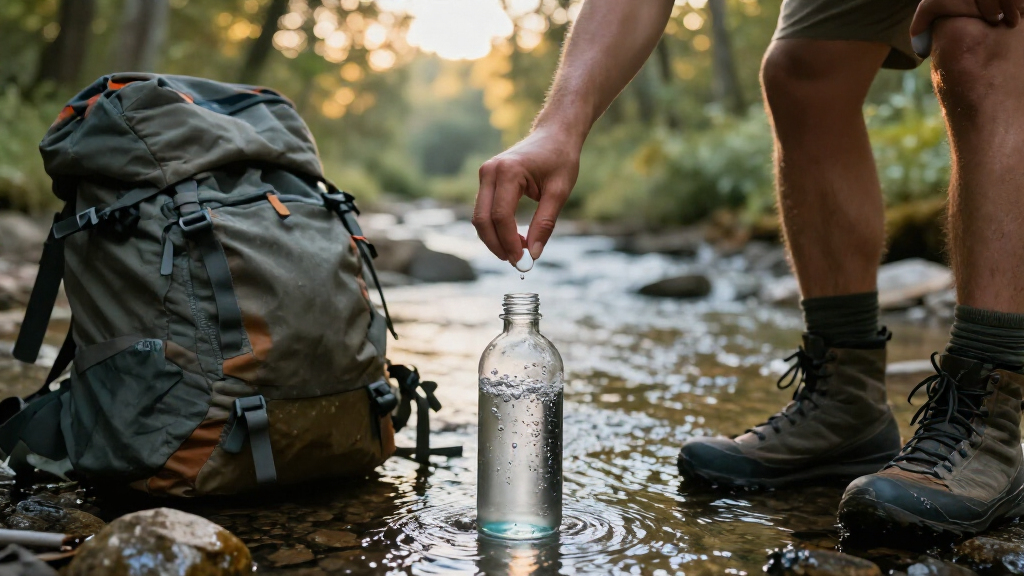
How We Picked
I compared the products by the information a buyer can use before purchase: treatment format, stated tablet strength, pack size, dose clarity, portability, and how easily each option fits travel or emergency storage. I also separated chemical tablets from the chlorine dioxide kit and the LifeStraw Go bottle, since they are not interchangeable formats and require different usage habits. Where product names or strengths repeat, I treated them as separate listings rather than assuming identical instructions or packaging.
The order favors options with a clear, practical role and recognizable format, then distinguishes smaller packs, less clearly specified listings, and non-tablet alternatives. A tablet’s milligram figure alone does not establish effectiveness or the amount of water treated, so I did not rank products on that number in isolation. Buyers should follow the exact label for dose, contact time, water temperature, and limitations, and use filtration or clarification when sediment is present.
| water purification tablet | Purification method |
|---|---|
| Portable Water Purification Ta | Not specified |
| Aquatabs 49 mg Water Purificat | — |
| Oreno AQUADOSE Water Purificat | Listed as 1 |
| SHOU MENG Water Purification T | Oxidation Reduction Potential |
| Aquatabs Water Purification Ta | — |
| 500 mg NaDCC Water Purificatio | NaDCC |
| Potable Aqua Water Purificatio | Iodine |
| Oreno AquaDose Water Purificat | Chemical water treatment |
| Portable Water Purification Ta | Chemical water treatment |
| Chlorine Dioxide Water Treatme | Oxidation reduction potential |
| Aquatabs 49 mg Water Purificat | — |
| Oreno AquaDose Water Purificat | Chemical water treatment |
| LifeStraw Go Series BPA-Free W | — |
Factors to Consider When Choosing Water Purification Tablets
Choosing a treatment starts with the water you expect to encounter, not the biggest count or strongest-sounding label. These broader checks can help prevent a mismatch between a product and the job you need it to do.
Match the treatment to the water source
Water from a treated municipal supply during an outage differs from water collected from a lake, stream, or unfamiliar tap. Read the label to learn which organisms and contaminants the product is intended to address, since no tablet should be assumed to handle every chemical, toxin, or particulate. Chemical purification is aimed at specific biological risks and does not remove sediment or improve every water-quality problem. If the source is visibly cloudy, let particles settle and filter the water through an appropriate prefilter before applying a chemical treatment. For uncertain or high-risk sources, use a treatment plan that follows public-health guidance rather than relying on a single product label. A small filter can complement tablets, but the two methods have different limits.
Read dose and contact-time directions as a pair
A tablet’s labeled strength is only useful when paired with its intended water volume and contact time. Do not infer that two products are equivalent because their milligram figures look close, or that a higher number automatically means a better treatment. Cold water, cloudy water, and certain organisms may call for different handling under the label instructions. Check whether the package gives directions in a form you can use under stress, such as a dose per liter or per container. Avoid splitting tablets unless the manufacturer explicitly allows it, because uneven portions can lead to inconsistent dosing. For emergency storage, keep a copy of the instructions with the tablets rather than relying on memory.
Choose pack size around rotation and use
A 100-count pack may suit a household kit or repeated trips, while a 50-count pack can be easier to stow in a small travel pouch. Tablet count does not equal treated-water capacity unless you know the dose per container and the number of doses needed for your situation. Check the expiration date and storage guidance, then plan to replace stock on schedule rather than buying more than you can maintain. Individual packaging can help protect tablets from moisture, but packaging details vary by listing and should be confirmed. Keep tablets sealed, dry, and separated from food or gear that could damage the package. For occasional travel, a smaller pack may be more practical than a large bottle left unused for years.
Account for taste and treatment routine
Some chemical treatments can leave a noticeable taste or odor, which can affect whether people will drink enough during a trip. Follow the label’s waiting period even when the water looks clear, and do not shorten the process to make a drink more convenient. If taste is a concern, look for manufacturer-approved steps for improving it rather than improvising with extra chemicals. A bottle filter can offer a different drinking routine, but it does not automatically replace chemical treatment for every source or risk. Think about who will use the water, including children or travelers sensitive to flavor, before choosing a method. A treatment that fits your routine is more likely to be used correctly.
Decide whether tablets need a backup
Tablets are lightweight and compact, but they do not remove suspended grit, and their limitations depend on the active ingredient and source. For backcountry use, pairing chemical treatment with a sediment prefilter can make the process more practical. For household emergencies, keep enough safe water stored where possible and treat tablets as one part of a wider plan. The LifeStraw Go bottle is a filter-based alternative in this roundup, not a chemical tablet, so compare its stated capabilities and maintenance needs separately. A chlorine dioxide kit also has its own instructions and preparation steps, which may be less convenient for someone who wants a simple single-tablet routine. A backup method is most useful when it covers a limitation of your primary option rather than duplicating it.
Frequently Asked Questions
Can I compare 49 mg, 397 mg, and 500 mg tablets by strength alone?
No. The number on the listing does not tell you the active ingredient, the volume of water treated, or the contact time by itself. Read the product label for its exact dose and intended use, and do not assume listings with similar names share directions. This matters especially in this roundup, where several products use different stated strengths and some names recur. Choose by verified label instructions and source compatibility rather than the largest number.
Should I choose a 50-count or 100-count pack?
Choose based on how often you expect to use the tablets and how you will store and rotate them. A 50-count pack can fit a small travel kit, while a 100-count pack may be more practical for repeated trips or a household reserve. Neither count tells you the total water capacity without the dose per container and any required repeat treatment. Check package sealing, expiration information, and storage requirements before buying. If you rarely use tablets, a smaller pack may reduce the chance of keeping unused stock past its recommended period.
Are water purification tablets enough for cloudy stream water?
Cloudy water can interfere with treatment and leaves particles that tablets do not remove. Follow the product label, and prefilter or allow the water to settle when needed before applying the chemical treatment. A cloth can catch larger debris but should not be treated as a purifier. The right approach depends on the product and source, so check its instructions for turbidity and contact-time guidance. For persistently dirty water, a suitable filtration step paired with a compatible treatment may be more practical than tablets alone.
Are the LifeStraw Go bottle and chlorine dioxide kit substitutes for tablets?
They are alternatives in format, not direct equivalents. The LifeStraw Go is a filter bottle with maintenance and source limitations described by its manufacturer, while the chlorine dioxide kit has its own treatment procedure. Tablets are usually chosen for compact storage and straightforward dosing, but they also have chemistry-specific limits and may affect taste. Compare each product’s stated treatment targets, preparation steps, and suitability for your water source. For uncertain water, avoid assuming that any single method covers every hazard.
What should I check when several listings have nearly identical names?
Compare the active ingredient, tablet strength, dose per water volume, contact time, package count, and expiration or storage information on the actual listing and package. In this roundup, Oreno AquaDose and generic 500 mg descriptions appear more than once, so a familiar name alone does not confirm identical contents. Verify that the instructions match your intended use and that the product is sold in the package format you expect. If the listing omits treatment details, contact the seller or choose an option with clearer labeling. Do not substitute directions from one product for another.
Conclusion
For a general-purpose tablet pick from this lineup, I would start with Aquatabs 49 mg, 100 Count because its larger pack suits buyers building a repeat-use kit, while still requiring careful label checks. For best value by pack size, compare the 100-count Aquatabs and other 100-count listings against the dose instructions and packaging rather than assuming counts indicate equivalent capacity. For beginners, Potable Aqua’s smaller pack is a manageable starting point if its label matches the intended water source and use. For a premium or different-format option, consider the chlorine dioxide kit only if you are comfortable following its preparation steps; for a bottle-based filter routine, evaluate the LifeStraw Go separately. Buyers facing sediment, unclear treatment targets, or emergency conditions should prioritize a verified label and an appropriate backup method over tablet count alone.
Black Friday Picks

Bose QuietComfort Headphones (2nd Gen), Wireless Noise-Cancelling Over-Ear Headphones, Black
As an affiliate, we earn on qualifying purchases.