
TL;DR
An Outdoor Life report published Nov. 10 describes an October bowhunt for caribou in Alaska’s Dalton Highway Corridor Management Area, where big-game hunting is restricted to archery. The hunters encountered large migrating herds, but snow, difficult road conditions and moving animals made getting within bow range a challenge.
Outdoor Life published a report Nov. 10 describing an October bowhunt for migrating caribou along Alaska’s Dalton Highway, where the corridor’s archery-only big-game rules do not make the hunt easy. The account describes wet snow, rough driving and fast-moving herds that repeatedly complicated attempts to get close enough for a shot.

Get emergency and outdoor gear delivered free with Prime
- Fast, free delivery on millions of items
- Prime Video, Amazon Music and more included
- Member-only deals all year
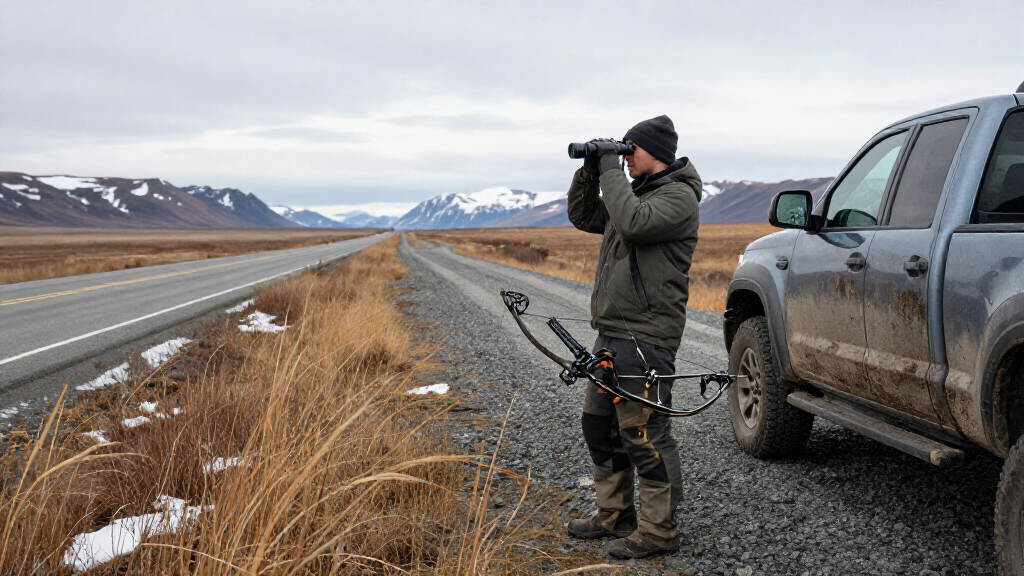
The hunters drove north with the report’s author’s father and videographer Tanner Denton, facing about 500 miles of travel and six inches of wet snow on the ground. The account describes potholes, frost heaves, rocks thrown up by passing trucks and muddy, silty road conditions. It says some rental-vehicle contracts prohibit travel on the highway and that travel guides recommend carrying two spare tires.
By sunset, the group saw more than 1,000 caribou spread across hillsides in the northern foothills of the Brooks Range. The report says the hunters planned to use terrain as cover and wait for animals to pass, rather than trying to pursue large herds across open tundra. Caribou moving at a feeding pace could outpace the hunters’ attempts to gain ground.
One stalk ended when the author climbed above a creek bank and saw about 100 caribou roughly 50 yards away. The animals saw the hunter as well, ending that approach. The group then had to look for another herd. The report’s account emphasizes that seeing numerous animals did not mean a bowhunter could reliably get into range.
Why Bowhunting Still Demands Patience
The report illustrates the gap between access to hunting country and a realistic opportunity to take an animal. The Dalton Highway opens access to extensive public land, and the corridor’s archery-only rules shape how big-game hunters can pursue animals there. But migrating caribou move across exposed terrain, while weather and road conditions can add logistical risks before a stalk even begins.
For readers considering a similar trip, the account is a reminder that large herds do not guarantee close shots. The hunters’ approach depended on reading movement and using ravines or other terrain for concealment. Conditions described in the report also make preparation for travel and cold-weather camping part of the hunt, not a minor detail.
Popular right now

Shark PowerDetect Robot Vacuum and Mop Combo with 60-Day Self-Emptying Base (AV2800ZE)

Ninja Foodi DZ201 8-Qt DualZone 6-in-1 Air Fryer

Ninja Double Oven Pro XL Countertop Oven and Air Fryer, 12-in-1, Onyx, DCT801BK
As an affiliate, we earn on qualifying purchases.
The Dalton Corridor’s Hunting Rules
The Dalton Highway, also called the Haul Road, was built in 1974 to support construction of the Trans-Alaska Pipeline and service oil fields near Prudhoe Bay. The report says the 414-mile road opened to the public in 1980 and still serves pipeline and oil-field operations while providing access to public land.
The Dalton Highway Corridor Management Area extends five miles on either side of the road for about 370 miles, from the Yukon River north to Prudhoe Bay. The report says big-game hunting in that area is restricted to archery. It identifies the caribou as part of the Central Arctic Herd, whose migration means hunters must find the animals where they are at a given time.
““This is going to be a long drive.””
— The report’s author
Hunt Outcome and Conditions Ahead
The supplied report excerpt does not establish whether the author or companions ultimately harvested a caribou, or how the hunt concluded. It also does not provide specific harvest figures, current herd estimates or official road-condition data. The account describes conditions during one early-October trip; it does not establish that the same weather or animal movements apply across the season.
The report’s description of archery-only big-game rules is specific to the corridor it discusses. Readers should not assume that the same rules, season dates or other requirements apply elsewhere or remain unchanged. The source material does not provide current regulation details or agency guidance.
Check Rules Before Traveling
The report does not announce a further development or a scheduled next milestone. Anyone planning a hunt should check current Alaska hunting regulations and road information with the relevant authorities before setting out, since conditions and requirements can vary. The account’s practical next step for hunters is preparation: plan for a remote drive, snow and mud, and the possibility that caribou movements will not align with a day’s plans.
For the reported hunt itself, the supplied excerpt leaves the outcome open. It records a blown stalk and the search for another group, but does not say what happened after that.
Key Questions
What happened in the report?
Outdoor Life published an account of an October bowhunt for migrating caribou along Alaska’s Dalton Highway. It describes rough travel, large herds and difficult stalking conditions.
Where did the hunt take place?
The report describes hunting in the Dalton Highway Corridor Management Area, a zone extending five miles on either side of the highway for about 370 miles between the Yukon River and Prudhoe Bay.
Why was the hunt difficult despite the large herds?
The animals were moving across open tundra, often in large groups. The hunters said they needed terrain for concealment and could not easily keep pace with herds that were feeding and moving.
Does the report say whether a caribou was harvested?
Not in the supplied excerpt. It describes a stalk that failed after the animals spotted the author, then says the group had to look for another herd.
What should hunters check before traveling?
Hunters should consult current Alaska regulations and official road information before a trip. The report describes conditions during one October journey and does not provide current rules or road updates.
Source: outdoorlife.com