AI and robotics are transforming rescue missions by helping you reach stranded hikers faster and safer. Drones can navigate tough terrains, deliver supplies, and provide real-time video to assess the situation. Robotic medical assistants offer immediate care in hazardous areas. These technologies extend rescue capabilities, reduce risks, and improve response times. By integrating AI and robotics, rescue efforts become more effective—keeping you one step ahead in emergencies. Stay with us to discover how these innovations continue to evolve.
Key Takeaways
- Drones can quickly reach inaccessible hiking areas, delivering supplies and providing real-time video for remote assessment.
- Robotic medical assistants can offer on-the-spot care to injured hikers in hazardous environments.
- AI-powered rescue systems enable faster response, improving survival chances for stranded hikers.
- Autonomous drones reduce rescue times by bypassing obstacles and navigating difficult terrain efficiently.
- Integration of AI and robotics enhances coordination and decision-making during complex rescue operations.
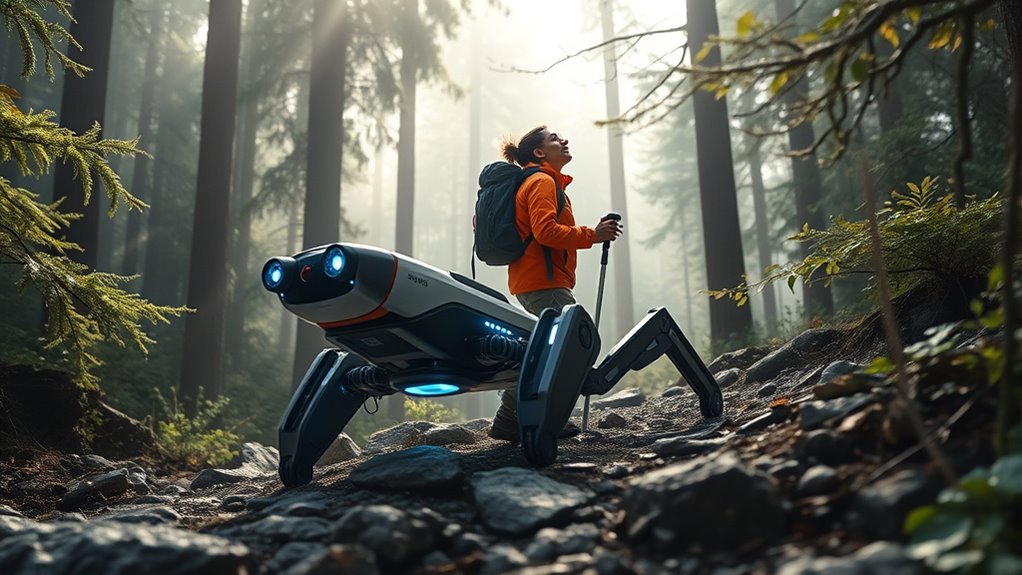
When emergencies strike, robots are increasingly stepping in to save lives and assist rescue teams. Imagine yourself lost in a remote, rugged area, injured or unable to reach help on your own. That’s where modern technology, like drones for delivery and robotic medical assistants, can make a real difference. These advanced tools are transforming rescue operations, ensuring that help arrives faster and more efficiently than ever before.
Drones for delivery are a game-changer in rescue scenarios. They can swiftly navigate difficult terrain, flying over obstacles and reaching stranded hikers in record time. With their ability to carry supplies such as water, food, or first aid kits, drones can deliver essential items directly to your location. This immediate aid can stabilize your condition until human rescue teams arrive. Because drones are autonomous and equipped with GPS, they can operate in environments where traditional vehicles can’t go, reducing the time it takes to get critical supplies to someone in need. Their real-time video feeds also enable rescue coordinators to assess the situation remotely, helping them plan the best way to extract you safely.
Alongside drones, robotic medical assistants play a pivotal role. These robots can be dispatched to provide on-the-spot medical care, especially when human responders face difficult terrain or hazardous conditions. Equipped with sensors and diagnostic tools, robotic medical assistants can evaluate your injuries, administer basic treatments, and even communicate with emergency personnel. If you’re unable to move or speak clearly, these robots can relay essential information to rescuers, expediting the rescue process. Their presence means you don’t have to wait for a full medical team to arrive before receiving some level of aid, which can be crucial in life-threatening situations.
Additionally, integrating sauna and cold plunge systems into rescue operations can help in cooling and stabilizing injured individuals, especially in extreme environments. Together, drones for delivery and robotic medical assistants exemplify how AI and robotics are reshaping rescue missions. They extend the reach of emergency services into areas that were once inaccessible or too dangerous for humans alone. As these technologies continue to evolve, they’ll become even more efficient, intelligent, and capable of handling complex rescue scenarios. For stranded hikers like yourself, this means a safer, quicker response, with assistance arriving before conditions worsen. With robots increasingly part of rescue efforts, your chances of survival and recovery improve markedly. It’s a promising step toward a future where technology and human effort combine to save lives in ways previously unimaginable.

FIRE / RESCUE DRONE MISSION LOGBOOK: PUBLIC SAFETY UAS OPERATIONS / FIRE · RESCUE · EMERGENCY MANAGEMENT
As an affiliate, we earn on qualifying purchases.
As an affiliate, we earn on qualifying purchases.
Frequently Asked Questions
How Do Rescue Robots Navigate Complex Terrains?
You’ll find that rescue robots navigate complex terrains using advanced terrain mapping and obstacle avoidance. They analyze their surroundings in real-time, creating detailed 3D maps to plan safe routes. With sensors and AI algorithms, they detect and bypass obstacles like rocks, trees, or uneven surfaces. This combination allows them to move efficiently and safely through challenging environments, ensuring they can reach stranded hikers quickly and accurately.
What Are the Limitations of Current Rescue Robots?
You should know current rescue robots face limitations like ethical concerns around decision-making and ensuring they follow robot ethics. Additionally, you need to take into account robot maintenance, as frequent repairs can hinder their efficiency and response times. These issues mean robots can still struggle with unpredictable terrain and complex rescue scenarios, highlighting that while helpful, they’re not yet fully reliable or autonomous in every rescue situation.
How Do Robots Communicate With Stranded Hikers?
Robots communicate with stranded hikers through advanced communication systems that translate robot language into understandable messages. While robots use digital signals and sensors, they often rely on audio or visual cues to connect with you. This juxtaposition of high-tech language and simple, human-friendly communication guarantees you receive clear instructions or reassurance. By bridging this gap, robots can effectively assist and guide hikers, even in the most challenging environments.
What Safety Protocols Are in Place for Rescue Robots?
You should know that safety protocols for rescue robots include strict robot deployment protocols to guarantee safe operation. Ethical considerations guide decision-making, preventing harm to hikers and prioritizing their privacy. These protocols involve thorough testing, real-time monitoring, and emergency shutdown procedures. By following these guidelines, you can trust that rescue robots are deployed responsibly, minimizing risks and maximizing safety during rescue missions.
Can Robots Operate in Extreme Weather Conditions?
Can robots operate in extreme weather conditions? Yes, they can, but it’s a delicate dance between weather adaptation and robotic ethics. Like a swimmer fighting waves, engineers design resilient systems to withstand harsh environments. Advanced materials and sensors help robots adapt, yet ethical considerations guarantee safety and environmental impact are prioritized. So, while they’re becoming more capable, responsible innovation guides their deployment in even the most brutal weather.

Lange Q&A Surgical Technology Examination, Sixth Edition (Lange Q&A Allied Health)
As an affiliate, we earn on qualifying purchases.
As an affiliate, we earn on qualifying purchases.
Conclusion
So here you are, trusting robots to save you when nature turns hostile. Ironically, the very machines designed to assist might be your last hope—or your unintended captors, waiting silently in the shadows of the wilderness. As you marvel at their high-tech prowess, don’t forget they’re still just machines, lurking in the wilderness, ready to rescue or perhaps, in a twist of fate, leave you stranded. Nature’s unpredictability—now with a robot twist—keeps you on your toes.

FW10 GPS Module with QMC5883L Compass, Upgraded 10th Generation Chip Dual Protocol Drone GPS, Fast Satellite Positioning for FPV Racing Drone Fixed-Wing
- Upgraded 10th Gen Chip: High sensitivity and low power consumption
- Built-in QMC5883L Compass: Stable course with precise support for landing
- Multiple Positioning Modes: Supports GPS, Galileo, BDS, GLONASS, IRNSS
As an affiliate, we earn on qualifying purchases.
As an affiliate, we earn on qualifying purchases.

Universal Drone Airdrop System, Release Device, Payload Clip, Airdropper
- Broad Compatibility: Compatible with various DJI drones
- Easy Installation: Velcro binding for secure attachment
- Long-Range Release: Effective up to 1 km distance
As an affiliate, we earn on qualifying purchases.
As an affiliate, we earn on qualifying purchases.