TL;DR

Get emergency and outdoor gear delivered free with Prime
- Fast, free delivery on millions of items
- Prime Video, Amazon Music and more included
- Member-only deals all year
Outdoor Life reported results from testing six 6.5 Creedmoor deer-hunting loads in a precision rifle and a budget hunting rifle. Winchester Deer Season XP and Barnes Harvest had the smallest combined five-shot group averages, while Remington Core-Lokt Tipped varied sharply between rifles. The test measured bench accuracy and velocity consistency; it did not establish which load performs best in every rifle or compare field results across all six.
Outdoor Life tested six 6.5 Creedmoor deer-hunting loads in two rifles and reported that Winchester Deer Season XP and Barnes Harvest Tipped Game King produced the smallest combined five-shot group averages. The results offer a side-by-side comparison under one test protocol, but do not establish that either load will be most accurate in every rifle.
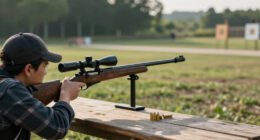
The report says the tester fired 20 rounds of each load through each rifle: a Seekins SIC Short Action precision rifle and a Ruger American Rifle Gen II hunting rifle. That amounts to 40 rounds per ammunition type. For accuracy, the tester used four five-shot groups per rifle and calculated average group sizes. Velocity and standard deviation were recorded with a Garmin Xero C2 chronograph; most velocity summaries were based on 20 shots per rifle and load.
Winchester’s 140-grain Deer Season XP had the smallest combined group average, at 0.700 inches. Barnes’ 140-grain Harvest Tipped Game King followed at 0.704 inches. Federal’s 140-grain Fusion Tipped averaged 0.989 inches combined; Nosler’s 140-grain Solid Base Whitetail Country, 1.167 inches; Hornady’s 129-grain InterLock American Whitetail, 1.375 inches; and Remington’s 129-grain Core-Lokt Tipped, 1.519 inches.
The rifle-specific results show why the combined ranking is not a guarantee for an individual firearm. Remington averaged 0.713 inches in the Seekins but 2.325 inches in the Ruger. Hornady also grouped differently between the rifles, averaging 1.205 inches in the Seekins and 1.545 inches in the Ruger. Federal’s velocity data used 30 shots, rather than the 20-shot basis stated for the other loads.
Why Rifle-Specific Accuracy Matters
The test gives hunters a measured comparison of six factory loads in two different rifles, rather than a ranking based only on product descriptions. Its clearest practical finding is that ammunition performance varied by rifle: Remington’s groups were relatively tight in the Seekins but substantially larger in the Ruger. That makes the figures useful as a starting point, not a substitute for checking a load in the rifle a hunter will use.
Accuracy is only one consideration in choosing hunting ammunition. The report also collected velocity and standard-deviation data, but bench groups and chronograph readings alone do not establish how a bullet will perform on an animal. The article’s summary describes some loads as performing well in the field, but the supplied results do not provide a controlled, comparable field test of all six. Hunters should not treat the accuracy ranking as a complete measure of terminal performance or suitability.
Popular right now

Dyson V15 Detect Cordless Vacuum

Dreame G10 Pro Wet and Dry Vacuum Mop

Samsung QN65LS03FAFXZA 65 The Frame QLED 4K Art Mode Vision AI Smart TV (2025)
As an affiliate, we earn on qualifying purchases.
How the Ammunition Test Was Run
The report focused on 6.5 Creedmoor, which the author describes as a widely available big-game cartridge. Testing the same chambering in both rifles allowed a comparison of the loads while showing how results differed between a high-end precision platform and a lower-cost hunting rifle.
The author says the group figures represent averages of four five-shot groups for each rifle-and-ammunition combination. The combined group average represents the results across both test rifles; it is not a promise of the group size a different rifle, shooter, or conditions will produce. The article also notes that factory-ammunition standard deviations in the teens are very good in this test’s framing, while values in the 20s are not necessarily problematic for the type of center-of-mass deer-hunting ammunition considered.
“I tested six popular whitetail loads to compare their precision at the bench, how they fed and cycled, and the consistency of their velocities.”
— Outdoor Life test report
Limits of the Reported Results
The findings cover two rifles, one cartridge, and a limited number of rounds. The supplied report does not establish how the loads would perform in other rifle models or under different conditions, and it does not provide enough detail here to independently assess feeding and cycling for each product. The Federal velocity and standard-deviation figures also use a different shot count from the other loads.
The report’s summary refers to field performance, but the data provided are primarily bench-group and velocity measurements. It remains unclear from the supplied material how all six loads compare in controlled terminal-performance testing. Availability and price can also change: the report listed Winchester at about $35 for a 20-round box and described it as difficult to find at publication, but those details may not reflect current retailers.
Check Performance in Your Rifle
The article does not announce a follow-up test or a future publication date. For readers using the results, the next step is to treat the rankings as a shortlist and confirm how a chosen load groups in their own rifle, following the firearm maker’s instructions and safe range practices. The reported result for one load should not be assumed to apply to a different bullet weight or product variant: the test specifically notes that the 125-grain Winchester version was not evaluated.
Key Questions
Which load had the smallest combined group average?
Winchester 140-grain Deer Season XP had the smallest combined five-shot group average in the report, at 0.700 inches across the two rifles.
Which load ranked second?
Barnes 140-grain Harvest Tipped Game King averaged 0.704 inches in the combined results, just behind Winchester’s 0.700 inches.
Did every load perform similarly in both rifles?
No. Results varied by rifle. Remington Core-Lokt Tipped averaged 0.713 inches in the Seekins but 2.325 inches in the Ruger American Rifle Gen II.
Does the test prove which ammunition performs best in the field?
No. The reported measurements chiefly cover bench accuracy and velocity consistency. They do not establish that one load is best for every rifle or provide a fully comparable field-performance assessment of all six loads.
Source: outdoorlife.com