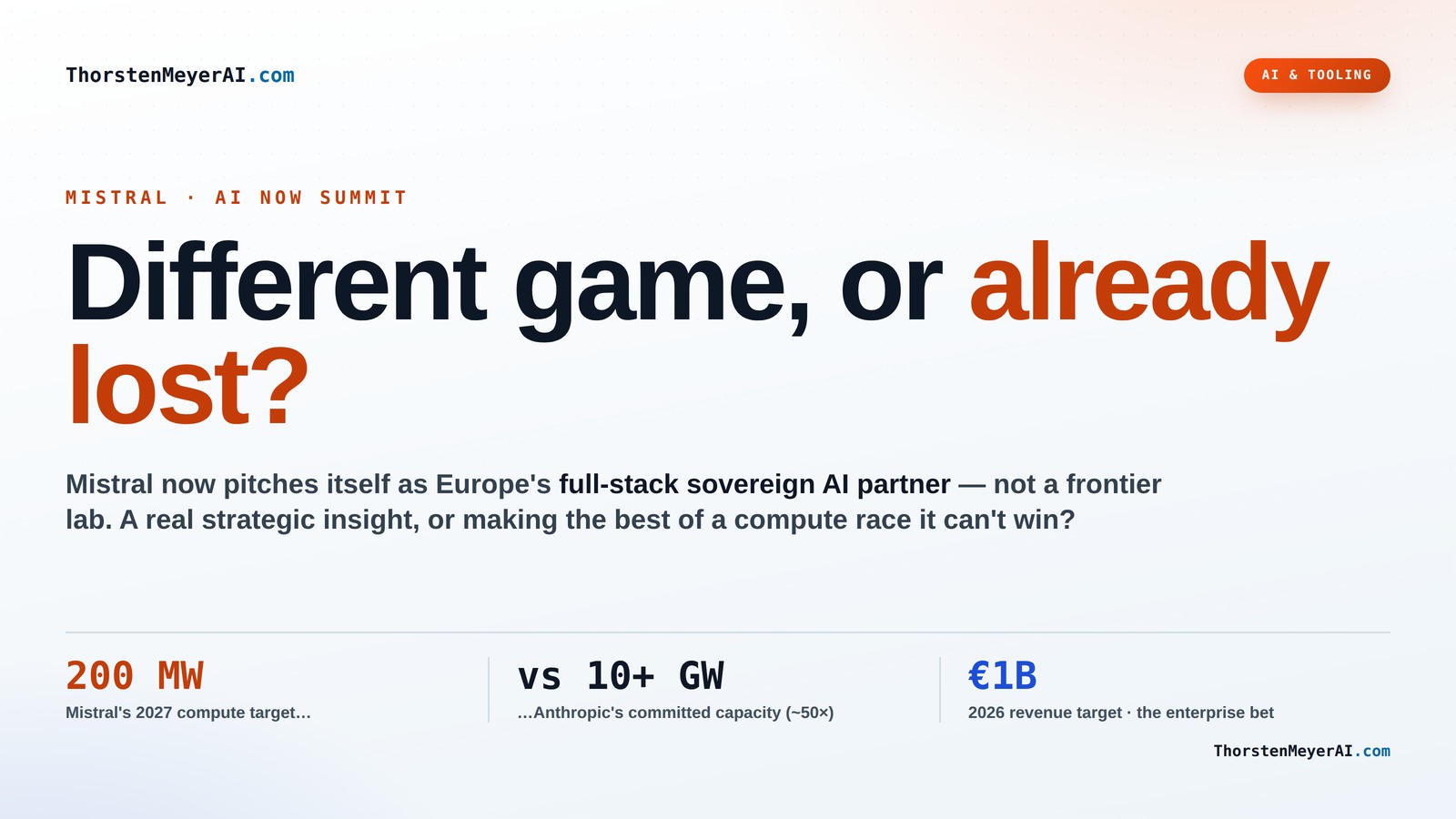

TL;DR

Get emergency and outdoor gear delivered free with Prime
- Fast, free delivery on millions of items
- Prime Video, Amazon Music and more included
- Member-only deals all year
Mistral emphasizes sovereignty and self-hosting over raw model size, appealing to regulated European markets. Its strategy hinges on control and independence, but critics question if it can keep pace technically.
When you think of AI giants, the image is usually massive models, endless data, and global dominance. You can learn more about the landscape of AI models on spectralore.com. But Mistral is rewriting the story. Instead of chasing the largest models, it’s betting on sovereignty—giving organizations control over their AI, data, and infrastructure. That shift might seem subtle, but it’s a game-changer for Europe’s digital future.
At the recent AI Now Summit in Paris, Mistral made one thing clear: it’s no longer just about making models. For insights into AI industry trends, visit 1023 Jack. It’s about owning the entire stack—compute, models, and deployment. Why? Because in regulated sectors like finance or defense, control equals security. That’s the real prize. But the big question remains—are they winning the race on the technical front, or just playing a smarter game?
Different game, or already lost?
Mistral now pitches itself as Europe’s full-stack AI provider — compute, models, platform, consultancy — not a frontier-model lab. Is that a real strategic insight, or making the best of a race it can’t win? Both readings fit the same facts.
From model lab to full-stack provider
The clearest signal from the summit wasn’t a model — it was a posture. Heavy on enterprise logos and partnerships (ASML, BNP Paribas, Alexa+), light on new-model announcements. That absence is exactly what skeptics seized on.
Compute
40MW Paris DC + Sweden build · 200MW target by 2027
Models
Open & custom · efficient · you own and run them
Platform
Forge for custom models · Vibe for Work agent
Consultancy
Sales teams, integrators, EU provenance & support
Small & focused, or large & general?
Mistral bets on specialized small models. The claim isn’t that they win a reasoning leaderboard — they don’t. It’s that on the metrics that matter in production agent systems, a purpose-built small model wins. Flip the metric to see the case reverse.
Small specialized vs large general — by what you measure
In token-heavy agentic apps making hundreds of calls, speed/energy/cost compound. Toggle the metric.
Narrow models doing real work
Each is one model doing one thing efficiently — the tangible version of the strategy. Strong on their own terms; the open question is whether the bundle beats a free Chinese open-weight download.
On-prem KYC compliance
Mistral models run inside the bank’s walls for know-your-customer checks. Sensitive financial data never leaves. (BNP was Mistral’s first customer, 2023.)
Voxtral multilingual voice
A focused voice model powering Alexa+ across Europe — speed and efficiency over raw size.
Robostral industrial robotics
Plus a “physics AI” push (via the Emmi acquisition) into aerospace, automotive & semiconductor design and simulation.
Document AI / OCR at scale
Large-scale text extraction — the unglamorous, high-volume enterprise work small models excel at.
The strategy is downstream of the compute gap
Once you see the raw numbers, “why is Mistral behind?” answers itself — and the specialized-small-model strategy starts looking partly like a smart adaptation to a binding constraint, not a pure philosophical choice.
Compute & capital · Mistral vs a frontier leader, this same week
Not a knock — it’s the constraint that forces the efficiency-first, sovereignty-wedge strategy. Adapting intelligently to your position is what good strategy is.
“I want them to win, but I’m worried”
That ambivalence is the most accurate read of where Mistral sits. The enterprise pivot gets read two opposite ways — and both deserve airing.
On-prem, real sales teams, the Koyeb deployment acquisition, EU provenance — exactly what regulated enterprises want, and stickier than consumer mindshare. Targeting €1B revenue in 2026 with 1,000 staff, up from 15 people and one customer in 2023. US closed-API labs structurally can’t match the sovereignty axis.
“Software consultancy with a data center,” not a foundation-model moat. Enterprise B2B is where European startups go when they can’t win consumer or world-scale SaaS. Why pay Mistral on-prem when you could run Qwen free? One paying Le Chat Pro user said the quality gap with frontier labs is now hard to ignore.
Key Takeaways
- Mistral’s core strength is its sovereignty-first approach—selling control and flexibility, not just models.
- European enterprises prefer on-prem models for compliance and security, giving Mistral a niche advantage.
- Small, purpose-built models can outperform larger ones on efficiency, but may lag in reasoning complexity.
- Europe’s digital dependency concerns fuel Mistral’s infrastructure investments, making sovereignty a strategic pillar.
- Long-term success hinges on balancing technical innovation with strategic control, not solely model size.
enterprise AI self-hosted platform
As an affiliate, we earn on qualifying purchases.
As an affiliate, we earn on qualifying purchases.
What is 'Sovereign AI,' and why does it matter now?
Sovereign AI is about control—control over data, models, and where the AI runs. For European companies and governments, it’s the difference between owning their AI tools and relying on U.S. giants like OpenAI or Google. Think of it like owning your house versus renting an apartment. The freedom to customize, secure, and comply makes all the difference.
For example, BNP Paribas uses Mistral models on-premise to keep sensitive financial data inside their own walls. This isn’t just about privacy; it’s about meeting strict regulations. In a world where data breaches and compliance failures can cost billions, sovereignty is a shield, not just a strategy.
Deeply, sovereignty impacts how organizations innovate and respond to crises. When data is stored locally or models are controlled internally, institutions can adapt faster, enforce stricter security protocols, and avoid the vulnerabilities associated with cloud dependencies. However, this approach also introduces tradeoffs: higher costs for infrastructure, the need for specialized expertise, and potential limitations in model updates or scaling. The choice reflects a prioritization of security and compliance over rapid access to the latest AI capabilities, shaping a landscape where control and trust are paramount.

As an affiliate, we earn on qualifying purchases.
How does Mistral's full-stack approach change the game?
Mistral isn’t just creating models. It’s building an entire infrastructure—compute, models, and tools—that organizations can own and control. Learn more about AI infrastructure at theintellihome.com. This means they’re competing not only on AI quality but on the ability to deploy securely within European borders.
Imagine a European bank wanting to run AI models on-site without exposing their data to outside cloud providers. Mistral’s approach gives them that control, unlike OpenAI or Anthropic, who mostly sell API access. This full-stack strategy aims to carve out a niche where control beats raw performance.
By providing a comprehensive ecosystem, Mistral reduces the fragmentation often seen in AI deployments, where organizations juggle multiple vendors and platforms. This integration fosters a more robust, secure environment but also asks organizations to accept higher upfront investments and a potentially slower pace of innovation compared to cloud-native giants. The strategic tradeoff is clear: prioritize security and sovereignty, or chase the latest AI breakthroughs with less control and more dependency.

As an affiliate, we earn on qualifying purchases.
Is Mistral winning or falling behind on technical performance?
The question of technical prowess looms large. Critics argue Mistral hasn’t yet demonstrated it can keep pace with the best on reasoning and large-model benchmarks. For more on AI model performance, see wiredguide.com. This gap could limit its appeal for applications requiring complex, nuanced understanding. Conversely, supporters emphasize that for enterprise and regulation-heavy markets, speed, customization, and control are more valuable than chasing the frontier models.
For instance, Mistral’s smaller, purpose-built models excel in efficiency—like the OCR system used by the European Patent Office or the multilingual voice agent powering Amazon Alexa+ in Europe. These applications prioritize reliability and compliance over raw reasoning power. However, in large reasoning tasks—such as advanced scientific research or complex decision-making—these smaller models may struggle to match the capabilities of giants like GPT-4 or PaLM. The technical gap signifies a strategic choice: focus on control and specialization at the expense of pushing the boundaries of AI reasoning. This tradeoff could define Mistral’s future success or limitations depending on market demands and technological advancements.

As an affiliate, we earn on qualifying purchases.
Why Europe’s digital dependency makes sovereignty the real strategy
Europe fears over-reliance on U.S. and Chinese tech isn’t just political—it’s business. You can explore the importance of sovereignty in AI at this article. Mistral’s focus on local compute capacity and open weights aligns perfectly with European policies to keep data onshore and secure. Think of it like building a local power grid instead of depending on distant, unpredictable sources.
With €1.2 billion planned in Sweden and a 40MW data center near Paris, Mistral’s infrastructure push is tangible. It’s about creating a European AI ecosystem that’s resilient, transparent, and aligned with local laws, rather than being vulnerable to foreign influence or shutdowns.
This focus on sovereignty isn’t just about political independence; it’s about economic resilience. By investing heavily in local infrastructure, Mistral aims to reduce dependency on external cloud providers, which can be subject to geopolitical pressures or outages. Such investments also foster local expertise and innovation, creating a self-sustaining AI ecosystem. The tradeoff involves significant capital expenditure and the challenge of maintaining cutting-edge performance within a more constrained, localized environment. Ultimately, it’s a strategic move to shape the future landscape of AI—one where European control and resilience are central.

Can Mistral stay relevant without leading the frontier race?
This is the crux. Many wonder: if Mistral isn’t building the biggest, most capable models, can it still compete? Read more about the strategic implications of AI sovereignty at this analysis. The answer depends on your yardstick. For enterprises needing control, compliance, and customization, it might be enough. But for those chasing the bleeding edge of reasoning, not yet.
Consider the debate: smaller models designed for specific tasks can outperform giant general-purpose models in speed and cost, especially in regulated environments where precision and security matter more than raw power. However, if the goal is to solve the most complex reasoning problems or push AI boundaries, Mistral’s current focus might limit its growth. Its technical strategy involves balancing the need for robust, controllable models with the aspiration to improve reasoning capabilities over time. The tradeoff is clear: sacrificing some immediate performance for long-term strategic control. Whether this approach will sustain Mistral’s relevance depends on market trends and technological breakthroughs that could either bridge or widen this gap.
The future of Europe’s AI: a different kind of race
Mistral’s bets reflect a different vision: one where sovereignty, control, and trust matter more than size and raw power. It’s a game where local infrastructure and open weights become the currency of trust. Imagine a Europe where AI models are as common as local energy grids—resilient, independent, and customizable.
Whether this vision triumphs depends on how well Mistral can balance technical growth with its strategic identity. It’s a gamble, but one that could redefine AI’s landscape—away from the U.S.-China duopoly toward a more European, sovereign model.
Long-term, this approach could foster a more resilient and ethically aligned AI ecosystem, reducing geopolitical risks and promoting local innovation. However, it also risks fragmenting the global AI landscape, potentially limiting access to the most advanced models and innovations. The success of this vision hinges on Europe’s ability to sustain technological competitiveness while maintaining its sovereignty-driven principles. If successful, Mistral could set a precedent for a new paradigm—one where control and trust are as valued as raw performance, reshaping the global AI order.
Frequently Asked Questions
What does 'sovereign AI' really mean?
Sovereign AI means having full control over data, models, and deployment. It’s about running AI on your own infrastructure, ensuring compliance, security, and independence from external cloud providers.
Why is Mistral focusing on open weights and self-hosting?
Open weights give organizations the ability to inspect, customize, and run models locally, which is crucial for regulated industries like finance or defense. It’s a way to gain control and avoid dependence on proprietary APIs.
Is Mistral lagging behind in technical performance?
Some critics say yes, especially in reasoning benchmarks. But supporters argue that for enterprise needs—speed, security, customization—their smaller, specialized models could be more practical and valuable.
Can Europe really compete without leading the frontier in model size?
Yes, if the focus is on control, compliance, and local infrastructure. Europe’s market values sovereignty, and Mistral’s approach aligns with that. But for cutting-edge reasoning, they’ll need to keep up technically.
Conclusion
Choosing Mistral isn’t just about AI performance; it’s about trusting a local, sovereign ecosystem. In a world where control equals security, their strategy makes a lot of sense—if they can keep pace technically.
As the AI landscape shifts, the real question is whether sovereignty will become the new standard or a niche. For now, Mistral is rewriting the rules—playing a different game, with the future of Europe’s digital autonomy on the line.

Fall Picks
fall essentials
As an affiliate, we earn on qualifying purchases.

![[Editorial] Psychedelics: after the renaissance](https://wildernesssense.com/wp-content/uploads/2026/05/editorial-psychedelics-after-the-renaissance-featured-560x300.jpg)