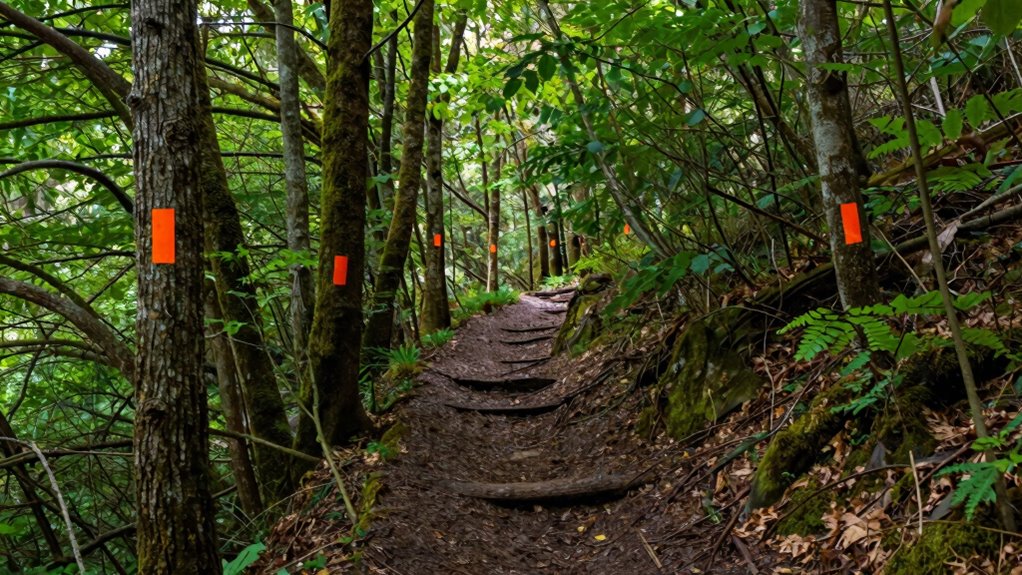

When every trail looks the same, stay oriented by closely observing distinctive landmarks like unique trees, rock formations, or water features, and cross-referencing them with your map. Use your compass to confirm directions and take bearings from distant landmarks. Pay attention to subtle terrain cues such as slope angles or vegetation changes. Keep your surroundings consistent by regularly reassessing your position with environmental features. For more tips, you’ll discover how to enhance your navigation skills effectively.
Key Takeaways
- Use recognizable landmarks and natural features to differentiate similar-looking trails regularly.
- Cross-reference terrain details with your map to verify your position frequently.
- Take and confirm bearings with a compass when trail markers become indistinct.
- Pay attention to subtle environmental cues like lighting, vegetation, and slope changes.
- Reassess your surroundings often to prevent wandering and ensure you stay on the correct trail.
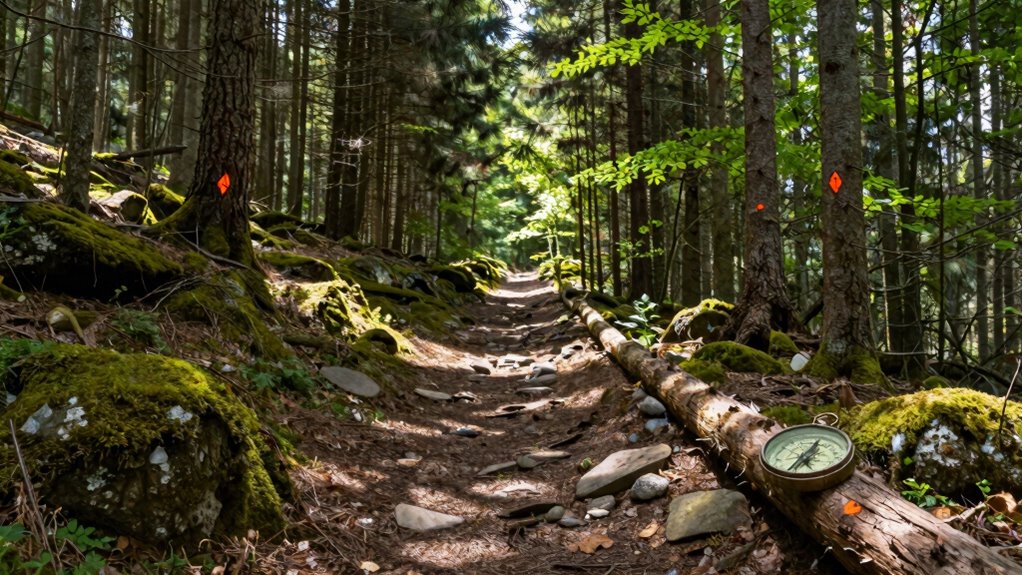
Have you ever found yourself in an unfamiliar place, unsure of which way to go? It’s a common feeling when trails look alike, and landmarks seem to blend together. Staying oriented in such situations can be challenging, but mastering a few essential skills makes all the difference. First, sharpen your map reading skills. Before setting out, familiarize yourself with the map’s symbols, scale, and key features. When you’re on the trail, keep the map accessible and regularly check your position against recognizable landmarks like distinctive trees, rock formations, or water bodies. Don’t rely solely on the map; combine it with your observations of the terrain to confirm you’re on the right track. Incorporating contrast ratio awareness can help distinguish subtle differences in terrain and lighting conditions, aiding your navigation. This skill is especially useful when visual cues are limited or confusing. Complement your map reading with solid compass skills. Carry a reliable compass and learn how to use it effectively. To do this, practice taking bearings from your map and translating them to the ground. For example, find your current location on the map, identify a distant landmark, and determine its bearing with your compass. When you’re in the field, hold the compass steady, align the needle with the orienting arrow, and rotate your body until the magnetic needle lines up with the compass’s north marking. This will give you a precise direction to follow. Regularly check your compass to confirm your heading, especially when trail markers are absent or confusing. In environments where trails look similar, small details become critical. Notice subtle differences like slope angles, vegetation types, or the presence of a stream or rocky outcrop. Using your map and compass in tandem, cross-referencing your position frequently enhances your confidence and accuracy in navigation. If you start to feel disoriented, stop, take a bearing, and re-assess your surroundings. Knowing how to read your surroundings and navigate confidently prevents you from wandering aimlessly and helps you stay on course even when trail markers are sparse or identical. Applying spatial awareness techniques can further enhance your ability to interpret environmental cues and maintain orientation.

Sportneer Military Lensatic Sighting Compass with Carrying Bag, Waterproof and Shakeproof, Army Green
High-Precision – Sportneer compass is engineered for superior accuracy, featuring a rear sight lens that magnifies the dial…
As an affiliate, we earn on qualifying purchases.
As an affiliate, we earn on qualifying purchases.
Frequently Asked Questions
What Should I Do if I Get Lost Unexpectedly?
If you get lost unexpectedly, stay calm and stop moving to avoid further disorientation. Use your trail marking tools, like ribbons or cairns, if available, to mark your location. Try to identify landmarks and retrace your steps if possible. If you’re unable to find your way, activate emergency signaling—use a whistle, mirror, or phone to call for help. Staying visible and alert increases your chances of rescue.
How Can I Prevent Losing My Way in Dense Forests?
Think of dense forests like a maze with hidden clues. To prevent losing your way, focus on landmark recognition and trail marking. Keep track of distinctive trees, rocks, or features, and use a compass or GPS to stay on course. Regularly check your trail markings, and if you spot a familiar landmark, confirm your direction. This proactive approach helps you navigate confidently and avoid getting lost in confusing terrain.
What Tools Are Essential for Navigation in Unfamiliar Terrain?
You need essential navigation tools like a reliable map and a compass. Master map reading to interpret terrain features and landmarks, and develop compass skills to determine your direction accurately. Always carry a detailed map suited for the area and learn how to use your compass in various conditions. These tools, combined with your knowledge, help you stay oriented and confidently navigate unfamiliar terrain, even when trails look alike.
How Do Weather Changes Affect Trail Navigation?
Weather changes, especially shifts in weather patterns, can profoundly impact your trail navigation. Sudden rain or fog can obscure trail markers, making it harder to stay oriented. You might find trail markers washed away or hidden, so it’s essential to pay close attention to your surroundings and use your map or compass. Stay flexible, watch for subtle cues, and adjust your route as needed to make certain you don’t lose your way.
Can I Rely Solely on Digital GPS Devices?
Relying solely on digital GPS devices is like putting all your eggs in one basket. While GPS offers great guidance, digital reliance has limitations—batteries can die, signals can falter, and devices may malfunction. Always carry a map and compass as backup. Combining technology with traditional navigation guarantees you stay oriented, even when digital tools fail. Don’t forget, a well-rounded approach keeps you safe on unfamiliar trails.

Map Reading And Land Navigation – FM 3-25.26 US Army Field Manual FM 21-26 (2001 Civilian Reference Edition): Unabridged Manual On Map Use, … Release) (Military Outdoors Skills Series)
As an affiliate, we earn on qualifying purchases.
As an affiliate, we earn on qualifying purchases.
Conclusion
Staying oriented on similar-looking trails can be challenging, but remember, trusting your instincts and using simple tools like a compass or landmarks can make all the difference. Did you know that hikers who rely solely on visual cues are 30% more likely to get lost? So, keep your navigation skills sharp, stay aware of your surroundings, and don’t hesitate to double-check your bearings. With these tips, you’ll confidently navigate even the most confusing trails.

Illustrated National Park Coffee Table Book of the Flora, Plants, Flowers, Foliage, Trees, Wildflower Species, and Native Botanical Landscapes: … Parks, Landmarks and Landscapes of the USA)
As an affiliate, we earn on qualifying purchases.
As an affiliate, we earn on qualifying purchases.

Garmin 010-02256-00 eTrex 22x, Rugged Handheld GPS Navigator, Black/Navy
Explore confidently with the reliable handheld GPS
As an affiliate, we earn on qualifying purchases.
As an affiliate, we earn on qualifying purchases.