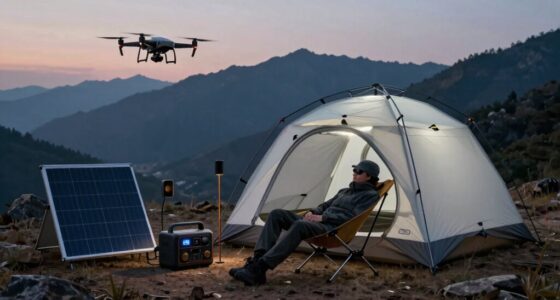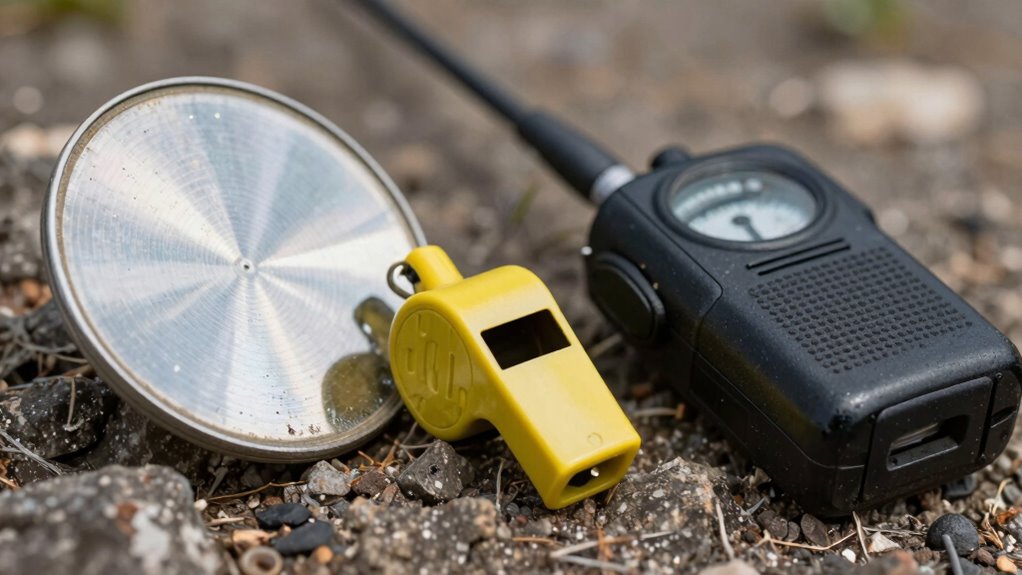
Using signal mirrors, whistles, and radios together creates a reliable emergency redundancy system that guarantees your safety in crisis situations. The mirror lets you attract distant attention with sunlight, while whistles are quick, loud alerts to nearby rescuers. Radios connect you to emergency services even in remote areas without cell coverage. Combining these tools assures you stay visible, heard, and connected no matter what happens—continue exploring to discover how each tool works best in different scenarios.

Get emergency and outdoor gear delivered free — and shop member deals
- Fast, free delivery on millions of items
- Access to Prime Big Deal Days deals on October 6–7
- Prime Video, Amazon Music and more included
Key Takeaways
- Combining different tools ensures communication and signaling options in various environments and signal disruptions.
- Signal mirrors provide visual signals over long distances, while whistles offer immediate audio alerts.
- Radios enable direct contact with rescue services, ensuring rapid response when visual signals are ineffective.
- Redundancy with multiple tools increases chances of successful rescue in diverse emergency scenarios.
- An integrated system enhances overall safety by covering communication gaps caused by terrain, equipment failure, or environmental conditions.
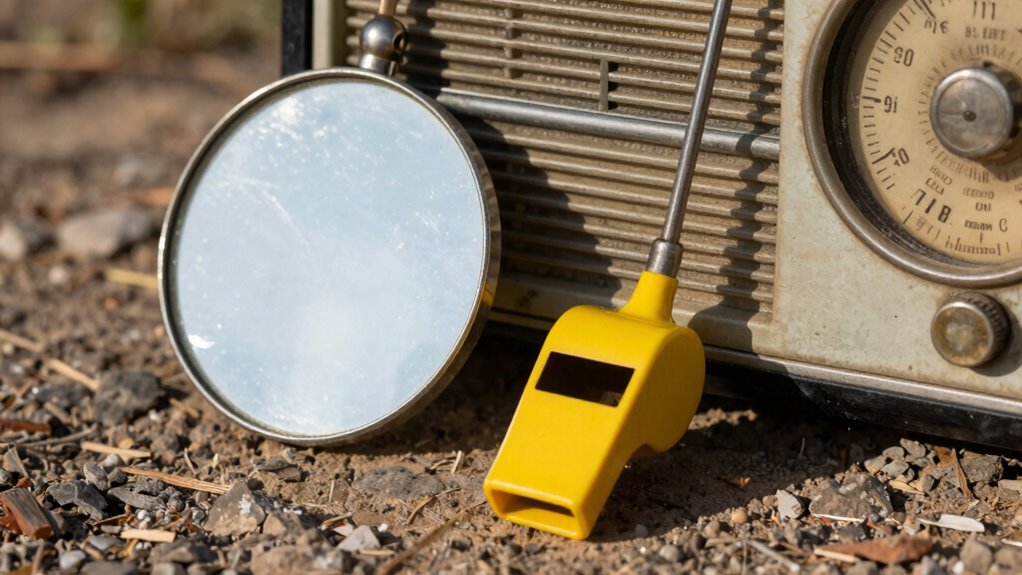
In today’s fast-paced world, having reliable backup systems is essential when emergencies strike. When you’re in a crisis, your ability to communicate can make the difference between safety and danger. Signal mirrors, whistles, and radios are simple but powerful tools that create better emergency redundancy, ensuring you stay connected when it matters most. These tools serve different purposes, but together, they form a layered defense that keeps you informed, alert, and prepared.
A well-rounded approach to emergency preparedness can also include understanding your own personality traits, which can influence how effectively you respond in high-pressure situations. Signal mirrors are your silent but effective way to catch the attention of rescuers over long distances. When other devices fail or are unavailable, the reflection of sunlight can be seen from miles away, especially if you’re in open terrain. Learning how to use a signal mirror properly is crucial; you aim the reflected light at potential rescuers or aircraft overhead, making your location visible without relying on electronic signals. This method is especially useful in remote areas where satellite communication might be unavailable or unreliable, and it requires no batteries or power. It’s an essential part of medical preparedness, as quick rescue can be lifesaving if someone is injured and needs urgent medical attention.
Whistles are another vital component of your emergency toolkit. Unlike electronic devices, whistles require no power and are easy to carry on your gear or around your neck. A loud, sharp blast can alert nearby individuals or rescue teams to your location. Whistles are particularly effective in environments where visual signals might be missed, such as dense forests or crowded urban areas. They also serve as an important communication tool in situations where satellite communication or radios aren’t functioning due to interference or equipment failure. When used correctly, a series of blasts can convey distress signals or help coordinate efforts among rescue parties.
Radios, especially those equipped for satellite communication, are your most versatile and reliable emergency redundancy tools. They allow you to contact emergency services or rescue teams directly, even if cellular networks are down. Satellite radios are critical in remote locations where traditional communication methods fail, providing a lifeline for medical preparedness and coordination. In emergencies, they enable you to relay vital information about injuries, supplies, or your exact location. Properly functioning radios can dramatically increase your chances of quick rescue, reducing wait times and improving survival odds.
Together, signal mirrors, whistles, and radios create a comprehensive backup system that keeps you connected in various scenarios. Each tool offers a unique advantage, ensuring that no matter what obstacle you face—be it terrain, equipment failure, or signal disruption—you have a reliable way to communicate, signal for help, and coordinate rescue efforts. When you combine these tools, you build a robust safety net that enhances your overall emergency response and medical preparedness.
signal mirror for emergency survival
As an affiliate, we earn on qualifying purchases.
As an affiliate, we earn on qualifying purchases.
Frequently Asked Questions
How Durable Are Signal Mirrors in Harsh Weather Conditions?
Signal mirrors are quite durable in harsh weather, thanks to their weather resistance and sturdy material resilience. They’re typically made from high-quality, shatter-resistant plastic or glass, which withstands rain, snow, and wind. While extreme conditions might cause minor scratches or fogging, most signal mirrors hold up well over time. To guarantee longevity, choose one with a rugged design and protective coatings, especially if you expect frequent exposure to tough weather.
What Are the Best Whistle Types for Different Environments?
Think of your whistle as your voice in a storm—clear, sharp, and loud. A pea whistle offers excellent sound amplification, perfect for dense forests or crowded environments. For open spaces, a high-decibel, weather-resistant whistle boosts signal visibility through sound, ensuring your call isn’t lost. In wet conditions, choose a waterproof whistle to keep your signals crisp. Select the right whistle to cut through chaos and grab attention when it matters most.
How Do Radio Frequencies Affect Emergency Communication Effectiveness?
Radio frequencies directly impact your emergency communication effectiveness by influencing signal clarity and susceptibility to interference. Lower frequencies often travel farther and penetrate obstacles better, improving reach, while higher frequencies may suffer from more interference and limited range. You should choose the right frequency to minimize signal interference and maximize clarity. Being aware of these factors helps you maintain reliable communication, especially when traditional channels become compromised during emergencies.
Can Signal Mirrors Be Used at Night?
Sure, signal mirrors are great—until night falls, and suddenly they’re as useful as a flashlight in a blackout. Nighttime signaling with mirror reflections becomes nearly impossible without sunlight bouncing off the glass. You’d need a superpower to see your reflection in the dark, so don’t count on signal mirrors for emergencies at night. Instead, keep a whistle or flashlight handy—those work regardless of the hour.
What Maintenance Is Required for Emergency Radios?
You need to regularly check your emergency radio’s battery lifespan and replace batteries as needed to make certain it works when needed. Store your radio in cool, dry conditions to prevent damage from moisture or extreme temperatures. Periodically test the device to confirm it’s functioning properly, and keep spare batteries handy. Proper maintenance guarantees your radio stays reliable during emergencies, providing essential communication when other systems might fail.
As an affiliate, we earn on qualifying purchases.
Conclusion
Think of your emergency tools as a symphony of signals; if one instrument falters, others carry the tune. When I once hiked alone in remote terrain, my whistle and radio became lifelines, each backup ensuring I wasn’t silenced. Just like a well-orchestrated concert, your mirror, whistle, and radio work together to create a resilient safety net. By embracing multiple redundancies, you transform vulnerability into confidence, turning potential chaos into a controlled, recoverable situation.
As an affiliate, we earn on qualifying purchases.
handheld survival communication radio
As an affiliate, we earn on qualifying purchases.
As an affiliate, we earn on qualifying purchases.
Evergreen bestsellers Picks
bestsellers
As an affiliate, we earn on qualifying purchases.