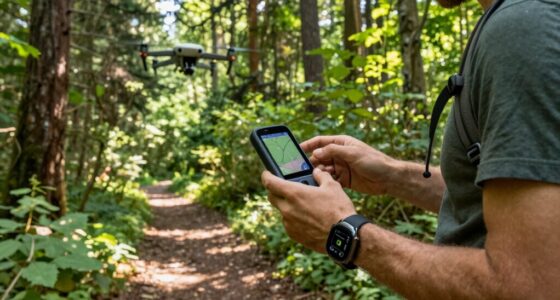
Antennas, boosters, and routers work together to guarantee your communication stays connected even during disruptions. Antennas capture signals from various sources, adapting to different environments, while boosters strengthen weak signals and reduce interference. Routers distribute the internet to multiple devices and can switch sources seamlessly if one fails. By properly configuring these devices, you create a resilient system that keeps you connected in emergencies or remote areas—continuing to support you when it matters most.
Prime for Young Adults — start your free trial
Fast free delivery, streaming and member deals for eligible 18–24 year olds.
As an affiliate, we earn on qualifying purchases.
Key Takeaways
- Antennas detect signals from various sources, enabling alternative connection options during primary signal failures.
- Boosters amplify weak signals, improving stability and reducing disruptions caused by interference or physical barriers.
- Routers distribute internet locally and enable failover switching between different connectivity sources.
- Combining antennas, boosters, and routers creates a resilient system that maintains communication despite external disruptions.
- Proper configuration and investment ensure sustained connectivity, safety, and reliable communication in critical situations.

Have you ever experienced a communication blackout just when you needed it most? It’s frustrating and can even be dangerous, especially if you rely on constant connectivity for work or safety. That’s where antennas, boosters, and routers come into play, creating a safety net through communication redundancy. They work together to guarantee your connection remains stable, even when unexpected issues like signal interference or satellite connectivity problems occur.
Antennas serve as the first line of defense. They capture signals from various sources, whether it’s satellite signals, cell towers, or Wi-Fi networks. High-quality antennas can adapt to different environments, improving signal reception and reducing dead zones. When satellite connectivity weakens due to weather or obstructions, your antennas can still pick up signals from alternative sources, keeping your communication lines open. This flexibility is essential in maintaining continuous contact, especially in remote areas or during emergencies.
Antennas adapt to environments, improving signal reception and maintaining communication during emergencies or in remote areas.
Boosters, also known as signal amplifiers, are designed to strengthen weak signals. If your antenna detects a faint or inconsistent signal, a booster enlarges its strength, making it more reliable. Signal interference—caused by electronic devices, physical barriers, or atmospheric conditions—can markedly degrade your connection. Boosters help counteract this by boosting the signal above interference levels, ensuring clearer and steadier communication. They’re particularly useful in crowded areas where multiple signals compete, or in buildings with thick walls that block signals from outside sources.
Routers, on the other hand, distribute your internet connection across multiple devices. They create local networks that can operate independently of external disruptions. When combined with antennas and boosters, routers can seamlessly switch between different sources of connectivity—like switching from satellite to cellular networks—if one source becomes unreliable. This automatic switching, called failover, guarantees that your internet stays up, no matter what issues arise outside your immediate environment.
Together, these devices form a resilient system that supports communication redundancy. They allow you to maintain a connection even when external factors threaten to disrupt it. Whether it’s combating signal interference, overcoming satellite connectivity issues, or ensuring your Wi-Fi remains stable, antennas, boosters, and routers work in unison to keep you connected. This redundancy isn’t just about convenience; it’s an essential safety feature in today’s interconnected world. By investing in and properly configuring these tools, you’re building a durable communication setup that can adapt to and withstand the unpredictable challenges of signal disruptions. Understanding how these devices work together can help you optimize your setup for maximum reliability.
high gain satellite antenna for home
As an affiliate, we earn on qualifying purchases.
As an affiliate, we earn on qualifying purchases.
Frequently Asked Questions
How Do Antennas Improve Signal Stability in Remote Areas?
Antennas improve signal stability in remote areas by providing effective signal amplification, which strengthens weak signals received from distant sources. They also help maintain frequency stability, ensuring the signal remains consistent without fluctuations. By capturing and transmitting signals more efficiently, antennas reduce disruptions and enhance overall communication reliability, even in challenging environments. This makes your connection more stable and dependable, especially where signal strength is naturally limited.
What Are the Differences Between Active and Passive Boosters?
Active boosters amplify signals actively, using power to enhance signal strength, often providing up to 10 times more amplification than passive boosters. Passive boosters, on the other hand, rely solely on reflective or passive components, requiring no power but offering limited signal enhancement. You might find that active boosters are more effective in areas with weak signals, but they do consume more power, making passive boosters a more energy-efficient choice.
Can Routers Automatically Switch Between Different Internet Sources?
Yes, your router can automatically switch between different internet sources through network failover. This feature guarantees continuous connectivity by seamlessly switching to backup sources when the primary connection drops. It also helps with bandwidth management, distributing traffic efficiently across multiple sources. This way, you experience less downtime and better performance, especially in critical applications. Make sure your router supports dual WAN or similar features for automatic source switching.
How Do Environmental Factors Affect Antenna Performance?
Environmental factors greatly impact antenna performance. For example, weather interference like rain or snow can reduce signal strength by up to 30%, causing slower or unreliable connections. Signal attenuation from obstacles like buildings, trees, or even fog can weaken signals as they travel, making reception patchy or unstable. You’ll notice these effects most during storms or in dense urban areas, where environmental conditions challenge your antenna’s ability to maintain a strong, clear connection.
What Security Risks Are Associated With Multiple Communication Devices?
Using multiple communication devices increases your security risks, such as encryption vulnerabilities and device spoofing. Hackers might exploit weaker encryption to intercept sensitive data or impersonate your devices to gain unauthorized access. To protect yourself, make sure all devices use strong, updated encryption protocols and implement multi-factor authentication. Regularly monitor network activity for suspicious behavior, and avoid connecting to unsecured or unknown networks to minimize these risks.
signal booster for weak Wi-Fi signals
As an affiliate, we earn on qualifying purchases.
As an affiliate, we earn on qualifying purchases.
Conclusion
By understanding how antennas, boosters, and routers work together, you can create a reliable communication network. These devices provide redundancy, ensuring your connection stays stable even if one link fails. It’s worth exploring the theory that having multiple layers of support enhances overall reliability. When you invest in these technologies, you’re not just improving speed—you’re building a resilient system that keeps you connected no matter what. Trust in their combined power to stay online.
dual band Wi-Fi router with failover
As an affiliate, we earn on qualifying purchases.
As an affiliate, we earn on qualifying purchases.
cellular signal booster for remote areas
As an affiliate, we earn on qualifying purchases.
As an affiliate, we earn on qualifying purchases.
NFL season / tailgating Picks
team gear
As an affiliate, we earn on qualifying purchases.