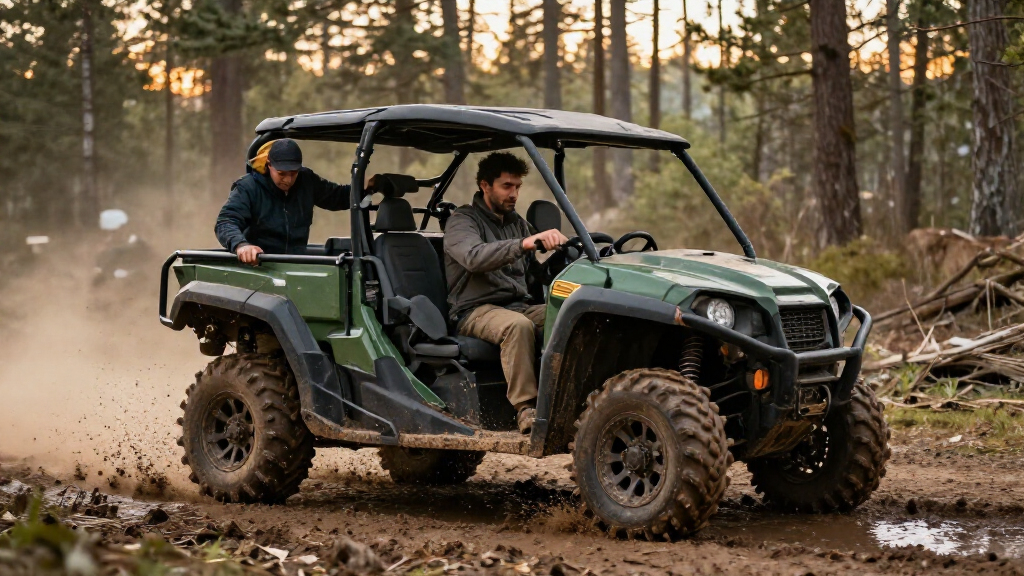

Choosing among the best side-by-side UTVs in this group means matching a small gas-powered machine to the work and terrain you actually have. The Armored 200cc Two-Seater is my practical pick for light property hauling, thanks to its cargo bed and automatic forward-neutral-reverse transmission. The MotoTec Titan 200cc brings the broadest listed equipment package, including independent suspension, a winch, and an LCD display. For a smaller-engine alternative with a steel frame and semi-automatic reverse, the Venom Motorsports 125cc Army Style takes a different approach.

Get emergency and outdoor gear delivered free with Prime
- Fast, free delivery on millions of items
- Prime Video, Amazon Music and more included
- Member-only deals all year
These are not interchangeable full-size recreational machines. Their modest engine displacements and differing layouts point toward light-duty property use and lower-speed off-road riding, while capacity, terrain ability, and equipment vary. I rank them by how clearly each matches a specific buyer need, how much useful capability its listed features add, and how easy it is to understand its limits. The key tradeoffs are cargo utility versus suspension and equipment, and simple automatic control versus a smaller engine with semi-automatic shifting. I would verify fit, assembly, parts support, and local operating rules with the seller before making a choice.
Key Takeaways
Pick the Armored 200cc if a built-in 33 × 16 × 6-inch cargo bed and automatic forward-neutral-reverse operation matter more than advanced suspension equipment.
Pick the MotoTec Titan for the most feature-rich specification sheet here: independent suspension, four-wheel hydraulic disc brakes, a listed 2000-pound front winch, and an 8-inch LCD.
Pick the Venom 125cc Army Style if you want a steel-frame, two-rider utility vehicle with reverse and do not need the larger engines or the Armored model’s cargo bed.
Do not treat the stated range or load figures as a guarantee; terrain, rider and cargo weight, maintenance, and operating conditions can change real-world results.
Check dimensions and support before ordering: the Titan is listed at 498 pounds, while the Venom is 450 pounds, and the supplied warranty terms differ.
| Armored 200cc Two-Seater UTV with Cargo Bed, Automatic Transmission and Reverse, Red |  | Best for light hauling and straightforward controls | Engine: 200cc single-cylinder, four-stroke, air-cooled | Transmission: CVT automatic with forward, neutral, and reverse | Starting: Electric start with CDI ignition | VIEW LATEST PRICE | See Our Full Breakdown |
| MotoTec Titan 200cc 4-Stroke Gas UTV, Blue |  | Best-equipped pick for riders who value suspension and listed features | Engine: 200cc JL1P63F-2, four-stroke, air-cooled, EPA-approved | Power: 8.7 kW at 7000 ± 500 rpm | Transmission: Forward-neutral-reverse | VIEW LATEST PRICE | See Our Full Breakdown |
| Venom Motorsports 125cc Army Style Off-Road Utility Vehicle |  | Best smaller-engine option with semi-automatic reverse | Engine: 125cc four-stroke, air-cooled | Transmission: Three-speed semi-automatic with reverse | Seating: Padded bench for two riders | VIEW LATEST PRICE | See Our Full Breakdown |
| side-by-side UTV | Engine | Transmission | Brakes | Seating |
|---|---|---|---|---|
| Armored 200cc Two-Seater UTV w | 200cc single-cylinder, four-stroke, air-cooled | CVT automatic with forward, neutral, and reverse | Front and rear disc brakes | Two seats with seat belts |
| MotoTec Titan 200cc 4-Stroke G | 200cc JL1P63F-2, four-stroke, air-cooled, EPA-approved | Forward-neutral-reverse | Four-wheel hydraulic disc brakes | — |
| Venom Motorsports 125cc Army S | 125cc four-stroke, air-cooled | Three-speed semi-automatic with reverse | Front and rear disc brakes | Padded bench for two riders |
More Details on Our Top Picks
Armored 200cc Two-Seater UTV with Cargo Bed, Automatic Transmission and Reverse, Red
The Armored 200cc earns my best overall role for light-duty property use because its layout addresses a familiar task: carrying two people and a small load without adding a separate trailer. Its 33 × 16 × 6-inch bed is a concrete advantage over the Venom 125cc, whose supplied details do not specify a cargo bed. The 200cc four-stroke engine is also larger than the Venom’s 125cc unit, though engine size alone does not establish speed, pulling ability, or hill performance.
Its automatic CVT with forward, neutral, and reverse keeps operation simpler than the Venom’s three-speed semi-automatic gearbox. That can be a better fit for a household or property owner who wants to focus on steering and load placement rather than shifting. Electric start, seat belts, LED headlights, a spare wheel, and front and rear disc brakes round out a practical feature set. The Titan also provides reverse and four-wheel hydraulic disc brakes, but its appeal leans more toward equipment and suspension than an explicitly sized cargo bed.
The main limitation is that this is a light-duty machine, not a heavy-hauling work UTV. The listing gives no load capacity, so I would not infer what the bed can safely carry from its dimensions. Nor does the description provide an independent suspension specification like the Titan’s. Buyers should check rated capacity, assembly needs, parts access, and whether the vehicle fits their terrain before relying on it for regular chores. For a buyer whose priority is a compact bed and easy controls, it makes more sense than the Venom; for rougher ground and a more elaborate equipment package, the Titan is the more relevant comparison.
Pros:- 33 × 16 × 6-inch cargo bed is useful for small property loads
- Automatic CVT includes forward, neutral, and reverse
- Front and rear disc brakes and seat belts for both riders
- Electric start, LED headlights, and a spare wheel are included
Cons:- Described as light-duty, with no payload capacity supplied
- Suspension details are less specific than the Titan’s independent setup
- The listing does not establish performance on steep or rough terrain
Best for: A property owner who wants two seats, automatic reverse, and a small built-in bed for light loads and routine chores.
Not ideal for: Buyers who need a stated heavy-duty payload, independent suspension, or a full-size machine for demanding terrain and frequent hauling.
- Engine:200cc single-cylinder, four-stroke, air-cooled
- Transmission:CVT automatic with forward, neutral, and reverse
- Starting:Electric start with CDI ignition
- Brakes:Front and rear disc brakes
- Seating:Two seats with seat belts
- Cargo bed:33 × 16 × 6 inches
- Wheelbase:72 inches
- Model:DF200GKV
Our verdict“I would choose the Armored 200cc for light chores when a compact cargo bed and simple automatic reverse matter more than advanced suspension.”
MotoTec Titan 200cc 4-Stroke Gas UTV, Blue
The MotoTec Titan is the most equipment-forward option in this comparison. Its 200cc EPA-approved four-stroke engine is paired with independent double-shock suspension, four-wheel hydraulic disc brakes, LED headlights and signals, and an 8-inch LCD dashboard. That collection makes the Titan more appealing than the Armored 200cc to a buyer focused on chassis equipment and instrument display rather than a clearly specified cargo bed. The Armored remains the easier recommendation for light hauling because it is the only listing here with a bed dimension.
A listed 2000-pound front winch and pneumatic tires add to the Titan’s utility pitch, while the four-gallon tank and claimed range of up to 60 miles may interest riders planning outings away from a fuel source. I would treat that range as a stated maximum, not a promise: load, speed, terrain, temperature, and maintenance can all affect fuel use. The listing also gives a maximum speed of 31 mph and a maximum load of 662 pounds, but these figures should be checked against the current seller documentation and operating conditions rather than used as a substitute for a suitable safety margin.
The tradeoffs are substantial enough to shape the choice. At 498 pounds dry, the Titan is the heaviest listed option, and its 4.4-inch ground clearance does not suggest that it should be assumed capable on deep ruts or rocks. Its six-month parts-replacement warranty is also comparatively limited on the supplied information; the Venom, by comparison, lists a one-year standard warranty. The Titan makes the strongest case for buyers drawn to its equipment package, but I would confirm the warranty process, replacement-part availability, and assembly arrangements before ordering. It is not automatically the best choice for hauling simply because it has a winch and a stated load figure.
Pros:- Independent double-shock suspension and four-wheel hydraulic disc brakes
- Listed 2000-pound front winch, LED lighting, and 8-inch LCD
- EPA-approved 200cc four-stroke engine with electric start
- Four-gallon tank and stated maximum range of up to 60 miles
Cons:- Listed dry weight of 498 pounds makes it the heaviest option here
- Six-month parts-replacement warranty is limited on the supplied details
- Stated maximum range and load figures depend on conditions and need seller confirmation
Best for: A buyer who prioritizes independent suspension, a detailed lighting and display package, and a listed front winch in a 200cc gas UTV.
Not ideal for: Anyone who needs a compact, lightweight vehicle, a clearly specified cargo bed, or longer stated warranty coverage.
- Engine:200cc JL1P63F-2, four-stroke, air-cooled, EPA-approved
- Power:8.7 kW at 7000 ± 500 rpm
- Transmission:Forward-neutral-reverse
- Suspension:Hydraulic independent double shock
- Brakes:Four-wheel hydraulic disc brakes
- Fuel capacity:15 liters (4 gallons)
- Listed maximum speed:31 mph
- Dry weight:498 pounds
- Warranty:Six-month parts replacement
Our verdict“I would choose the Titan for its unusually broad listed equipment package, provided its weight, warranty, and lack of a specified cargo bed fit the job.”
Venom Motorsports 125cc Army Style Off-Road Utility Vehicle
The Venom 125cc Army Style is the smaller-engine, utility-themed alternative in this group. A steel frame, padded two-person bench seat, roll cage, and front and rear disc brakes give it a distinct setup from the Armored 200cc, which is more directly aimed at light hauling with its measured cargo bed. The Venom includes a spare tire and jerry can, but its supplied description does not list a cargo bed, so I would not select it for carrying property loads in the way I might select the Armored model.
Its three-speed semi-automatic transmission with reverse provides more gear involvement than the Armored’s CVT, while still including a reverse gear for maneuvering. That arrangement may suit a buyer who prefers a geared feel and is comfortable learning the controls. The tradeoff is that it is less straightforward for a first-time driver than a fully automatic setup. Its 125cc air-cooled four-stroke engine is the smallest here, so I would keep expectations focused on modest recreational or property use rather than assume it will match the Titan or Armored in carrying or acceleration.
At 450 pounds and 82 inches long, this is not a particularly easy vehicle to transport or store simply because it has a smaller engine. Its listed maximum weight capacity is 350 pounds, a figure buyers should confirm with the seller and compare against the combined weight of occupants and any gear. The one-year standard warranty is longer on the supplied details than the Titan’s six-month parts-replacement term, but the warranty wording is not identical, so the terms should be compared directly rather than by duration alone. I would shortlist the Venom for its frame, two-rider bench, and included accessories; I would skip it if a cargo bed or automatic shifting is central to the purchase.
Pros:- Steel frame, roll cage, and padded bench seat for two riders
- Three-speed semi-automatic transmission includes reverse
- Front and rear disc brakes
- Includes a spare tire, jerry can, and ownership documents
Cons:- 125cc engine is smaller than the 200cc engines in the other two picks
- No cargo bed is specified in the supplied product details
- 450-pound vehicle weight and 350-pound listed capacity limit flexibility
Best for: A buyer seeking a two-person, steel-frame utility vehicle with reverse, a semi-automatic gearbox, and included spare tire and jerry can.
Not ideal for: First-time operators who want automatic transmission, people needing a cargo bed, or buyers whose combined rider and gear weight may approach the listed capacity.
- Engine:125cc four-stroke, air-cooled
- Transmission:Three-speed semi-automatic with reverse
- Seating:Padded bench for two riders
- Brakes:Front and rear disc brakes
- Weight:450 pounds
- Dimensions:82 × 41 × 45 inches
- Maximum weight capacity:350 pounds
- Warranty:One-year standard warranty
- Included components:Spare tire, jerry can, MCO title, and bill of sale
Our verdict“I would choose the Venom for its steel-frame two-rider layout and semi-automatic reverse, not for hauling or automatic ease of use.”
How We Picked
I compared these three listings as side-by-side-style utility vehicles, not as full-size trail or farm UTVs. Each product’s stated engine, transmission, seating, brakes, protection, cargo or load provisions, suspension, and listed support terms helped show what kind of ownership job it may suit. I gave more weight to features that change the choice directly: an actual cargo bed, independent suspension, reverse, two-person seating, and clearly described braking equipment.
The ranking reflects distinct buyer use cases, not a claim that one machine is best for every rider. The Armored model leads for accessible light hauling because its bed and automatic reverse suit straightforward property tasks. The MotoTec follows as the most equipment-rich option, though its listed weight and short parts-replacement warranty deserve attention. The Venom earns a place for its steel-frame construction, semi-automatic reverse, and included accessories, but its 125cc engine and lack of a specified cargo bed narrow its role. I have not treated promotional range, load, or speed figures as independently verified performance results.
Specifications and descriptions can vary by seller or production version. Before buying, I would confirm the machine’s final configuration, assembly requirements, parts availability, safety equipment, and warranty coverage in writing. I also distinguish listed features from proven capability: a winch rating, maximum speed, or claimed range does not establish how the vehicle will perform on a particular slope, surface, or workload. Because these are compact recreational and utility machines, they should not be assumed to match the capacity, protection, or certification of larger UTVs.
| side-by-side UTV | Transmission | Brakes | Seating | Warranty |
|---|---|---|---|---|
| Armored 200cc Two-Seater UTV w | CVT automatic with forward, neutral, and reverse | Front and rear disc brakes | Two seats with seat belts | — |
| MotoTec Titan 200cc 4-Stroke G | Forward-neutral-reverse | Four-wheel hydraulic disc brakes | — | Six-month parts replacement |
| Venom Motorsports 125cc Army S | Three-speed semi-automatic with reverse | Front and rear disc brakes | Padded bench for two riders | One-year standard warranty |
Factors to Consider When Choosing Best Side-by-side UTVs
I would choose among these three by starting with the job, then checking the limits and ownership details. Their shared two-person, off-road utility framing can make them appear closer than they are: the Armored has a specified cargo bed, the Titan emphasizes suspension and equipment, and the Venom pairs a smaller engine with semi-automatic shifting. Those differences matter more than color or styling when deciding which one fits a property or recreational routine.
Start with the job: carrying, riding, or a mix
If your regular task involves moving small tools, supplies, or other light items around a property, I would start with the Armored 200cc’s measured cargo bed. Neither the Titan nor Venom listing gives a cargo-bed size, so a buyer should not assume that either can carry the same kind of loose load as the Armored. A winch and a maximum load specification are not substitutes for a bed: they serve different purposes and do not tell you how cargo will be contained or secured.
For recreational riding or uneven ground, compare the chassis details instead. The Titan’s independent suspension is its clearest advantage on paper, but the product information does not establish how it handles a specific trail or worksite. The Venom’s steel frame and roll cage may appeal to a buyer who values its construction and seating setup, while the Armored offers a more direct light-duty utility arrangement. I would write down the actual tasks, terrain, and cargo dimensions before deciding.
Transmission: decide how much shifting you want
The Armored uses a CVT automatic with forward, neutral, and reverse, which makes it the clearest fit for someone who wants simple controls. The Titan is listed with forward-neutral-reverse operation, though its supplied information does not describe the shifting mechanism in the same detail. The Venom has a three-speed semi-automatic transmission; that gives it a more gear-oriented character but asks the operator to engage with shifting more than the Armored does.
Reverse is useful when turning around in a confined space, but it does not make a vehicle easy to recover from every rut or slope. I would ask the seller how the shift controls work, whether assembly or adjustment is required, and what instructions are provided. A first-time rider may prefer the Armored’s stated automatic arrangement, while a buyer who wants a semi-automatic setup may find the Venom more appealing.
Match engine, load, and terrain rather than relying on a single number
Two vehicles here have 200cc engines; the Venom has a 125cc engine. That distinction is useful for narrowing the shortlist, but displacement does not by itself reveal acceleration under load, hill-climbing ability, or durability. The Titan lists a 662-pound maximum load, while the Venom lists a 350-pound maximum weight capacity; these figures use the seller’s wording and should be verified for what they include. The Armored listing provides no payload figure, so I would request one before carrying anything beyond a light, secure load.
Think through the combined weight of riders, carried items, and any accessories. Then account for the ground you will cross. The Titan’s stated 4.4-inch clearance is a concrete point to compare against ruts and obstacles, but clearance alone does not describe traction or suspension travel. For frequent rough-ground use, I would seek current technical documentation and seller guidance rather than infer capability from an engine size or marketing description.
Check safety equipment and rider fit
The Armored listing specifies seat belts for both riders and disc brakes at the front and rear. The Titan lists four-wheel hydraulic disc brakes, LED headlights, turn signals, and brake lights. The Venom lists front and rear disc brakes, a roll cage, and a two-person padded bench. These are different safety and visibility details, not proof that the machines provide equivalent protection or satisfy every local requirement.
Before purchase, I would confirm the exact belt arrangement, occupant limits, protective structure, lighting, and any required operator equipment. Check seat width and legroom for the actual riders, especially if two adults will use the vehicle regularly. Also verify where it may legally be operated: an off-road utility vehicle should not be assumed to be street legal, and local rules can differ by location and vehicle configuration.
Compare dimensions, weight, and storage needs
The listed weights make transport and storage part of the decision. The Titan weighs 498 pounds dry; the Venom is listed at 450 pounds, and the Armored’s supplied specifications do not include its weight. A lower engine size does not necessarily mean a lightweight machine, as the Venom illustrates. Confirm overall dimensions, shipping form, assembly needs, and whether your trailer, ramp, shed, or storage space can accommodate the exact version being sold.
Weight can also affect how easy a machine is to reposition, load, or recover if it gets stuck. Do not choose a winch-equipped vehicle on the assumption that the winch removes every recovery concern. Ask whether the listed equipment is included with the exact unit, how it is mounted, and what operating instructions apply. For buyers with limited storage, the stated dimensions may be more useful than a general label such as compact.
Treat range, speed, warranty, and support as items to verify
The Titan lists a maximum speed of 31 mph and a range of up to 60 miles. I would treat both as seller-stated figures under unspecified conditions, not as results guaranteed on a route with two riders, cargo, or soft terrain. Ask what test conditions support those numbers and whether they apply to the version you are ordering. Fuel consumption can change with load, surface, rider behavior, and maintenance.
Warranty terms also need a close read. The Titan lists six-month parts replacement, while the Venom lists a one-year standard warranty; the supplied wording does not make these promises directly equivalent. The Armored details provided here do not state warranty coverage. Before paying, request the written warranty, identify who handles claims, and check the expected path for obtaining routine parts. Parts access and clear support terms can matter as much as a feature list once maintenance begins.
Confirm assembly, documentation, and intended use
Ask whether the vehicle arrives assembled, partially assembled, or in a crate, and whether a qualified mechanic is recommended for setup. Confirm what tools, fluids, battery steps, and initial inspections are required. The Venom listing mentions an MCO title and bill of sale; buyers should still check what documentation is supplied with their exact order and what their local registration or off-road rules require.
Finally, keep the category in perspective. These are compact machines with modest engine sizes and specific listed capacities, not a direct replacement for every full-size farm UTV. If you expect to carry heavy loads, work steep slopes, or regularly traverse demanding terrain, ask a dealer or seller for a suitable rated vehicle and written specifications. A good match starts with the workload the machine is designed to handle, not the most impressive-looking accessory.
Frequently Asked Questions
Which of these side-by-side UTVs is best for light property hauling?
I would start with the Armored 200cc because it is the only option here with a specified cargo bed, measuring 33 × 16 × 6 inches. The listing describes it for light-duty use but does not provide a payload limit, so I would confirm the rated capacity before carrying supplies. The Titan’s winch and stated load figure do not replace a cargo bed, and the Venom listing does not specify one.
Which model has the simplest transmission for a new operator?
The Armored 200cc is the clearest choice on the information provided: it has an automatic CVT with forward, neutral, and reverse. The Venom’s three-speed semi-automatic transmission involves shifting, while the Titan is listed as forward-neutral-reverse without the same level of transmission detail. New operators should still review the controls and safety instructions with the seller before riding.
Is the MotoTec Titan’s stated 60-mile range guaranteed?
No. The Titan listing describes a maximum range of up to 60 miles, but the supplied information does not specify the test conditions. Actual range can change with terrain, rider and cargo weight, speed, temperature, and maintenance. I would ask the seller how the figure was measured and plan conservatively rather than relying on the maximum for a route.
Which UTV is the lightest of the three?
The listed weights do not establish a complete comparison. The Venom is specified at 450 pounds, and the Titan at 498 pounds dry; no weight is supplied for the Armored model in the details here. The Venom is lighter than the Titan based on those figures, but that does not prove it is easy to transport. Confirm the Armored’s weight and the shipping or operating weight of any model you are considering.
Can I assume these UTVs are suitable for public roads?
No. The supplied product details describe off-road or utility vehicles, but they do not establish road legality. Requirements can depend on location, vehicle configuration, registration, lighting, and other equipment. I would check local rules and ask the seller for documentation before using any of these machines on a public road; off-road lighting or a title document alone does not prove street-legal status.
Conclusion
My recommendation depends on what you need the vehicle to do. For light property chores and simple automatic controls, I would choose the Armored 200cc, while first confirming its payload rating and warranty details. For the broadest listed equipment package, including independent suspension, a front winch, and an LCD dashboard, the MotoTec Titan is the stronger match—if its 498-pound dry weight and six-month parts-replacement warranty work for you. For a two-rider machine with a steel frame, semi-automatic reverse, and included accessories, the Venom 125cc Army Style has the clearest niche, but it is not my pick for cargo-bed utility or automatic ease.
Before ordering any of them, I would verify the final specifications, capacity, assembly requirements, warranty process, parts availability, and local use rules. That last check matters because the right choice is not simply the model with the most listed features; it is the one whose controls, capacity, equipment, and support fit your riders and regular workload.