For a versatile emergency water filtration system, I’d start with the Sawyer Squeeze with CNOC 2-Liter Bladder: its larger reservoir supports batch filtering, while the Sawyer SP129 is a practical alternative with two included pouches. The Katadyn Vario suits people who want a hand pump, and Aquatabs offer a lightweight chemical-treatment backup. The main tradeoff is between fast access and larger-volume preparation: personal straws and bottles are portable, while gravity systems and pumps can serve several people but take more setup. Filtration and purification also address different risks, so matching the method to your water source matters. Read on for the full breakdown of all 14 options and what each is best suited to.

Get emergency and outdoor gear delivered free with Prime
- Fast, free delivery on millions of items
- Prime Video, Amazon Music and more included
- Member-only deals all year
Key Takeaways
- The Sawyer Squeeze with CNOC 2-Liter Bladder stands out for group-oriented batch filtering; its larger reservoir gives it an edge over the SP129’s two 32-ounce pouches when you need to collect more water before filtering.
- The Katadyn Vario is the lineup’s manual-pump choice, a better fit for controlled water collection than personal straws, though it involves more parts and operation.
- Gravity systems prioritize hands-off filtering over compact carry; the Waterdrop 1.5-gallon bag offers more listed capacity than the one-gallon bag options.
- Personal straws and the LifeStraw Go bottle are designed for individual access, not for efficiently filling multiple containers or preparing a household reserve.
- Aquatabs add a different kind of backup: chemical treatment is compact and does not require a filter body, but it is not a substitute for every filtration task or a complete emergency water plan.
| Sawyer Products SP129 Squeeze Water Filtration System with Two 32 oz Pouches |  | Best Overall for Flexible Emergency Use | Filter pore size: 0.1 micron absolute | Filter weight: 2 oz | Included pouches: Two reusable, collapsible 32 oz BPA-free pouches | VIEW LATEST PRICE | See Our Full Breakdown |
| Waterdrop TK Gravity Water Filter System, NSF/ANSI 42&372 Standard |  | Best for Household Water Storage | Capacity: 2.25 gallons | Housing material: 304 food-grade stainless steel | Filtration method: Gravity-fed carbon filtration | VIEW LATEST PRICE | See Our Full Breakdown |
| Katadyn Vario Dual Mode Hand Pump Continuous Water Filter for Backcountry |  | Best for Variable or Silty Sources | Filter stages: Glass fiber, cleanable ceramic pre-filter, and activated carbon granules | Glass-fiber pore size: 0.2 micron | Maximum flow rate: Up to 2 liters per minute | VIEW LATEST PRICE | See Our Full Breakdown |
| Waterdrop Gravity Water Filter Straw with 1.5-Gallon Water Bag | 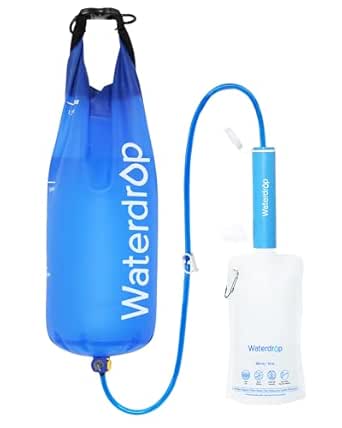 | Best Lightweight Gravity Setup | Filtration method: Hollow-fiber ultrafiltration membrane | Filter pore size: 0.1 micron | Water bag capacity: 1.5 gallons | VIEW LATEST PRICE | See Our Full Breakdown |
| LifeStraw Personal Water Filter, 5 Pack, Blue |  | Best for Distributing to Multiple People | Pack quantity: 5 filters | Filter capacity: Up to 4,000 liters (1,000 gallons) per filter | Filter weight: 1.6 oz | VIEW LATEST PRICE | See Our Full Breakdown |
| ITEHIL Portable Electric Water Filter with Solar Charging, 0.01-Micron Filtration | 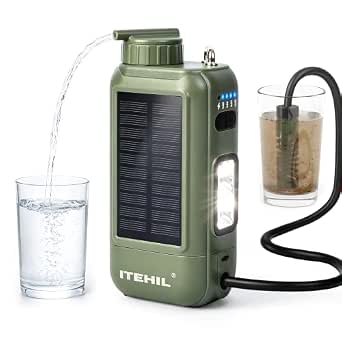 | Best for Powered, Multi-Use Preparedness | Filtration precision: 0.01 microns | Purification method: Ahlstrom filter and hollow-fiber membrane filtration | Flow rate: 700 ml/min | VIEW LATEST PRICE | See Our Full Breakdown |
| Practical Survival Reusable Emergency Water Filter Straws, 2-Pack |  | Best Two-Person Straw Backup | Quantity: 2 filters | Filtration method: Hollow-fiber membrane | Bacteria and parasite removal: Over 99.99% | VIEW LATEST PRICE | See Our Full Breakdown |
| Aquatabs Water Purification Tablets, 397 mg, 100 Count |  | Best Chemical Treatment Backup | Tablet strength: 397 mg | Quantity: 100 tablets | Water capacity: Up to 4 gallons | VIEW LATEST PRICE | See Our Full Breakdown |
| LifeStraw Go Series Insulated Steel Water Filter Bottle, 24 oz, Kyoto Orange |  | Best Insulated Everyday Emergency Bottle | Capacity: 0.7 liters (24 oz) | Material: Stainless steel | Insulation: Double-wall vacuum insulation | VIEW LATEST PRICE | See Our Full Breakdown |
| Sawyer Squeeze Water Filtration System with CNOC 2-Liter Bladder |  | Best for Flexible Field Filtration | Purification method: Hollow-fiber membrane | Filtration pore size: 0.1 micron absolute | Bladder capacity: 2 liters (64 ounces) | VIEW LATEST PRICE | See Our Full Breakdown |
| LifeStraw Personal Water Filter for Hiking, Travel, and Emergencies |  | Best Compact Grab-and-Go Filter | Filter type: Hollow-fiber membrane straw | Bacteria reduction: 99.999999% | Parasite reduction: 99.999% | VIEW LATEST PRICE | See Our Full Breakdown |
| 1-Gallon Gravity-Fed Water Filter Bag with 0.1-Micron Filter Straw |  | Best for Hands-Free Batch Filtering | Bag capacity: 1 gallon (3.78 liters) | Filter pore size: 0.1 micron | Filtration stages: 4 | VIEW LATEST PRICE | See Our Full Breakdown |
| Practical Survival Reusable Emergency Water Filter Straws, 5-Pack |  | Best Multi-Person Straw Reserve | Pack quantity: 5 filters | Purification method: Hollow-fiber membrane | Filtration claim: Removes over 99.99% of waterborne bacteria and parasites | VIEW LATEST PRICE | See Our Full Breakdown |
| 1-Gallon Gravity-Fed Water Filter Bag with 0.1-Micron Filter Straw, 2-Pack |  | Best Two-Station Gravity Kit | Pack quantity: 2 sets | Bag capacity: 1 gallon (3.78 liters) per bag | Filter media: 0.1-micron hollow-fiber membrane, coconut-shell activated carbon, and dual PP pre-filters | VIEW LATEST PRICE | See Our Full Breakdown |
| emergency water filtration system | Weight | Dimensions |
|---|---|---|
| Sawyer Products SP129 Squeeze | — | — |
| Waterdrop TK Gravity Water Fil | — | 9.44 × 9.44 × 15.74 inches |
| Katadyn Vario Dual Mode Hand P | — | — |
| Waterdrop Gravity Water Filter | 4.64 oz | — |
| LifeStraw Personal Water Filte | — | 3.75 × 12 × 1.39 inches |
| ITEHIL Portable Electric Water | — | 3.2 × 2.4 × 7 in |
| Practical Survival Reusable Em | 56.7 g | 8 × 1.5 × 1.5 inches |
| Aquatabs Water Purification Ta | 0.06 kg | — |
| LifeStraw Go Series Insulated | 515 g | 3.35 × 3.35 × 11.02 inches |
| Sawyer Squeeze Water Filtratio | — | 5.5 × 2 × 11.75 inches |
| LifeStraw Personal Water Filte | 1.62 oz | 3.75 × 12 × 1.39 in |
| 1-Gallon Gravity-Fed Water Fil | 1.5 pounds | — |
| Practical Survival Reusable Em | 56.7 g | — |
| 1-Gallon Gravity-Fed Water Fil | 1.5 pounds | — |
More Details on Our Top Picks
Sawyer Products SP129 Squeeze Water Filtration System with Two 32 oz Pouches
The Sawyer SP129 earns my lead spot for emergencies because it can serve one person directly or help fill containers without relying on power. Its 0.1-micron hollow-fiber filter and connections for the included pouches, compatible bottles, and hydration packs give it more setup options than the LifeStraw Personal Water Filter, which is designed primarily for drinking straight from a source. The pouches also pack flat, and backwashing can help restore flow over a long service life. The tradeoff is effort: squeezing a pouch takes hands-on time, especially when several people need water. Bottle use depends on a compatible 28 mm thread, so I would not treat every bottle as a fit. This is the most adaptable compact pick here, but not the easiest option for producing water in bulk.
Pros:- Light 2-ounce filter is easy to store in an emergency kit or pack.
- Works with the included pouches, compatible bottles, and hydration packs.
- Two reusable 32-ounce pouches roll up for compact storage.
- Backwashable design and stated capacity of up to 100,000 gallons support extended use.
Cons:- Pouch use requires manual squeezing, which can slow water preparation for a group.
- Bottle compatibility depends on a standard 28 mm thread.
- Does not provide the hands-off batch filling of a gravity system.
Best for: Preparedness-minded hikers and small households who want one compact filter that can connect to several kinds of containers.
Not ideal for: Groups that need a large volume of water with little effort, or buyers whose bottles do not use compatible 28 mm threads.
- Filter pore size:0.1 micron absolute
- Filter weight:2 oz
- Included pouches:Two reusable, collapsible 32 oz BPA-free pouches
- Compatibility:Most standard 28 mm plastic water bottles
- Included accessories:Drinking straw, hydration pack adapters, mesh storage bag
- Stated filter lifespan:Up to 100,000 gallons
- Backwashing:Can restore up to 98% of original flow rate
Our verdict“Choose the Sawyer SP129 if you want a compact, adaptable filter for individual use and occasional container filling, and can accept manual squeezing.”
Waterdrop TK Gravity Water Filter System, NSF/ANSI 42&372 Standard
For a home emergency station, the Waterdrop TK offers something the portable Sawyer SP129 and the Waterdrop Gravity Water Filter Straw cannot: a 2.25-gallon stainless-steel countertop tank that holds treated water ready to dispense. Its gravity-fed operation needs no electricity, and the sight-glass spigot makes the remaining level easy to check. The stated NSF/ANSI 42 certification covers chlorine, taste, and odor reduction, while NSF/ANSI 372 relates to lead content in the system materials; those claims should not be read as proof of pathogen removal. That distinction matters in an emergency: this carbon system is best for improving suitable tap water, not treating an unknown surface-water source. Its fixed countertop format also takes up space and is far less portable than the squeeze and straw filters. I’d choose it for household convenience, not as a stand-alone wilderness purifier.
Pros:- 2.25-gallon capacity provides a useful household reserve in a countertop format.
- Gravity operation does not depend on electricity.
- Stainless-steel housing and visible water-level spigot support durable, easy-to-monitor use.
- Two carbon filters are stated to process up to 6,000 gallons.
Cons:- The stated NSF/ANSI 42 claim concerns chlorine, taste, and odor reduction, not pathogen removal.
- Countertop housing is bulkier and less portable than the Sawyer SP129 or Waterdrop gravity straw.
- Filter installation and flushing are needed before use.
Best for: Households seeking a non-electric countertop dispenser for improving the taste and odor of suitable tap water during outages.
Not ideal for: People who need a lightweight field filter or a system with stated bacteria and protozoa removal for untreated surface water.
- Capacity:2.25 gallons
- Housing material:304 food-grade stainless steel
- Filtration method:Gravity-fed carbon filtration
- Filter configuration:Supports up to two carbon filters and two fluoride filters
- Stated carbon filter capacity:Up to 6,000 gallons with two carbon filters
- Certification claims:NSF/ANSI 42 for carbon filter; NSF/ANSI 372 for system
- Dimensions:9.44 × 9.44 × 15.74 inches
- Power:No electricity required
Our verdict“Pick the Waterdrop TK for a household tap-water backup where taste and odor improvement matter more than portability or pathogen treatment.”
Katadyn Vario Dual Mode Hand Pump Continuous Water Filter for Backcountry
The Katadyn Vario is the most adaptable pump in this group when water quality varies. Its dial switches between a faster-flow mode for clearer water and a longer-life mode that uses a cleanable ceramic pre-filter for silty conditions. That makes it a better match for changing backcountry sources than the simpler Sawyer SP129, which relies on squeezing or compatible connections rather than a hand pump. The Vario also combines glass-fiber filtration with activated carbon and can pump up to 2 liters per minute under stated conditions. The price of that flexibility is mechanical effort and more parts to manage: intake and output hoses, a pump, and a cartridge with a stated 530-gallon capacity. I’d favor it when source conditions are unpredictable, but skip it if a small, low-maintenance filter matters more than controlled pumping.
Pros:- Two modes let users trade faster flow for added pre-filtration in turbid conditions.
- Cleanable ceramic pre-filter can help protect the main cartridge when water is silty.
- Connects to most water bottles and hydration packs with the included adapter.
- Up to 2 liters per minute is stated for pumping under suitable conditions.
Cons:- Hand pumping takes sustained effort compared with gravity-fed systems.
- Stated cartridge capacity of up to 530 gallons is lower than the stated capacities of the Sawyer SP129 and Waterdrop gravity straw.
- Pump, hoses, and cleaning components add setup and maintenance compared with a simple filter straw.
Best for: Backpackers and emergency planners who may draw from silty sources and want a pump with selectable filtration modes.
Not ideal for: Minimalist kit builders who want the lightest possible setup or people who need high-volume household storage rather than hand-pumped batches.
- Filter stages:Glass fiber, cleanable ceramic pre-filter, and activated carbon granules
- Glass-fiber pore size:0.2 micron
- Maximum flow rate:Up to 2 liters per minute
- Stated cartridge capacity:Up to 530 gallons
- Listed filter weight:15 oz
- Modes:Longer Life and Faster Flow
- Included components:Intake hose with float, output hose with clip, bottle-compatible base, ceramic disc, cleaning pad, carry bag
- Power:Hand-operated pump
Our verdict“Choose the Katadyn Vario if you expect changing or silty water sources and value adjustable pumping modes over a lighter, simpler filter.”
Waterdrop Gravity Water Filter Straw with 1.5-Gallon Water Bag
This Waterdrop kit bridges the gap between a personal straw and a countertop gravity tank: its 1.5-gallon bag lets water filter through without hand-squeezing, while the filter weighs just 4.64 ounces. That makes it easier to prepare a shared supply than the LifeStraw Personal Water Filter, which is mainly for drinking directly, yet far more packable than the stainless-steel Waterdrop TK. The 0.1-micron hollow-fiber membrane, backwashable design, and stated 1,400-gallon capacity suit repeated outdoor or emergency use. The main limits are the bag’s finite batch size and the need for clean water to backwash. Its listed maximum supported TDS is 300 ppm, so I would not choose it for water outside that stated range or assume it addresses every dissolved contaminant. It’s a practical middle ground for mobile users who want hands-off filling without a rigid tank.
Pros:- 1.5-gallon bag supports batch filtering without manual squeezing.
- Light 4.64-ounce filter is more portable than the Waterdrop TK countertop tank.
- Backwashable filter has a stated capacity of up to 1,400 gallons.
- Includes a separate 16-ounce water pouch alongside the gravity bag.
Cons:- The bag holds less than the Waterdrop TK’s 2.25-gallon countertop system.
- Backwashing requires access to clean water.
- Listed maximum supported TDS is 300 ppm.
Best for: Campers and small emergency-kit owners who want to filter a shared batch by gravity while keeping the setup lightweight.
Not ideal for: Households needing a large, durable countertop reservoir or buyers who need treatment for high-TDS water beyond the stated limit.
- Filtration method:Hollow-fiber ultrafiltration membrane
- Filter pore size:0.1 micron
- Water bag capacity:1.5 gallons
- Stated filter capacity:1,400 gallons (5,300 liters)
- Maximum flow rate:700 ml/min
- Maximum supported TDS:300 ppm
- Weight:4.64 oz
- Included components:Filter straw, 1.5-gallon gravity-fed water bag, 16-ounce water pouch
Our verdict“Choose this Waterdrop straw kit for portable, hands-off batch filtering when a 1.5-gallon bag is enough and the water fits its stated limits.”
LifeStraw Personal Water Filter, 5 Pack, Blue
The five-filter pack stands out for preparedness groups that want to hand each person a simple, independent way to drink from a water source. Each 1.6-ounce LifeStraw works without batteries or setup, unlike the hand-pumped Katadyn Vario or the bag-and-hose arrangement of the Waterdrop gravity straw. The listed membrane claims cover bacteria, parasites, microplastics, and turbidity, with up to 4,000 liters of stated use per filter. That is useful for a go-bag or evacuation kit, but these are personal drinking filters: they are less convenient for filling pots, bottles, or a shared reserve. Flow is also limited to one person drinking at a time, even with five filters on hand. I’d choose this pack for simple distribution and redundancy, not for central household water production or filtering into storage containers.
Pros:- Five individual filters allow distribution across a household or group.
- No electricity or batteries are required.
- Each filter weighs 1.6 ounces and is easy to pack.
- Stated capacity is up to 4,000 liters per filter.
Cons:- Personal straw format is less useful for filling larger containers than the Sawyer SP129 or Waterdrop gravity straw.
- A group must use multiple filters in turn rather than produce a shared batch.
- The listed dimensions are wide for a single personal filter.
Best for: Families, school groups, and emergency-kit organizers who want to distribute individual, no-power drinking filters.
Not ideal for: Buyers who need to fill containers for cooking or store a shared water supply, since the straw format is intended for direct drinking.
- Pack quantity:5 filters
- Filter capacity:Up to 4,000 liters (1,000 gallons) per filter
- Filter weight:1.6 oz
- Dimensions:3.75 × 12 × 1.39 inches
- Maximum flow rate:1,000 liters per hour
- Temperature range:1 °C to 60 °C
- Maximum supported TDS:1,000 ppm
- Material:BPA-free plastic
Our verdict“Choose the five-pack when you need simple, individual drinking filters for several people, not a system for preparing shared water reserves.”
ITEHIL Portable Electric Water Filter with Solar Charging, 0.01-Micron Filtration
The ITEHIL stands out for emergency kits where powered filtration and backup electronics are useful together. Its stated 0.01-micron hollow-fiber filtration and 700 ml-per-minute flow give it a different role from the manual Sawyer Squeeze: the ITEHIL runs on a rechargeable battery, while the Sawyer relies on squeezing or gravity. USB-C charging is practical before an outage, and solar charging offers another option when power is unavailable, though the listing says solar charging may take 30 minutes to produce a liter. Its built-in light and power-bank function add utility, but also mean more components to manage than a simple filter straw. The stated cartridge life is up to 1,000 liters, with replacement timing dependent on water quality and declining flow. I would choose it for flexible backup use, not as the lightest or simplest option.
Pros:- USB-C and solar charging provide more than one way to replenish power.
- Stated 0.01-micron filtration and 700 ml-per-minute flow suit repeated water treatment.
- Can also serve as an emergency light and power bank.
- Compact body includes a hook for attachment to a backpack.
Cons:- Solar charging may take 30 minutes to produce one liter, limiting its usefulness when water is needed quickly.
- Filter replacement timing varies with source-water quality and may be signaled by reduced flow.
- Battery dependence adds a failure point that manual options such as the Sawyer Squeeze avoid.
Best for: Preparedness-minded campers and households who want powered water filtration plus a light and emergency power-bank function.
Not ideal for: Ultralight hikers or people who want a simple, battery-free filter; its charging needs and extra functions add complexity.
- Filtration precision:0.01 microns
- Purification method:Ahlstrom filter and hollow-fiber membrane filtration
- Flow rate:700 ml/min
- Filter life:Up to 1,000 liters
- Battery capacity:5,200 mAh
- Charging options:USB-C and solar
- Battery runtime:Up to 4 hours
- Dimensions:3.2 × 2.4 × 7 in
Our verdict“Choose the ITEHIL if you want a rechargeable emergency filter with added power and lighting functions, and can accept slower solar charging and battery upkeep.”
Practical Survival Reusable Emergency Water Filter Straws, 2-Pack
This two-filter set makes sense when separate, ready-to-use drinking options matter more than collecting and treating a larger batch. Each person can use a straw directly at a water source, while the included backflushing plunger helps maintain flow over time. Compared with the Sawyer Squeeze with CNOC 2-Liter Bladder, these straws are more straightforward for direct drinking, but they do not offer the same bag-based collection or gravity setup. The listing describes removal of bacteria, parasites, and microplastics down to 0.1 micron, but gives conflicting filter capacities: 1,800 gallons in the description and 1,100 gallons in the specifications. I would plan around the lower figure unless the manufacturer clarifies it. Backflushing is useful maintenance, though it adds a step that a disposable emergency treatment does not require.
Pros:- Two independent filters let two people drink without sharing one mouthpiece.
- Hollow-fiber filtration is described as addressing bacteria, parasites, and microplastics down to 0.1 micron.
- Each filter includes a backflushing plunger for maintenance.
- Lightweight, BPA-free construction suits compact emergency kits.
Cons:- Published capacity conflicts between 1,100 and 1,800 gallons, making service-life planning uncertain.
- Direct-use straws are less convenient than the Sawyer Squeeze system for filling containers or setting up gravity filtration.
- Backflushing requires maintenance equipment and effort.
Best for: Two campers or household members who want individual, reusable filters for direct drinking from suitable freshwater sources.
Not ideal for: People who need treated water collected for cooking or group use, or who want consistent capacity information before buying.
- Quantity:2 filters
- Filtration method:Hollow-fiber membrane
- Bacteria and parasite removal:Over 99.99%
- Microplastic filtration:Down to 0.1 micron
- Stated filter capacity:Conflicting listing figures: up to 1,800 gallons in description and 1,100 gallons in specifications
- Dimensions:8 × 1.5 × 1.5 inches
- Weight:56.7 g
- Included components:One backflushing plunger per filter; user manual
Our verdict“Pick this set for two people who want compact direct-drinking filters, but skip it if you need batch treatment or a clearly stated capacity.”
Aquatabs Water Purification Tablets, 397 mg, 100 Count
Aquatabs are the most compact backup here for treating microbes without carrying a pump or filter. The tablets are described as treating up to four gallons in 30 minutes and addressing bacteria, viruses, and cysts—a broader set of purification claims than the filter-focused Practical Survival straws, which are described for bacteria and parasites. That makes tablets useful when a virus-treatment option is part of an emergency plan, but they do not remove sediment, so cloudy source water may still need filtering or settling first. The wait time also means this is not instant access to drinking water. The listing states the tablets leave no noticeable taste, color, or odor, and gives an expiration date of February 2029; I would track that date and replace the supply when needed. This is a strong kit supplement, not a full substitute for filtration.
Pros:- Tablets are lightweight and compact for emergency kits and travel.
- Each treatment is described as addressing bacteria, viruses, and cysts.
- Treats up to four gallons with a stated 30-minute wait.
- Listing says treatment leaves no noticeable taste, color, or odor.
Cons:- Requires a 30-minute treatment wait before drinking.
- Does not remove sediment, so cloudy water may need a separate filter or settling step.
- Supplies have an expiration date that requires rotation.
Best for: Hikers, travelers, and emergency-kit planners who want a lightweight treatment option described as addressing bacteria, viruses, and cysts.
Not ideal for: People who need immediate drinking water or have only sediment-heavy sources and no way to prefilter them.
- Tablet strength:397 mg
- Quantity:100 tablets
- Water capacity:Up to 4 gallons
- Treatment time:30 minutes
- Purification claims:99.9999% of bacteria, 99.99% of viruses, and 99.9% of cysts
- Container type:Bag
- Weight:0.06 kg
- Expiration date:February 2029
Our verdict“Choose Aquatabs as a compact microbial-treatment backup, especially when virus treatment matters, but pair them with a way to handle sediment.”
LifeStraw Go Series Insulated Steel Water Filter Bottle, 24 oz, Kyoto Orange
The LifeStraw Go is best viewed as an everyday bottle with emergency filtration built in, rather than a high-volume household treatment system. Its two-stage setup combines a hollow-fiber membrane for bacteria, parasites, microplastics, and sediment with activated carbon to reduce chlorine and improve taste. That carbon stage is a useful difference from the Practical Survival filter straws, which focus on direct-use filtration, but it has a much shorter stated life: about 26 gallons or two months. The insulated stainless-steel body keeps water cool and feels more durable than a lightweight bladder system, though its 515 g weight makes it less appealing for long hikes. Its 24-ounce capacity also means repeated refills for groups. I would pick it for a personal grab-and-go kit that doubles as a daily bottle, not for storing or treating large amounts of emergency water.
Pros:- Two-stage filtration addresses microbes and particles while activated carbon reduces chlorine and improves taste.
- Double-wall vacuum insulation helps keep water cool.
- Stainless-steel construction offers a sturdy everyday bottle format.
- Membrane filter life is stated at up to 1,000 gallons.
Cons:- The carbon filter lasts only about 26 gallons or two months, requiring more frequent replacement than the membrane.
- At 515 g, it is heavier than simple straw or squeeze-filter options.
- The 24-ounce bottle capacity is limiting when treating water for more than one person.
Best for: Commuters and travelers who want a reusable daily bottle that can also filter water during an evacuation or short-term disruption.
Not ideal for: Ultralight hikers, families treating water for several people, or buyers who do not want to replace the carbon filter frequently.
- Capacity:0.7 liters (24 oz)
- Material:Stainless steel
- Insulation:Double-wall vacuum insulation
- Purification method:Activated carbon and hollow-fiber membrane
- Membrane filter life:Up to 1,000 gallons (4,000 liters)
- Carbon filter life:Up to 26 gallons (100 liters), about 2 months
- Dimensions:3.35 × 3.35 × 11.02 inches
- Weight:515 g
Our verdict“Choose this LifeStraw if you want one insulated bottle for daily use and personal emergency filtration, not a lightweight or high-capacity group solution.”
Sawyer Squeeze Water Filtration System with CNOC 2-Liter Bladder
The Sawyer Squeeze with CNOC bladder is the most adaptable manual option in this group for people who need to collect, carry, and filter water in the field. Its wide-opening 2-liter bladder simplifies filling, and the filter can connect to compatible threaded bottles or work in a gravity setup. That gives it more flexibility than the Practical Survival filter straws, which are primarily for direct drinking, while avoiding the battery dependence of the ITEHIL. The tradeoff is effort: squeezing takes hand pressure, and a gravity setup takes time and a suitable place to hang the bag. Flow can also slow and require backwashing. The stated filter lifespan is very high, but that does not remove the need for care and maintenance. I would choose this system for trips or emergency kits where a reusable, manually operated filter and collected water are more useful than a ready-to-drink bottle.
Pros:- Wide-mouth 2-liter bladder makes it easier to collect water than a narrow-neck container.
- Can be squeezed, connected to compatible threaded bottles, or used in a gravity setup.
- Backwashable hollow-fiber filter supports field maintenance and repeated use.
- System weighs less than 6 ounces.
Cons:- Manual squeezing requires effort, while gravity filtration needs setup time and a suitable hanging point.
- Flow can decrease and require backwashing.
- The stated lifespan does not eliminate the need to protect and maintain the filter.
Best for: Backpackers and emergency planners who want a lightweight filter that can collect two liters, connect to compatible bottles, or run by gravity.
Not ideal for: People with limited hand strength or anyone who needs fast, low-effort water treatment without squeezing, setup, or backwashing.
- Purification method:Hollow-fiber membrane
- Filtration pore size:0.1 micron absolute
- Bladder capacity:2 liters (64 ounces)
- Bladder material:TPU
- System weight:Less than 6 ounces
- Dimensions:5.5 × 2 × 11.75 inches
- Power source:Manual
- Filter lifespan:Up to 100,000 gallons
Our verdict“Choose the Sawyer Squeeze with CNOC bladder if you want a lightweight, reusable system for collecting and filtering water in several ways and do not mind manual upkeep.”
LifeStraw Personal Water Filter for Hiking, Travel, and Emergencies
For an emergency kit that needs to stay light and simple, the LifeStraw Personal Water Filter is the most packable choice here: at 1.62 ounces, it needs no power and can draw water directly from a natural source. Its hollow-fiber membrane is specified to reduce bacteria, parasites, microplastics, and sediment, making it more capable against those contaminants than purification tablets alone. Unlike the 1-gallon gravity-fed filter bags in this lineup, it does not collect water for a group or let you fill a clean container hands-free; you drink through the straw or supply your own vessel. The published capacity also varies: the specs list 1,000 liters, while another section states 4,000 liters. I’d choose it for individual backup, not as a household water station.
Pros:- Weighs only 1.62 ounces and requires no batteries or electricity.
- Designed to reduce bacteria, parasites, microplastics, and sediment.
- Can be used directly at a natural water source or with water in a container.
- BPA-free construction suits a lightweight personal kit.
Cons:- Does not provide a hands-free way to filter water into a storage container.
- The listed capacity is inconsistent: 1,000 liters in the specs versus 4,000 liters elsewhere in the product information.
Best for: Solo hikers, travelers, and emergency-kit builders who want a very light, power-free way to drink from natural water sources.
Not ideal for: Families or anyone who needs to filter and store several servings at once; the straw is designed for individual drinking and requires a separate container for collected water.
- Filter type:Hollow-fiber membrane straw
- Bacteria reduction:99.999999%
- Parasite reduction:99.999%
- Microplastic reduction:99.999%; down to 1 micron
- Listed capacity:1,000 liters; another product section states 4,000 liters
- Weight:1.62 oz
- Dimensions:3.75 × 12 × 1.39 in
- Power:None required
Our verdict“Choose this LifeStraw for compact, one-person emergency drinking; pick a gravity bag if you need a larger batch for multiple people.”
1-Gallon Gravity-Fed Water Filter Bag with 0.1-Micron Filter Straw
This 1-gallon gravity bag suits a campsite or emergency shelter where a filled reservoir can hang while water filters without pumping or electricity. Its main advantage over the LifeStraw Personal Water Filter is the ability to collect a larger batch rather than have each person drink through a straw. The food-grade TPU bag is reusable, and the replaceable filter is specified at 0.1 micron with a stated life of up to 1,057 gallons. That setup is useful for shared access, but it depends on having a secure hanging point and a hose without trapped air. The flow information is inconsistent: one listing gives 300 ml/min, while another gives 3 liters/min. I’d favor this over a squeeze-style option when hands-free filtering matters, but not when reliable, clearly stated flow performance is the priority.
Pros:- Filters by gravity without electricity, pumping, or squeezing.
- One-gallon capacity supports batch filtering for shared use.
- Food-grade, BPA-free TPU bag is portable and reusable.
- Replaceable 0.1-micron filter is rated for up to 1,057 gallons.
Cons:- Requires a secure place to hang the filled bag.
- Product information gives conflicting maximum flow rates of 300 ml/min and 3 liters/min.
- Trapped air in the hose can interfere with flow, and performance depends on source water quality.
Best for: Campers and emergency-preparedness households with a sturdy place to hang a one-gallon bag and time to filter water without pumping.
Not ideal for: People who need a freestanding filter, a dependable stated flow rate, or a setup that works without a hanging point.
- Bag capacity:1 gallon (3.78 liters)
- Filter pore size:0.1 micron
- Filtration stages:4
- Filter life:Up to 1,057 gallons (4,000 liters)
- Maximum flow rate:300 ml/min; product information also lists 3 liters/min
- Bag material:Food-grade TPU; BPA-free
- Weight:1.5 pounds
- Power:No power required
Our verdict“Pick this bag when hands-free, one-gallon filtering suits your setup; skip it if you cannot hang it securely or need a consistent published flow rate.”
Practical Survival Reusable Emergency Water Filter Straws, 5-Pack
Where the single LifeStraw Personal Water Filter is a compact backup for one person, this five-pack lets a group keep separate filters in individual kits or distribute them among family members. Each hollow-fiber straw is specified to filter down to 0.1 micron, reduce bacteria and parasites, and handle up to 1,800 gallons; each also comes with a backflushing plunger for maintenance. That combination makes the pack a more scalable emergency reserve than buying one personal straw, though it still does not create a shared water reservoir: users need access to a source and drink through their own filter. The product information gives a six-year shelf life, so it is less suited to a set-and-forget cache intended to sit indefinitely. I’d choose it for distributed personal kits, not for hands-free household water service.
Pros:- Five individual filters can be placed in separate emergency or travel kits.
- Each filter is rated for up to 1,800 gallons.
- 0.1-micron hollow-fiber filtration is specified to reduce bacteria, parasites, and microplastics.
- An individually supplied backflushing plunger supports filter maintenance.
Cons:- Does not filter into a shared storage vessel; each person must use a straw or arrange a compatible container.
- Requires access to a water source and gravity for operation.
- The stated six-year shelf life limits suitability for very long-term storage.
Best for: Families, group campers, and preparedness planners who want a separate reusable straw filter for each person.
Not ideal for: Households seeking a common filtered-water container or a long-term cache beyond the stated six-year shelf life.
- Pack quantity:5 filters
- Purification method:Hollow-fiber membrane
- Filtration claim:Removes over 99.99% of waterborne bacteria and parasites
- Capacity:Up to 1,800 gallons per filter
- Weight:56.7 g
- Shelf life:6 years
- Included maintenance accessory:One backflushing plunger per filter
Our verdict“Choose this pack to equip several people with individual reusable filters, but choose a gravity bag for shared, hands-free batch filtering.”
1-Gallon Gravity-Fed Water Filter Bag with 0.1-Micron Filter Straw, 2-Pack
This two-set option is for buyers who want two separate one-gallon gravity stations, not just a spare personal straw. Each bag uses a 0.1-micron hollow-fiber membrane, coconut-shell activated carbon, and dual PP pre-filters; compared with the single 1-gallon gravity bag in this roundup, the extra set can serve a second location or provide a ready backup. The bags hang for filtering without power or pumping, which is more convenient for shared water access than the Practical Survival five-pack of straws. The tradeoff is setup: each bag needs a secure hanging point, and trapped air can impede the hose. Flow data also conflicts, listing 300 ml/min in the description and 3 liters/min in the specifications. Its multi-stage media is appealing, but source-water quality still affects performance.
Pros:- Two complete one-gallon sets provide a second station or backup.
- Gravity operation requires no electricity, pumping, or squeezing.
- Combines a 0.1-micron hollow-fiber membrane, activated carbon, and dual PP pre-filters.
- Reusable food-grade TPU bags include adjustable hanging straps.
Cons:- Both bags require secure hanging points for gravity filtration.
- Published flow rates conflict: 300 ml/min in the description and 3 liters/min in the specifications.
- The stated filter life and performance depend on source-water quality.
Best for: Households or camp groups that want two independent gravity-filtering setups for separate locations, backup, or parallel use.
Not ideal for: Solo users with limited storage space, or buyers who cannot hang the bags and want a clearly specified filtration flow rate.
- Pack quantity:2 sets
- Bag capacity:1 gallon (3.78 liters) per bag
- Filter media:0.1-micron hollow-fiber membrane, coconut-shell activated carbon, and dual PP pre-filters
- Filter life:Up to 1,057 gallons (4,000 liters)
- Maximum flow rate:300 ml/min in description; 3 liters/min in specifications
- Bag material:Food-grade TPU
- Weight:1.5 pounds
- Certifications:Independently tested by NSF and SGS; designed to meet NSF/ANSI 42, 372, and 401 standards
Our verdict“Choose this two-pack when you need two gravity-fed water stations or a full spare set; a single bag is a simpler fit for one-person use.”
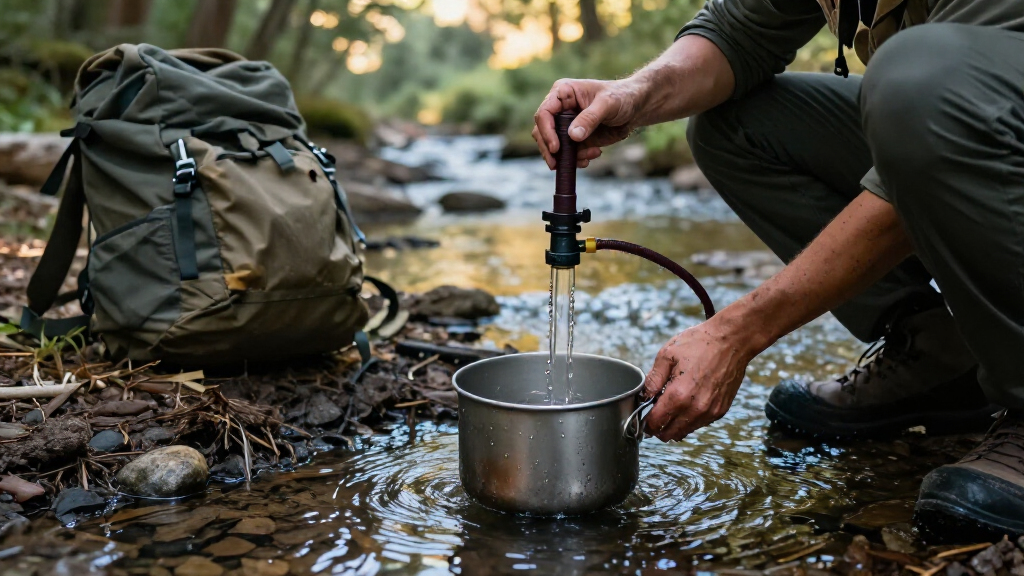
How We Picked
I ranked these emergency water filtration systems by how well their format serves realistic emergency needs: personal drinking, collecting and preparing water for several people, or keeping a compact backup in a kit. I compared the stated capacity and setup, portability, need for hand pumping or power, and how easily each option can fit a water-preparation routine. I also treated the listed filtration claims and standards as product-specific claims, not as proof that every system addresses every contaminant.
Ranking reflects role and practical flexibility, not a claim that one treatment method is universally safest. Systems that can collect and process more water without relying on electricity rank ahead for general emergency readiness, while personal straws, bottles, and tablets earn places for focused needs such as individual portability or a non-filter backup. Build and maintenance matter too: a filter that needs cleaning, replacement parts, or careful storage may be a poor fit if the owner cannot keep it ready. Readers should check each manufacturer’s instructions and confirm the system’s stated treatment scope matches their water source.
Factors to Consider When Choosing Emergency Water Filtration Systems
Choosing a system is less about picking the smallest device and more about planning how water will move from source to drinker. I’d start with the likely water source, the number of people, and whether you need to prepare water ahead of time or drink while traveling. These broader factors can change which format makes sense, even when two products appear to offer similar filtration.
Match Treatment Claims to the Water Risk
Filtration and disinfection are not interchangeable. A filter’s stated pore size or standard does not by itself tell you that it addresses every biological or chemical hazard in an emergency source. Tablets use a different treatment approach, while many personal filters are designed around specific types of waterborne contaminants. Check the manufacturer’s documentation for the exact organisms and substances addressed, plus any limitations for cloudy or chemically contaminated water. A common mistake is assuming that clearer-tasting water is safe, or that one device can handle every hazard. If the source is uncertain, plan for a treatment method suited to that risk rather than relying on a broad product label.
Plan Around Group Size and Daily Volume
One-person convenience does not scale automatically. A straw or bottle may be easy to carry, but it usually serves its user directly rather than producing a shared supply for cooking, pets, or other household members. Gravity bags, larger reservoirs, and pumps can support batch preparation, though their capacity and flow still determine how often you must refill or wait. Estimate the water your group needs for drinking and food preparation, then consider how often you can reach the source. Avoid equating a listed container volume with the amount of safe water available for an entire day. For a household plan, pairing a bulk-capable system with an individual backup can be more practical than buying several personal straws alone.
Choose a Workflow You Can Use Under Stress
Setup friction matters when time and attention are limited. Squeeze systems require filling a pouch or bladder and applying pressure; gravity systems need a place to hang or position the bag; pumps call for repeated manual operation. A bottle or straw can be simpler for immediate personal use, but it may not help when you need to fill a separate cooking container. Think through where you would collect water, how you would keep clean and untreated water apart, and whether the setup works without a table or sturdy branch. Practice with the instructions before an outage so the process is familiar. The easiest system for your actual surroundings is often more useful than a higher-capacity design that is awkward to operate.
Account for Power, Consumables, and Storage
Emergency readiness depends on what remains usable when utilities are unavailable. A solar-charged electric filter may appeal if its power setup suits your plan, but relying on electronics adds charging and component considerations. Manual filters avoid that dependency, while chemical tablets take little space but are consumable and have product-specific instructions and treatment times. Check filter replacement or cleaning guidance, storage conditions, and any shelf-life information before choosing. A device stored wet, damaged, or without its needed accessories may not be ready when called on. Keep treatment supplies together and inspect them periodically rather than assuming a packed kit stays ready indefinitely.
Decide Whether Portability or Shared Access Comes First
Compact carry and household output pull in different directions. A personal straw or filtered bottle makes sense for a go-bag, commuting, or a single person who may need to drink directly from a source. A gravity bag or pump is bulkier, but it can make treated water available in a container for more than one person. The best emergency setup may combine those roles: a shared system at home and a small personal option in a vehicle or evacuation bag. A frequent buying mistake is selecting only for backpack weight when the main scenario is a prolonged home interruption, or selecting a large system that is too cumbersome to take along. Let the expected location of use set the balance.
Budget for Maintenance and a Backup Method
The purchase is only one part of a workable water plan. Filters need to be used and maintained according to their instructions, and a damaged or clogged unit can interrupt access at the wrong time. A second device that uses the same approach may not provide much backup if the shared failure is contamination outside that method’s scope. Consider pairing a mechanical filter with a separately stored treatment option, while checking compatibility and instructions for each. Do not wait until an emergency to learn whether replacement parts are available or how the system should be cleaned after use. Spending more makes sense when it buys a useful capability for your situation, not simply a more elaborate device.
Frequently Asked Questions
Is a water filter straw enough for a household emergency kit?
Usually not by itself if several people need water. A straw is designed for direct personal drinking, so it does not readily produce a shared supply for cooking or filling containers. It can still be a useful compact backup for each person or for an evacuation bag. For household use, add a system that can collect and treat water in batches, or plan another way to prepare shared water. Check the treatment scope and instructions for every device rather than assuming multiple straws cover all water risks.
Should I choose a gravity filter or a pump for emergency water?
Choose based on how you expect to collect and prepare water. A gravity system suits batch preparation when you have a place to position the bag and can wait for water to pass through. A hand pump gives more direct control and may fit sources or setups where hanging a bag is inconvenient, but it requires repeated effort. Compare the actual capacity, hose or accessory needs, cleaning steps, and manufacturer-stated output rather than relying on format alone. If you may need both shared water and a portable option, a large system and a separate personal backup can cover different situations.
Can I use an emergency filter for water that may contain chemicals?
Do not assume a general water filter removes chemical contamination. Filtration claims vary by model, and a micron rating alone does not identify which dissolved substances a unit can reduce. Check the manufacturer’s documentation for the specific contaminants addressed and any limits on source water. If a source may contain fuel, industrial chemicals, or other hazardous substances, use official local guidance to identify a safe supply or suitable treatment approach. Clear water and a familiar filter design are not proof that chemically affected water is safe to drink.
Are water purification tablets a good backup to a filter?
They can add a compact, non-mechanical treatment option, but they are not a universal substitute. Tablets do not require a pump, pouch, or powered device, which can be useful if a filter is damaged or inconvenient to carry. Their effectiveness and required waiting time depend on the product instructions and water conditions, so read the label before an emergency. They also do not provide the same physical filtration function as a filter, which may matter when water contains sediment. A useful backup plan pairs methods only after checking the hazards each one addresses.
What should I check before storing an emergency water filter?
Start with the manufacturer’s storage and maintenance instructions. Confirm whether the filter must be dried, protected from freezing, or kept with particular accessories, and note any cleaning or replacement guidance. Store the unit where it will stay intact and easy to find, with its pouches, hoses, or charging equipment if needed. Check tablet expiration information and inspect the kit periodically rather than treating storage as a one-time task. It is also useful to review the setup before an emergency, since a stored filter may require steps that are easy to forget.
Conclusion
For most people seeking one flexible manual setup, I’d choose the Sawyer Squeeze with CNOC 2-Liter Bladder as best overall, especially when preparing water for more than one person matters. The Sawyer SP129 is my best-value-style pick for buyers who prefer an included pouch setup, while the Katadyn Vario is the best premium-style choice for someone specifically wanting a hand pump. For beginners who want a simple personal drinking format, the LifeStraw Personal Water Filter is easier to understand than a multi-part gravity or pump setup, though it is not a shared-water solution. Choose the Waterdrop 1.5-gallon gravity system for a larger listed batch capacity, and keep Aquatabs in mind as a compact treatment backup rather than a replacement for every filter. The right choice depends on who needs water, where it will come from, and what hazards the selected method is documented to address.