TL;DR

Get emergency and outdoor gear delivered free with Prime
- Fast, free delivery on millions of items
- Prime Video, Amazon Music and more included
- Member-only deals all year
An Outdoor Life report published Oct. 27, 2026, revisits an old-school approach to duck hunting: seek exposed places that receive little hunting pressure and adapt concealment to the terrain. It describes lying low in pastures and using an air mattress in shallow flooded fields, but does not provide comparative harvest data or establish that these tactics work in every location.
Outdoor Life published an old-school account of duck hunting that urges hunters to look beyond familiar cover and try exposed places waterfowl use but hunters often avoid. The report describes low-profile setups in pastures and flooded fields, arguing that concealment, patience and choosing less-pressured locations can create opportunities where conventional blinds are difficult to use.
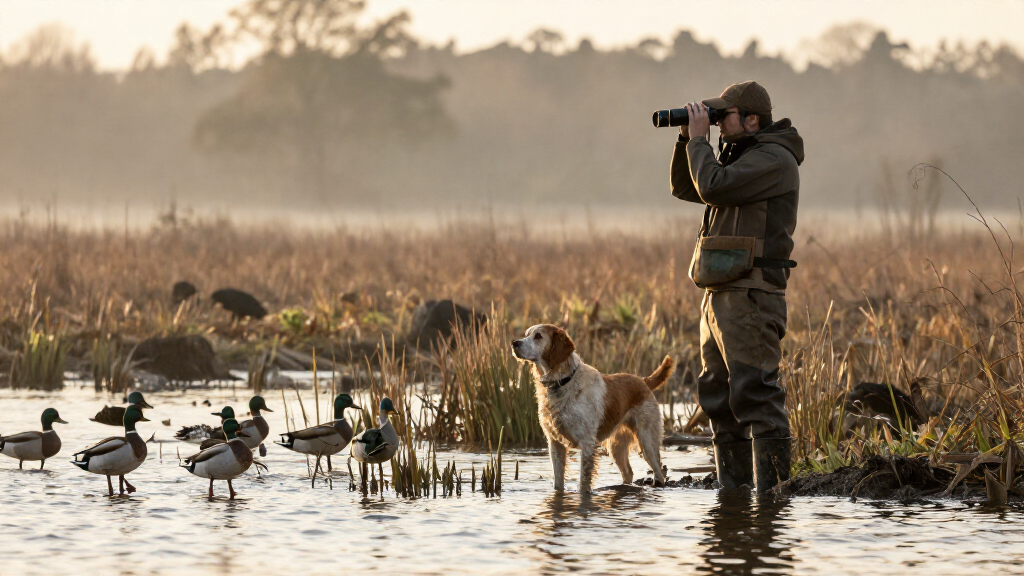
The report defines “hard places” as areas that may hold many ducks or geese but are challenging to hunt because they offer little natural cover. Examples include open pastures, flooded crop fields, large bodies of open water and expanses of ice. The author says such areas can receive less hunting pressure than familiar spots, though the article offers no survey or harvest figures to quantify that difference.
For pasture hunting, the author describes lying on the ground rather than erecting a blind, which may be conspicuous and unwelcome to landowners concerned about damage to sod. The advice is to remain still, match clothing to the ground and place decoys away from obvious cover such as ditches and weed patches. The report says the approach has worked for the author and hunting companions; it does not establish a general success rate.
In partly flooded fields, the author recounts using an air mattress as a low platform, with decoys placed downwind and camouflage cloth used to reduce visibility. For deeper water, the report suggests a small rubberized raft rather than an air mattress. Water depth and the ability to anchor equipment are described as practical limits; the account does not provide a full safety protocol.
Why Open Ground Can Matter
The report challenges the idea that worthwhile duck hunting is no longer available by pointing readers toward habitat that may be overlooked because setting up there is inconvenient. Its central argument is that hunting pressure can shape where birds are wary: the author says waterfowl in heavily hunted areas learn to avoid places associated with hunters, while birds in less-pressured open country may be less cautious.
That is the article’s explanation, not an independently tested finding in the supplied material. Still, the practical point is relevant to hunters deciding where to scout and how to adapt equipment: a location that appears difficult to conceal in may be worth investigating if birds use it and access is lawful. The techniques also depend on weather, terrain, water conditions and landowner permission; they are not guarantees of a successful hunt.
Popular right now

Sony BRAVIA XR8B 65-Inch 4K OLED Google TV (K-65XR8B)

Philips 2200 Series Fully Automatic Espresso Machine with Classic Milk Frother, 2 Coffee Varieties, Intuitive Touch Display, Ceramic Grinder

De'Longhi Rivelia Fully Automatic Espresso Machine with Milk Frother, White
As an affiliate, we earn on qualifying purchases.
The Article’s Open-Country Approach
The piece was published in Outdoor Life’s waterfowl coverage on Oct. 27, 2026. It frames its advice against a familiar complaint among hunters—that duck hunting was easier decades ago—and counters that millions of ducks and geese still move through flyways each fall. The report does not give a specific population estimate or compare current hunting results with those from 25 years earlier.
The author draws on personal experience in Oregon, where Canada geese feed and rest on pastures, and on examples involving flooded grainfields. The article’s emphasis is less on specialized gear than on finding habitat birds use and minimizing visible movement. Its descriptions are presented as the author’s methods and observations, rather than as formal research or universal instructions.
“It’s just that you have to hunt the hard places.”
— Outdoor Life report
What the Report Does Not Establish
The supplied article provides personal examples but no independent data on success rates, bird numbers or hunting pressure. It is not clear how often the described setups produced opportunities, how well they perform in different regions, or whether conditions have changed since the author’s experiences. The report also does not specify local regulations for equipment, access or hunting methods; rules vary by jurisdiction and should be checked before a hunt.
Safety details are limited, particularly for using an air mattress or raft around water and ice. The account says an air mattress should not be used in deep water, but it does not set out guidance on cold-water exposure, flotation equipment or other hazards. Its methods should not be treated as a substitute for local regulations, safe boating practices and sound judgment about conditions.
Scouting Before the Next Hunt
The article does not announce a scheduled follow-up or a new hunting program. Its practical next step for readers is to scout areas where waterfowl are present but conventional setups are difficult, then assess access, cover, wind and water depth before choosing equipment. Hunters should obtain permission where required and check current state and local rules before setting decoys or hunting.
Whether the approach pays off will depend on local bird activity and conditions. The report’s examples offer ideas to test, not a prediction that open-country tactics will outperform established locations.
Key Questions
What does the report mean by “hard places”?
It means open areas used by waterfowl that are difficult to hunt because they offer little cover, including pastures, flooded fields, open water and ice.
What concealment methods does the author describe?
The author describes lying still on the ground, matching clothing to the terrain, using decoys to break up the outline and, in a partly flooded field, lying on an air mattress under camouflage cloth.
Does the article prove these methods improve hunting results?
No. It reports the author’s experiences and opinions but provides no comparative success rates or independent data.
Is an air mattress suitable for deep water?
The report says not to use one in deep water and describes a small raft as an alternative. It does not provide a complete safety guide; hunters should follow local boating and water-safety rules.
What should hunters check before trying these setups?
They should confirm land access and applicable hunting and equipment regulations, and assess weather, water depth and other safety conditions before hunting.
Source: outdoorlife.com